
May vs. Might: Difference, Examples, and an Easy Rule
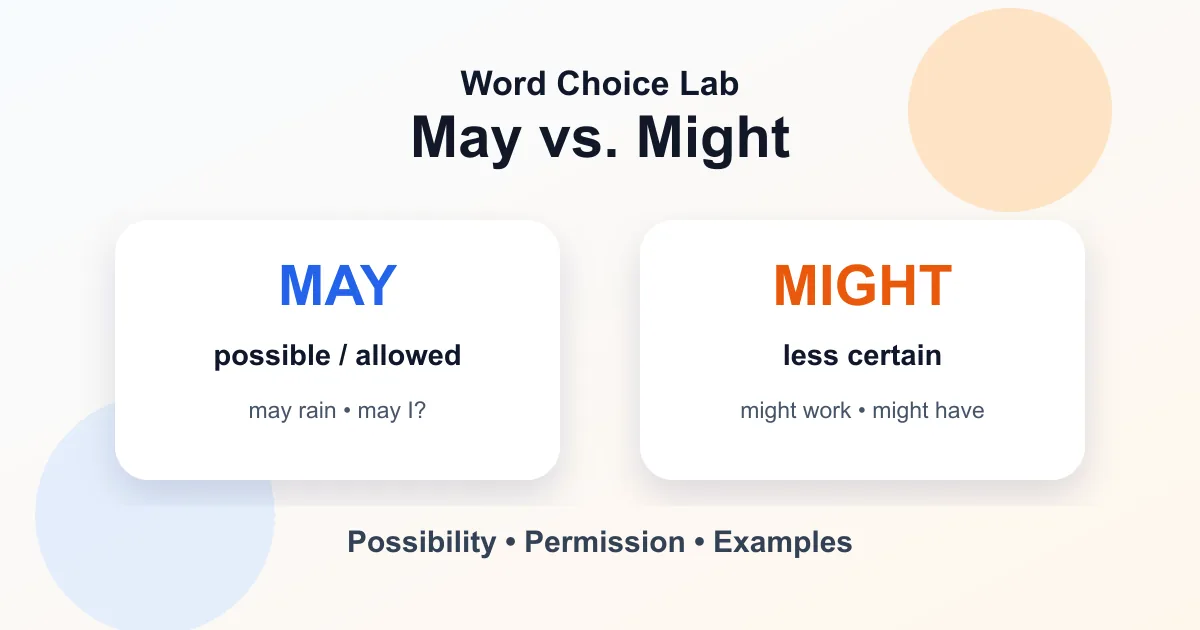
Use may for possibility or permission. Use might for a weaker possibility, a more cautious tone, or a possible situation that did not happen.
- It may rain later.
- It might rain, but the sky looks clear now.
In everyday English, may and might are often close in meaning. The easiest rule is: may = possible or permitted; might = less certain or more tentative.
May vs. might at a glance
| Word | Main use | Simple meaning | Example |
|---|---|---|---|
| may | possibility or permission | possible; allowed | You may leave early. |
| might | weaker possibility or cautious suggestion | possibly, but less certain | We might leave early. |
Quick test:
- If you are asking for or giving permission, may is usually the better choice.
- If you want to sound less certain, more cautious, or more hypothetical, use might.
When to use may
May is a modal verb. It is commonly used for possibility and permission.
May for possibility
Use may when something is possible.
- The package may arrive today.
- She may know the answer.
- This update may fix the issue.
- We may need more time.
In these examples, may means the speaker thinks something is possible, but not certain.
May for permission
Use may to ask for or give permission, especially in polite or formal situations.
- May I ask a question?
- You may begin the test now.
- Students may use a calculator.
- Visitors may enter through the front door.
In casual conversation, people often use can for permission: “Can I leave early?” But may sounds more formal or polite.
May for wishes
May can also introduce a wish or blessing.
- May you have a wonderful year.
- May the best team win.
- May your new business succeed.
This use is more formal, but it is still common in speeches, cards, and ceremonial language.
When to use might
Might is also a modal verb. It often shows a weaker possibility, a cautious suggestion, or a hypothetical situation.
Might for weaker possibility
Use might when something is possible but feels less certain.
- I might go to the meeting.
- The store might still be open.
- He might call later.
- This answer might be correct.
Compared with may, might often sounds more uncertain.
Might for cautious suggestions
Use might to make a suggestion sound gentle or less direct.
- You might want to save a copy.
- We might consider another option.
- You might try restarting the app.
- The team might benefit from clearer instructions.
This is useful in business, academic, and polite writing because it avoids sounding too forceful.
Might for hypothetical situations
Use might when talking about something that is imagined, conditional, or not guaranteed.
- If we left earlier, we might avoid traffic.
- With more practice, she might pass the exam.
- If the weather improves, we might play outside.
- A different design might solve the problem.
These sentences depend on a condition or possibility.
May or might for possibility?
Both may and might can express possibility.
- It may snow tonight.
- It might snow tonight.
The difference is usually tone:
- may can sound a little more likely or neutral.
- might can sound less certain or more tentative.
This is not a strict mathematical difference. Context matters more than a fixed percentage.
May I or might I?
Use may I for a polite request for permission.
- May I use your phone?
- May I sit here?
- May I ask a question?
Might I is also possible, but it sounds very formal, old-fashioned, or extra hesitant in modern American English.
- Might I make a suggestion?
For most everyday writing and speaking, may I is the clearer choice.
May have vs. might have
Use may have when something possibly happened in the past and you do not know for sure.
- She may have left already.
- The email may have gone to spam.
- I may have misunderstood the question.
Use might have in two common ways.
Might have for past uncertainty
Like may have, might have can show uncertainty about the past.
- She might have left already.
- The email might have gone to spam.
In this use, may have and might have are close.
Might have for something that did not happen
Might have can also describe a possible result that did not actually happen.
- If we had left earlier, we might have arrived on time.
- With better instructions, they might have avoided the mistake.
- I might have accepted the offer if the salary had been higher.
These sentences are about unreal or missed possibilities.
May not vs. might not
Use may not when something is possibly not true or when permission is denied.
- The answer may not be correct. = It is possible the answer is not correct.
- You may not enter this area. = You are not allowed to enter.
Use might not when something is possibly not true, often with a more uncertain tone.
- He might not come today.
- This method might not work for everyone.
- We might not have enough time.
Be careful: may not can mean either “possibly not” or “not allowed,” depending on context.
Common phrases with may and might
Common phrases with may:
- may be
- may have
- may need
- may include
- may not
- May I…?
Common phrases with might:
- might be
- might have
- might need
- might not
- might want to
- might be able to
Example: You might want to check the settings before you call support.
Maybe or may be?
Maybe is one word when it means perhaps.
- Maybe we should wait.
- Maybe she forgot.
May be is two words when may is a modal verb before be.
- She may be at home.
- This may be the best option.
Quick test: if you can replace the word with perhaps, use maybe.
Common mistakes and corrections
Incorrect: May you help me?
Better: Can you help me? More formal: Could you help me?
Use may to ask permission, not usually to ask whether someone is able or willing to help.
Incorrect: I might to go later.
Correct: I might go later.
After might, use the base verb without to.
Incorrect: She may has the answer.
Correct: She may have the answer.
After may, use the base form of the verb.
Incorrect: You might not enter this room.
Better for denied permission: You may not enter this room.
Use may not when the meaning is not allowed.
Incorrect: Maybe this may be wrong.
Better: Maybe this is wrong. Also correct: This may be wrong.
Avoid using maybe and may be together when one is enough.
Examples with may and might together
- We may publish the report today, but we might wait until tomorrow.
- You may use the library, but you might need a visitor pass.
- The answer may be correct, although another explanation might be clearer.
- She may have missed the email, or it might have gone to spam.
- This feature may help beginners, but advanced users might prefer more options.
These examples show the main contrast: may is often neutral or permission-based, while might sounds more uncertain or tentative.
How to remember may and might
Use this simple reminder:
- may = possible or permitted
- might = maybe, but less certain
If you are asking for permission, choose may. If you are showing uncertainty or making a gentle suggestion, choose might.
Quick quiz
Choose may or might.
- ___ I leave the room?
- It ___ rain this afternoon, but the forecast is unclear.
- You ___ want to save your work first.
- Students ___ use notes during the quiz.
- If we had called earlier, we ___ have gotten tickets.
- The answer ___ be correct.
- You ___ not park here without a permit.
- She ___ have forgotten the meeting.
Answers
- May — permission
- might — uncertain possibility
- might — cautious suggestion
- may — permission
- might — unreal past possibility
- may — neutral possibility
- may — denied permission
- may or might — both can show past uncertainty
FAQ
What is the difference between may and might?
May is used for possibility or permission. Might is used for weaker possibility, cautious suggestions, or hypothetical situations.
Is might less likely than may?
Often, yes. Might usually sounds less certain than may, but the difference depends on context.
Should I say may I or might I?
Use may I for a normal polite request. Might I is correct but sounds very formal or extra hesitant.
Is it may have or might have?
Use may have or might have for uncertainty about the past. Use might have for an unreal past possibility: “I might have gone if I had known.”
Can may mean permission?
Yes. May can ask for or give permission: “May I leave?” “You may begin.”
Is maybe the same as may be?
No. Maybe means perhaps. May be is a verb phrase: “This may be correct.”
The same context-first habit also helps with Less vs. Fewer and Further vs. Farther. For a wider set of examples in this topic, use the Similar Words archive as the category grows.
Final tip
Use may when something is possible or permitted. Use might when something is less certain, more cautious, or hypothetical.
Remember: may = possible/allowed, might = maybe/less certain.