
Further vs. Farther: Difference, Examples, and an Easy Rule
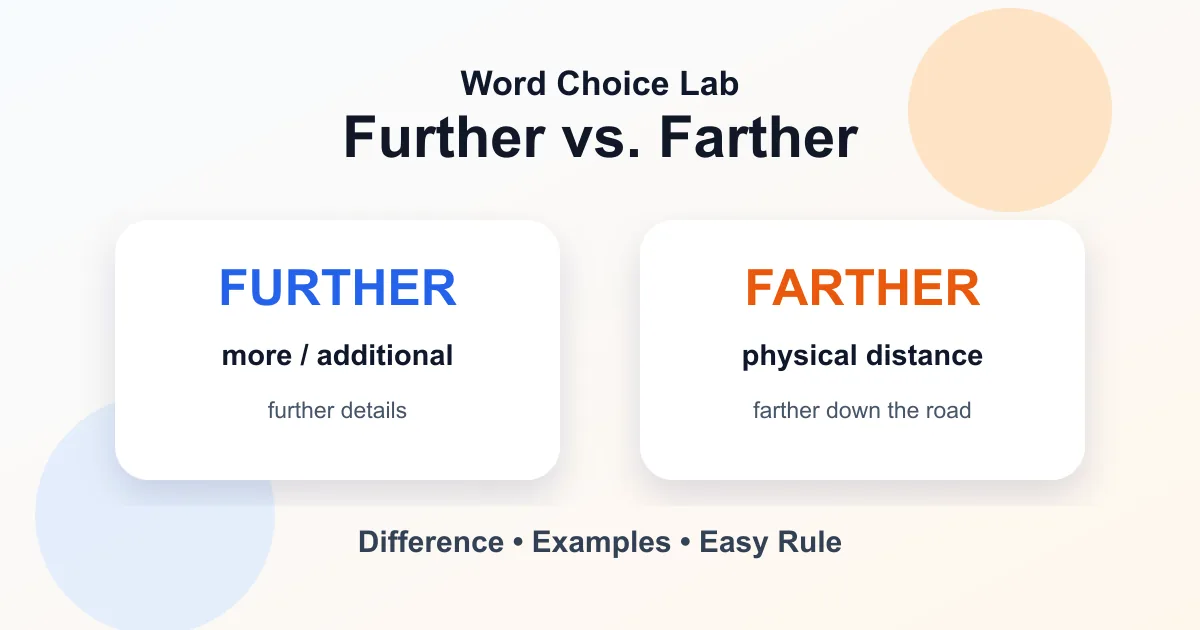
Use farther for physical distance. Use further for figurative distance, additional progress, or more information.
- We drove farther than expected.
- Let’s discuss this further tomorrow.
In everyday American English, people sometimes use further for both physical and figurative distance. But in careful writing, the clearest rule is: farther = physical distance; further = more or additional.
Further vs. farther at a glance
| Word | Best use | Meaning | Example |
|---|---|---|---|
| farther | physical distance | more distant in space | The airport is farther than the hotel. |
| further | figurative distance or additional amount | more, additional, or to a greater degree | We need further research. |
Quick test:
- If you can measure the distance in miles, feet, blocks, or steps, farther is usually the sharper choice.
- If you mean more, additional, or to a greater degree, use further.
When to use farther
Use farther when you are talking about actual physical distance.
- The gas station is farther down the road.
- I can throw the ball farther than before.
- Their new house is farther from school.
- We walked farther than we planned.
In these examples, the distance could be measured in a physical way.
Farther with places
Use farther when comparing the distance between places.
- Denver is farther from New York than Chicago is.
- The second parking lot is farther from the entrance.
- My office is farther away after the move.
- The trail gets farther from the river after the bridge.
If the sentence answers how far?, farther often works well.
Farther with movement
Farther is also natural when someone or something moves through space.
- Move the chair farther from the wall.
- She ran farther than the rest of the group.
- The boat drifted farther from shore.
- Push the box a little farther to the left.
The word points to physical movement or measurable distance.
When to use further
Use further when the meaning is figurative, abstract, or about additional progress or information.
Further meaning “additional”
- We need further details before we decide.
- The manager requested further review.
- No further action is required.
- Please contact us if you need further assistance.
In these examples, further means more or additional.
Further meaning “to a greater degree”
- The new evidence further supports the claim.
- The delay further complicated the project.
- Her explanation further confused the audience.
- The update will further improve security.
Here, further means something like even more or to a greater extent.
Further meaning “continue or advance”
Further can also be a verb meaning to help something develop or move forward.
- The scholarship helped further her education.
- The meeting was intended to further cooperation.
- The new policy may further the company’s goals.
Farther is not used as a verb in this way.
Can further mean physical distance?
Yes. Many dictionaries and style guides accept further for physical distance, especially in general use.
- We walked further into the woods.
- The store is further away than I thought.
These sentences are common and understandable. However, if you want the cleanest distinction in formal or edited writing, use farther for measurable physical distance.
Further or farther in American English?
In American English, many editors prefer this distinction:
- farther = physical distance
- further = figurative distance or additional
This rule is especially useful in school writing, business writing, and clear educational content.
Further or farther away?
Use farther away when you are talking about physical distance.
- The hotel is farther away than the map suggested.
- Move the candle farther away from the curtain.
Use further away if the distance is figurative or if you are speaking casually.
- The decision pushed us further away from a solution.
Further research or farther research?
Use further research.
- Correct: We need further research before making a recommendation.
- Incorrect: We need farther research before making a recommendation.
Research is not a physical distance. Further means additional.
Further notice or farther notice?
Use further notice.
- The office is closed until further notice.
The phrase means until additional notice is given.
Go further or go farther?
Both can be correct, depending on meaning.
- We need to walk farther. = more physical distance
- We need to go further with this idea. = make more progress
If you mean literal movement, farther is clearer. If you mean progress, development, or depth, further is better.
Common mistakes and corrections
Incorrect: We need farther information.
Correct: We need further information.
Use further when the meaning is additional.
Incorrect: The second store is further from my house.
Better in careful writing: The second store is farther from my house.
Use farther for physical distance.
Incorrect: This discussion will farther our goals.
Correct: This discussion will further our goals.
Use further as the verb meaning to advance or support.
Incorrect: No farther action is needed.
Correct: No further action is needed.
Use further for additional action.
Incorrect: He ran further than I did.
Better in careful writing: He ran farther than I did.
Running distance is physical, so farther is the more precise choice.
Examples with further and farther together
- We walked farther down the trail to discuss the plan further.
- The new office is farther away, but it may further our business goals.
- She moved farther from home to further her education.
- The report needs further analysis, but the data center is farther than expected.
- If we travel farther, we can collect further evidence.
These examples show the basic contrast: farther measures distance; further adds depth, progress, or information.
How to remember further and farther
Use this memory trick:
- farther contains far, so use it for distance.
- further often means more or additional.
Ask yourself:
- Is it physical distance? Use farther.
- Is it more information, more progress, or a figurative idea? Use further.
Quick quiz
Choose further or farther.
- The beach is ___ than the park.
- Please send ___ details by email.
- We walked ___ than usual.
- The new evidence ___ supports the theory.
- No ___ action is required.
- Move the desk ___ from the window.
- The program helped ___ his career.
- This route is ten miles ___.
Answers
- farther — physical distance
- further — additional details
- farther — walking distance
- further — to a greater degree
- further — additional action
- farther — physical movement
- further — advance or support
- farther — measurable distance
FAQ
What is the difference between further and farther?
Farther is best for physical distance. Further is best for figurative distance, additional information, or more progress.
Is farther only for distance?
Yes, farther is mainly used for physical or measurable distance.
Can further be used for distance?
Yes, further can be used for distance in general English, but farther is more precise for physical distance in careful writing.
Is it further information or farther information?
Use further information. It means additional information.
Is it further away or farther away?
Use farther away for physical distance. Use further away for figurative distance or in casual general use.
Is it further your career or farther your career?
Use further your career. As a verb, further means to advance or help something develop.
The same context-first habit also helps with Between vs. Among and Principal vs. Principle. For a wider set of examples in this topic, use the Similar Words archive as the category grows.
Final tip
If you can measure the distance, use farther. If you mean more, additional, or progress, use further.
Remember: farther = far distance, further = more progress or information.