
Everyday vs. Every Day: Difference, Examples, and an Easy Test
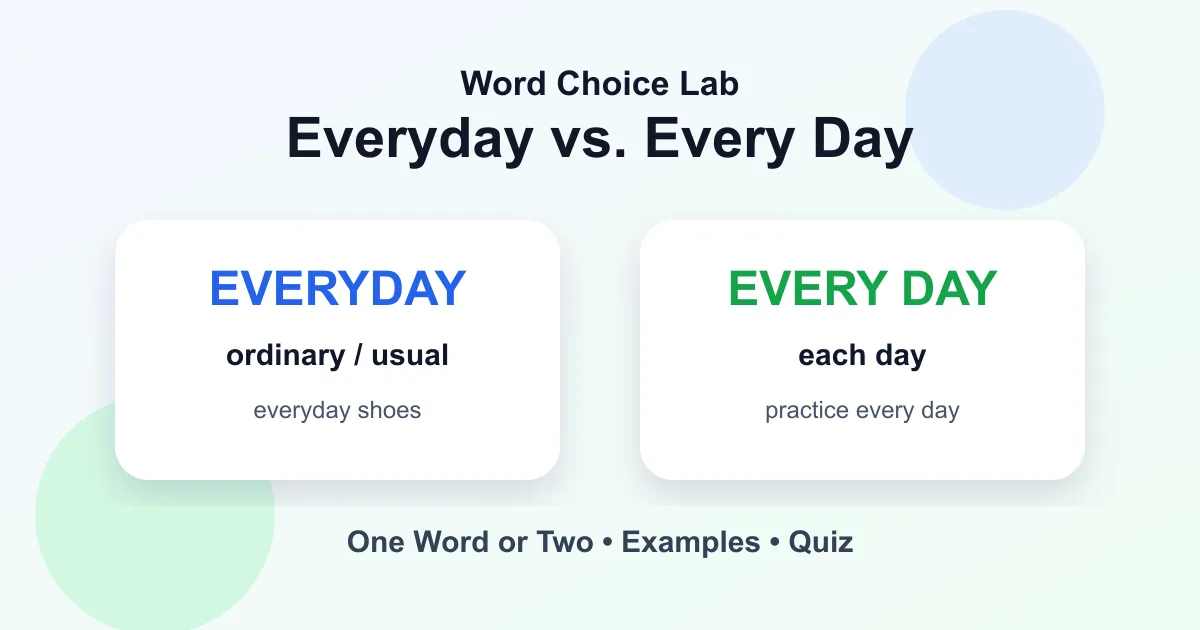
Use everyday as one word when it means ordinary, usual, or common. Use every day as two words when it means each day.
- These are my everyday shoes.
- I wear these shoes every day.
The easy test is: if you can replace the phrase with each day, write every day as two words.
Everyday vs. every day at a glance
| Form | Main job | Meaning | Example |
|---|---|---|---|
| everyday | adjective | ordinary or usual | This is an everyday problem. |
| every day | adverb phrase | each day | I check my email every day. |
The difference is not about formality. Both forms are standard English. The spelling changes because the words do different jobs.
When to use everyday
Everyday is an adjective. It describes a noun. It means ordinary, usual, common, routine, or normal.
- I need an everyday jacket.
- This app helps with everyday tasks.
- She writes about everyday life in New York.
- The book explains grammar in everyday language.
In each sentence, everyday comes before a noun and describes what kind of thing it is: jacket, tasks, life, or language.
Everyday before a noun
Because everyday is an adjective, it usually appears before the noun it describes.
- everyday clothes
- everyday English
- everyday problems
- everyday routines
- everyday conversations
- everyday expenses
Example: Good writing uses clear, everyday words when possible.
Everyday meaning ordinary
Use everyday when you are not talking about frequency. You are describing something as normal or common.
- This is not a special occasion; it is an everyday dinner.
- The teacher gave us everyday examples.
- The article focuses on everyday mistakes.
- These shoes are comfortable enough for everyday use.
If the meaning is close to ordinary, everyday is the right choice.
When to use every day
Every day is two words when it means each day. It tells how often something happens.
- I walk for 30 minutes every day.
- She studies English every day.
- The store opens at 8 a.m. every day.
- We publish new lessons every day.
In these examples, every day answers the question How often?
The “each day” test
The best test is to replace every day with each day.
- I practice every day.
- I practice each day.
The sentence still works, so every day should be two words.
Now compare:
- These are my everyday shoes.
- These are my each day shoes.
The second sentence sounds wrong. That means everyday should be one word because it describes the noun shoes.
Everyday or every day before a noun?
Before a noun, you usually need everyday.
- Correct: This is an everyday habit.
- Incorrect: This is an every day habit.
But if every day comes after the noun and means each day, use two words.
- Correct: This is a habit I practice every day.
The position in the sentence often helps:
- everyday + noun = one word
- verb/action + every day = two words
Everyday life or every day life?
The correct phrase is everyday life.
- Correct: Technology affects everyday life.
- Incorrect: Technology affects every day life.
Here, everyday describes the noun life. It means ordinary or normal life, not life that happens each day.
Everyday use or every day use?
The usual phrase is everyday use.
- This laptop is good for everyday use.
- The bag is strong enough for everyday use.
The meaning is ordinary or regular use, so everyday is one word.
If you are talking about an action that happens daily, use every day:
- I use this laptop every day.
- She uses that bag every day.
Everyday routine or every day routine?
Use everyday routine when you mean a normal routine.
- My everyday routine starts with coffee.
Use every day when you mean the routine happens each day.
- I follow this routine every day.
Both sentences can be correct, but the spelling depends on the role of the words.
Common mistakes and corrections
Incorrect: I drink coffee everyday.
Correct: I drink coffee every day.
The sentence means each day, so use two words.
Incorrect: These are my every day shoes.
Correct: These are my everyday shoes.
The word describes the noun shoes, so use one word.
Incorrect: We talk about every day problems.
Correct: We talk about everyday problems.
The meaning is ordinary problems, not problems that happen each day.
Incorrect: She exercises everyday.
Correct: She exercises every day.
The phrase tells how often she exercises.
Incorrect: This is useful for every day use.
Correct: This is useful for everyday use.
The phrase means ordinary use.
Examples with everyday and every day together
- My everyday schedule changes a little every day.
- These are everyday words that people use every day.
- He wears his everyday watch every day.
- We solve everyday problems every day at work.
- Good habits become part of everyday life when you practice them every day.
These examples show the main difference: everyday describes a noun, while every day tells how often something happens.
How to remember everyday and every day
Use this quick memory trick:
- everyday = ordinary
- every day = each day
Also, look at the word after it:
- If a noun comes next, you probably need everyday.
- If the phrase describes how often an action happens, use every day.
Quick quiz
Choose everyday or every day.
- I read for ten minutes ___.
- This is an ___ mistake.
- She wears those sneakers ___.
- We need simple ___ examples.
- The restaurant is open ___.
- This backpack is made for ___ use.
- He checks the schedule ___.
- Clear writing helps with ___ communication.
Answers
- every day — each day
- everyday — ordinary mistake
- every day — how often she wears them
- everyday — ordinary examples
- every day — each day
- everyday — ordinary use
- every day — how often he checks
- everyday — ordinary communication
FAQ
What is the difference between everyday and every day?
Everyday is an adjective meaning ordinary or usual. Every day is a two-word phrase meaning each day.
Is it “I work everyday” or “I work every day”?
Use I work every day. The phrase means you work each day, so it should be two words.
Is everyday one word or two words?
It depends on the meaning. Use everyday as one word before a noun when it means ordinary. Use every day as two words when it means each day.
Is “everyday life” correct?
Yes. Everyday life is correct because everyday describes the noun life. It means ordinary life.
Is “every day use” correct?
Usually no. The common phrase is everyday use, meaning ordinary use. But you can write “I use it every day” when the phrase means each day.
Can everyday come at the end of a sentence?
Usually, no. If the meaning is each day, write every day at the end of the sentence.
- Correct: I practice every day.
- Incorrect: I practice everyday.
The same context-first habit also helps with Lose vs. Loose and To vs. Too vs. Two. For a wider set of examples in this topic, use the One Word or Two archive as the category grows.
Final tip
If you can replace the words with each day, use every day. If the word describes a noun and means ordinary, use everyday.
Remember: everyday = ordinary, every day = each day.