Is It Apart or A Part? Difference, Examples, and Easy Rule
Learn the difference between apart and a part, with meanings, examples, common mistakes, memory tips, and a quick quiz.

Some English expressions change meaning or correctness depending on whether they are written as one word or two. This category explains spacing choices such as everyday/every day, awhile/a while, a lot/alot, anyone/any one, anymore/any more, cannot/can not, into/in to, and onto/on to.
The guides show how each form works in a sentence, when the one-word form is correct, when the two-word form is correct, and which forms are nonstandard. These distinctions are especially helpful for editing essays, emails, blog posts, and professional documents.
Use this archive when a phrase looks familiar both ways and you need to know which version fits your meaning. For practice, review the One Word or Two Quiz in the Quizzes & Practice section.
Learn the difference between apart and a part, with meanings, examples, common mistakes, memory tips, and a quick quiz.
Learn the difference between into and in to, with meanings, examples, common mistakes, memory tips, and a quick quiz.
Learn the difference between onto and on to, with meanings, examples, common mistakes, memory tips, and a quick quiz.
Learn the difference between sometime and some time, with meanings, examples, common mistakes, memory tips, and a quick quiz.
Learn the difference between may be and maybe, with meanings, examples, common mistakes, memory tips, and a quick quiz.
Learn the difference between anyone and any one, with meanings, examples, common mistakes, memory tips, and a quick quiz.
Learn the difference between everyday and every day, with meanings, examples, common mistakes, memory tips, and a quick quiz.
Learn the difference between anymore and any more, with meanings, examples, common mistakes, memory tips, and a quick quiz.
Learn the difference between all together and altogether, with meanings, examples, common mistakes, memory tips, and a quick quiz.
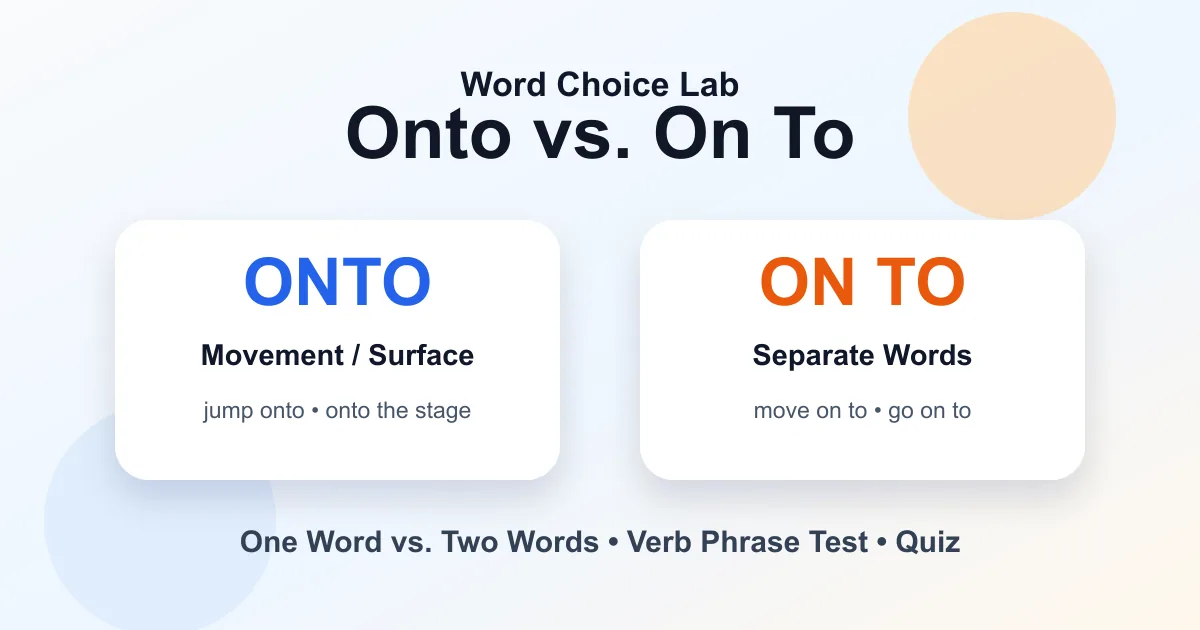
Learn the difference between onto and on to, when to use one word or two words, examples, common mistakes, move on to vs climb onto, and a quick quiz.