
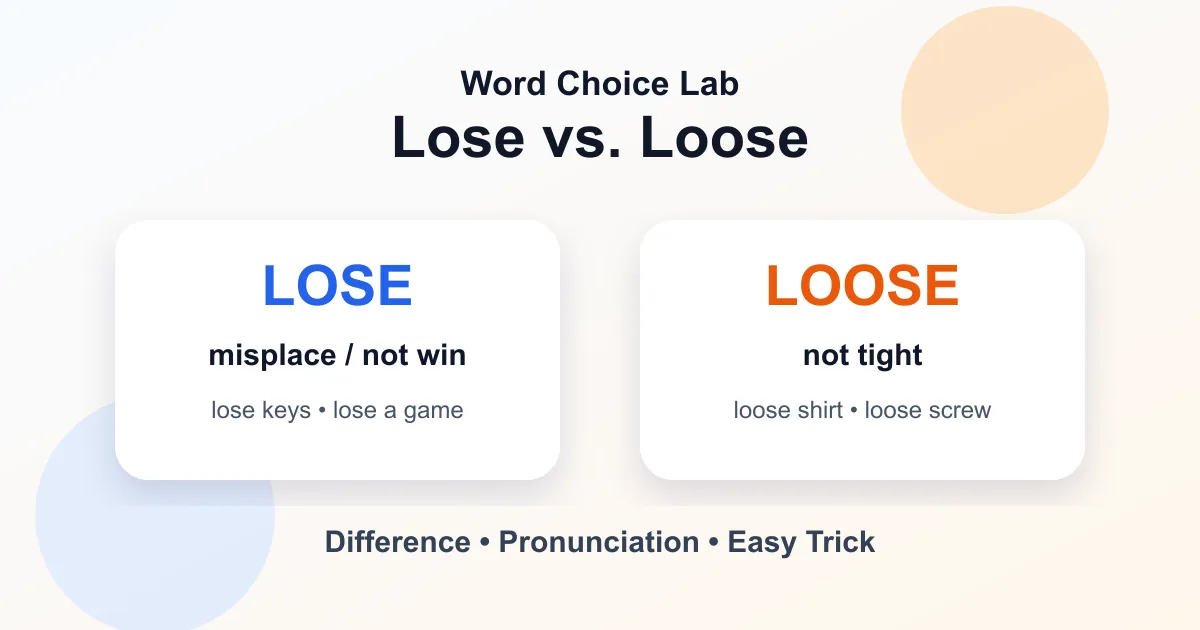
Lose vs. Loose: Difference, Examples, and an Easy Memory Trick
Use lose when you mean not win, misplace something, or no longer have something. Use loose when you mean not tight, not firmly attached, or free.
- I don’t want to lose my keys.
- This shirt is too loose.
The difference is simple once you remember that lose is usually a verb, while loose is usually an adjective.
Lose vs. loose at a glance
| Word | Main job | Meaning | Example |
|---|---|---|---|
| lose | verb | to not win, misplace, or no longer have | Don’t lose your ticket. |
| loose | adjective | not tight or not firmly held | The handle is loose. |
Quick test:
- If the sentence means misplace, fail to win, or no longer have, use lose.
- If the sentence means not tight, use loose.
When to use lose
Lose is a verb. It describes an action or change: something is gone, missing, no longer owned, or not won.
Lose meaning “misplace”
Use lose when someone cannot find something.
- I always lose my phone in the couch.
- Please don’t lose the receipt.
- She was afraid she would lose her passport.
- If you lose your card, call the bank immediately.
In these examples, lose means the object becomes missing.
Lose meaning “not win”
Use lose when a person or team does not win a game, race, argument, or competition.
- Our team might lose the final game.
- He hates to lose at chess.
- The candidate did not expect to lose the election.
- If we make another mistake, we could lose the match.
The opposite of lose in this sense is win.
Lose meaning “no longer have”
Lose can also mean to stop having something, often gradually or because of a change.
- She wants to lose weight in a healthy way.
- The company may lose customers if prices rise.
- I don’t want to lose your trust.
- He started to lose interest after the first chapter.
This use does not always mean something is physically missing. It can refer to trust, confidence, money, time, energy, or interest.
Lose in common phrases
- lose weight
- lose money
- lose interest
- lose control
- lose your keys
- lose your mind
- lose a game
- lose track of time
Example: I was so focused that I lost track of time.
When to use loose
Loose is most often an adjective. It describes something that is not tight, not fixed firmly, or not controlled closely.
Loose meaning “not tight”
- These pants are too loose.
- The ring feels loose on my finger.
- Wear loose clothing after the procedure.
- The knot is too loose to hold the box closed.
If the opposite word could be tight, loose is probably correct.
Loose meaning “not firmly attached”
- One screw is loose.
- The door handle came loose.
- A loose wire caused the problem.
- The shelf is loose and needs repair.
Here, loose means something is not secure.
Loose meaning “free or not contained”
Loose can also describe something that is not locked up, tied down, or controlled.
- The dog got loose during the storm.
- A few pages were loose inside the folder.
- The police warned residents about a bear on the loose.
- Keep the lid closed so the parts do not come loose.
The phrase on the loose means free, escaped, or not captured.
Loose as a verb
Loose can be a verb meaning to release, but this use is uncommon in everyday English.
- The archer loosed an arrow.
Most of the time, learners need loose as an adjective, not as a verb.
Do lose and loose sound the same?
No. In standard American English, lose and loose usually have different sounds.
- Lose sounds like looz.
- Loose sounds like loos.
The final sound is the key difference. Lose ends with a voiced z sound. Loose ends with an s sound.
Lost vs. loosed
The past tense of lose is lost.
- I lost my wallet.
- They lost the game.
- She lost confidence after the mistake.
Do not write loosed when you mean lost. Loosed exists, but it means released and is much less common.
- Uncommon but possible: The guard loosed the dog.
- Common: I lost my dog’s leash.
How to remember lose and loose
Use this simple memory trick:
- loose has an extra o, like a belt with extra room.
- lose has only one o, because something is gone.
Another quick test:
- Can you replace it with misplace or not win? Use lose.
- Can you replace it with not tight? Use loose.
Is it “loose weight” or “lose weight”?
The correct phrase is lose weight.
- Correct: I want to lose weight slowly.
- Incorrect: I want to loose weight slowly.
You are describing the action of no longer having some weight, so you need the verb lose.
Is it “loose my mind” or “lose my mind”?
The correct phrase is lose my mind.
- Correct: I’m going to lose my mind if this noise continues.
- Incorrect: I’m going to loose my mind.
The phrase means to stop thinking calmly or clearly, not that your mind is physically not tight.
Is it “loose ends” or “lose ends”?
The correct phrase is loose ends.
- We need to finish a few loose ends before Friday.
Loose ends are unfinished details that are not tied up or completed.
Common mistakes and corrections
Incorrect: I don’t want to loose my keys.
Correct: I don’t want to lose my keys.
Use lose because the meaning is misplace.
Incorrect: This screw is lose.
Correct: This screw is loose.
Use loose because the screw is not tight.
Incorrect: Did your team loose yesterday?
Correct: Did your team lose yesterday?
Use lose because the sentence is about not winning.
Incorrect: These shoes are too lose.
Correct: These shoes are too loose.
Use loose because the shoes are not tight enough.
Incorrect: I need to loose weight.
Correct: I need to lose weight.
Use lose because it is the verb for no longer having weight.
Examples with lose and loose together
- If your backpack is loose, you might lose your books.
- I don’t want to lose this button because it already feels loose.
- The team did not lose, but their defense looked loose.
- Tighten the cap so you don’t lose any liquid.
- Her plan was too loose, so the group began to lose focus.
These examples show the basic contrast: lose is an action; loose describes a condition.
Quick quiz
Choose lose or loose.
- Be careful not to ___ your boarding pass.
- This jacket is too ___.
- Did they ___ the game?
- A ___ wire caused the light to flicker.
- I don’t want to ___ your trust.
- The dog got ___ in the park.
- She wants to ___ weight before the race.
- The chair leg is ___.
Answers
- lose — misplace
- loose — not tight
- lose — not win
- loose — not firmly attached
- lose — no longer have
- loose — free or not contained
- lose — no longer have weight
- loose — not secure
FAQ
What is the difference between lose and loose?
Lose is usually a verb meaning misplace, not win, or no longer have. Loose is usually an adjective meaning not tight or not firmly attached.
Is it lose or loose weight?
Use lose weight. Lose is the verb that means to no longer have something.
Is it loose or lose a game?
Use lose a game. The opposite is win a game.
Is loose pronounced like lose?
No. Lose sounds like looz. Loose sounds like loos.
Is “looser” a word?
Yes. Looser means more loose or less tight.
- This shirt is looser than the other one.
Do not confuse looser with loser, which means a person or team that loses.
Is it loser or looser?
Use loser for someone who loses. Use looser for something that is less tight.
- The loser of the match goes home.
- This knot is looser than before.
The same context-first habit also helps with To vs. Too vs. Two and Its vs. It’s. For a wider set of examples in this topic, use the Spelling Confusions archive as the category grows.
Final tip
If the sentence is about something going missing, not winning, or no longer having something, choose lose. If the sentence is about something not being tight or secure, choose loose.
Remember: lose = gone, loose = not tight.