
That vs. Which: Difference, Examples, and the Comma Rule
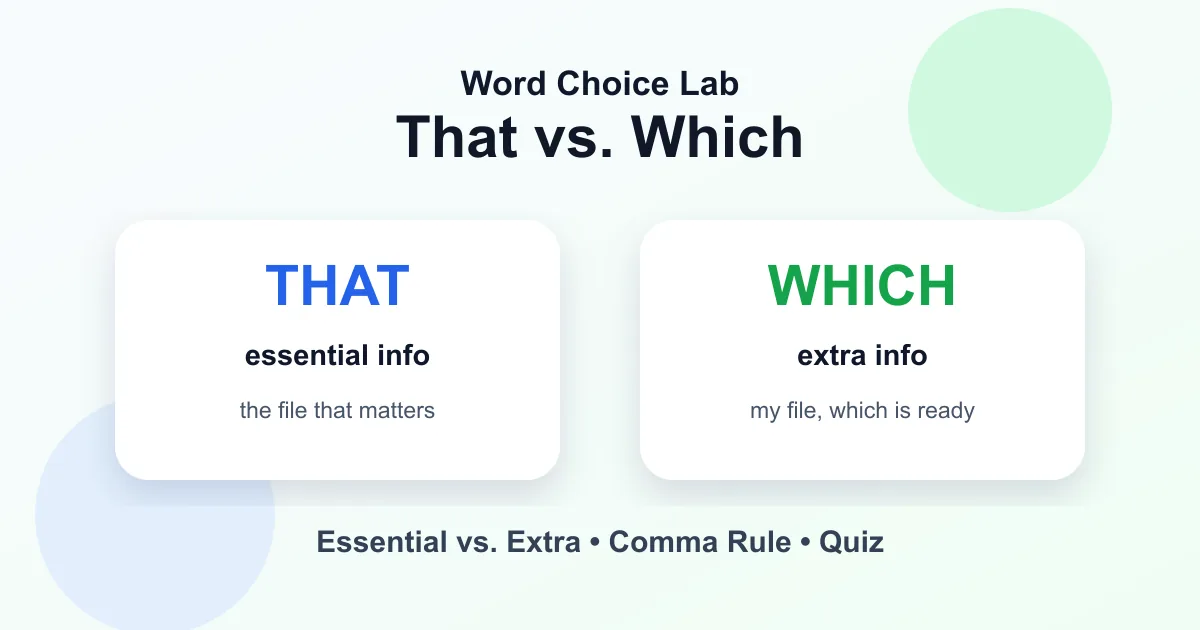
Use that for information that is essential to the meaning of the sentence. Use which with commas for extra, nonessential information.
- The laptop that has the cracked screen needs repair.
- My laptop, which has a cracked screen, needs repair.
The easy rule in American English is: that = essential; which = extra information with commas.
That vs. which at a glance
| Word | Best use in American English | Commas? | Example |
|---|---|---|---|
| that | essential information | no commas | The book that I borrowed is excellent. |
| which | extra information | commas | The book, which I borrowed yesterday, is excellent. |
Quick test:
- If removing the clause changes which person or thing you mean, use that.
- If removing the clause leaves the main meaning clear, use which with commas.
The main difference: essential vs. extra
The key is whether the clause is essential.
Essential clause
An essential clause identifies or limits the noun. Without it, the sentence becomes unclear or changes meaning.
- The files that contain personal data must be encrypted.
- Students that miss the deadline need permission.
- The car that is parked outside belongs to Maya.
The that clause tells us which files, which students, or which car.
Extra-information clause
An extra-information clause adds a detail, but the main noun is already clear.
- The files, which contain personal data, must be encrypted.
- Maya’s car, which is parked outside, needs gas.
- My laptop, which I bought last year, is already slow.
The which clause adds helpful information, but the sentence still makes sense without it.
When to use that
Use that when the information is necessary to identify the noun.
- The password that you created yesterday has expired.
- The article that explains commas is on the homepage.
- The route that avoids traffic is faster.
- The rule that confuses most learners is this one.
In these examples, the that clause narrows the noun.
That for restrictive clauses
Grammar books call this a restrictive clause or defining clause because it restricts the meaning of the noun.
- The emails that need replies are marked in red.
- The shoes that are on sale are near the door.
- The examples that use commas are easier to see.
Do not put commas around a restrictive that clause.
When to use which
Use which when the clause gives extra information about a noun that is already identified.
- My phone, which is almost five years old, still works.
- The report, which we finished yesterday, is ready.
- Our office, which is downtown, closes at 5 p.m.
- The website, which launched in June, focuses on English usage.
In these examples, the which clause is extra. The main sentence would still be clear without it.
Which for nonrestrictive clauses
Grammar books call this a nonrestrictive clause or non-defining clause because it does not restrict the noun’s identity.
- My car, which is blue, needs a wash.
- The meeting, which lasted two hours, ended late.
- Her book, which won an award, is now in paperback.
Use commas around a nonrestrictive which clause.
The comma rule
The comma rule is the easiest way to avoid most mistakes.
- that clause = no commas
- which clause = commas, when giving extra information
Compare:
- The chairs that are broken should be replaced.
- The chairs, which are broken, should be replaced.
The first sentence means only the broken chairs should be replaced. The second sentence suggests all the chairs are broken and should be replaced.
Can which be used without commas?
Yes, which can be used in restrictive clauses, especially in British English and in some formal writing.
- The book which I borrowed is excellent.
However, many American style guides prefer that for restrictive clauses and which for nonrestrictive clauses. For a US audience, this distinction is clear and useful:
- Preferred in American style: The book that I borrowed is excellent.
- Extra information: The book, which I borrowed yesterday, is excellent.
Can that be used with commas?
No, that is not normally used to introduce a nonessential clause with commas.
- Incorrect: My laptop, that I bought last year, is slow.
- Correct: My laptop, which I bought last year, is slow.
Use which for extra information set off by commas.
That or which with people?
Use who for people in most cases.
- The student who asked the question stayed after class.
- The editor who reviewed the article suggested changes.
That can sometimes refer to people in informal or general contexts, but who usually sounds more natural and respectful.
- Natural: The people who attended the meeting agreed.
- Possible: The people that attended the meeting agreed.
Use which for things and animals, not people.
Which referring to a whole sentence
Which can refer to a whole idea or sentence.
- The flight was delayed, which made us late.
- She answered quickly, which surprised me.
- The file was missing, which caused a problem.
In this use, which does not just refer to one noun. It refers to the whole previous idea.
Do not use that this way after a comma.
Common mistakes and corrections
Incorrect: The car which is parked outside belongs to me.
Better in American style: The car that is parked outside belongs to me.
Use that because the clause identifies which car.
Incorrect: My car, that is parked outside, belongs to me.
Correct: My car, which is parked outside, belongs to me.
Use which with commas for extra information.
Incorrect: The files, which need review, are in this folder.
Possibly correct, but meaning changes: This says all the files need review.
If only some files need review, write:
- The files that need review are in this folder.
Incorrect: The rule which confuses learners is important.
Better in American style: The rule that confuses learners is important.
Use that for essential identifying information.
Incorrect: The meeting that ended early, helped us finish on time.
Correct: The meeting that ended early helped us finish on time.
Do not put a comma between the subject and verb.
Examples with that and which together
- The article that explains commas, which we published last week, is popular.
- The laptop that needs repair is on the desk, which is near the window.
- The rule that students forget most often is simple, which is surprising.
- The emails that require action are marked red, which makes them easy to find.
- The guide that you requested is ready, which should save you time.
These examples show the core contrast: that identifies; which adds.
How to remember that and which
Use this memory trick:
- that points to the thing you mean
- which adds a side note
Ask yourself:
- Do I need the clause to identify the noun? Use that.
- Is the clause just extra information? Use which with commas.
Quick quiz
Choose that or which.
- The folder ___ contains the invoices is on my desk.
- My folder, ___ contains the invoices, is on my desk.
- The phone ___ I bought yesterday is already broken.
- The phone, ___ I bought yesterday, is already broken.
- The students ___ finished early can leave.
- The storm delayed the flight, ___ made us miss dinner.
- The rule ___ explains commas is useful.
- My car, ___ needs new tires, is in the garage.
Answers
- that — identifies which folder
- which — extra information
- that — identifies which phone
- which — extra information
- that — identifies which students
- which — refers to the whole previous idea
- that — identifies which rule
- which — extra information
FAQ
What is the difference between that and which?
In American English, that usually introduces essential information. Which usually introduces extra information and is set off with commas.
Does which need a comma?
Use commas with which when the clause gives extra, nonessential information.
Can I use which instead of that?
Sometimes, especially in British English or formal contexts. For clear American style, use that for essential information and which for extra information.
Can that be used after a comma?
Not normally for a nonessential clause. Use which after a comma when adding extra information.
Is that or which better for people?
Use who for people in most cases: “The student who asked the question.”
What is a restrictive clause?
A restrictive clause is essential information that identifies or limits the noun. In American style, it often begins with that and does not use commas.
The same context-first habit also helps with Who vs. Whom and Ensure vs. Insure. For a wider set of examples in this topic, use the Grammar & Usage archive as the category grows.
Final tip
Use that when the clause is essential. Use which with commas when the clause is extra.
Remember: that identifies; which adds.