
Fair vs. Fare: Difference, Examples, and an Easy Memory Trick
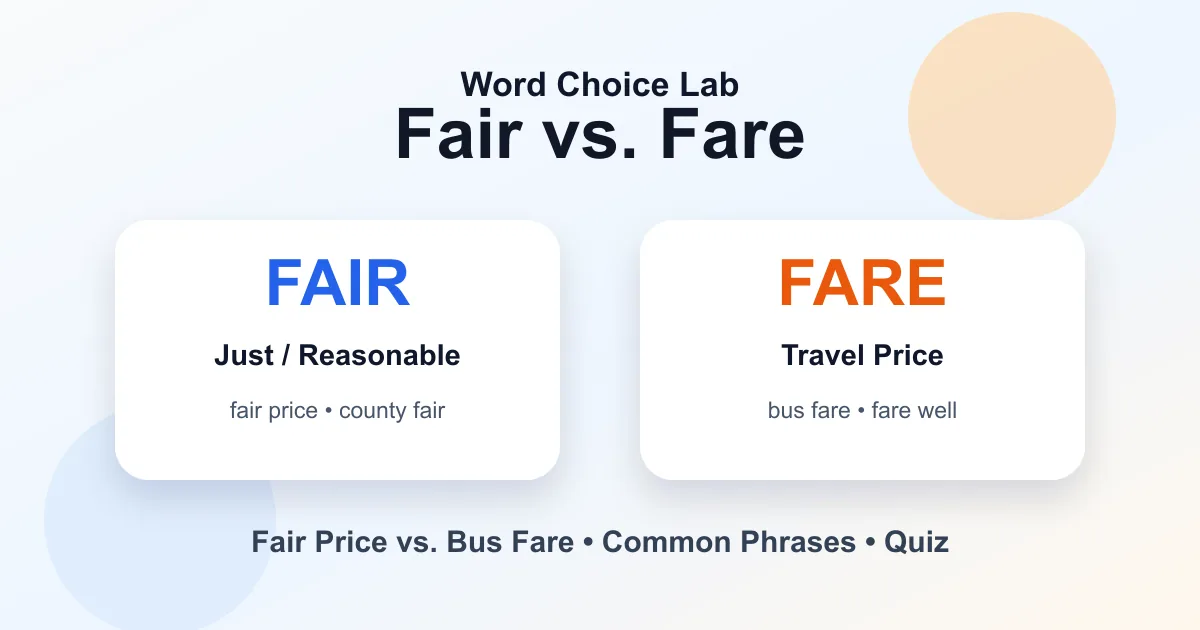
Fair usually means just, reasonable, acceptable, light-colored, or an event with games, food, and booths. Fare usually means the price paid for travel, food provided, or how someone does in a situation.
- That seems like a fair decision.
- The bus fare is two dollars.
These words sound the same, so they are easy to confuse. If you mean honest, equal, reasonable, or an event, use fair. If you mean travel price, food, or how someone performs, use fare.
Fair vs. fare at a glance
| Word | Meaning | Example |
|---|---|---|
| fair | just, reasonable, acceptable, light, or an event | The judge made a fair ruling. |
| fare | travel price, food, or how someone does | The train fare increased. |
Quick rule:
- Fair = just, reasonable, or an event.
- Fare = travel price or how someone does.
- The correct phrase is fair price, but bus fare.
When to use fair
Use fair when something is just, equal, reasonable, acceptable, or honest.
- The teacher gave everyone a fair chance.
- That is a fair price for the service.
- The rules should be fair to all players.
- It was not fair to blame one person.
Fair can also mean light in color.
- She has fair hair.
- His skin is very fair.
And fair can mean a public event.
- We went to the county fair.
- The school held a science fair.
- The job fair attracted many applicants.
If the sentence is about justice, reasonableness, appearance, or an event, fair is usually correct.
When to use fare
Use fare when you mean the price paid for travel, food, or how someone does in a situation.
- The taxi fare was higher than expected.
- Air fares often rise during holidays.
- The restaurant serves simple local fare.
- How did you fare on the exam?
Fare can be a noun or a verb.
As a noun:
- bus fare
- train fare
- taxi fare
- airfare
- local fare
As a verb:
- She fared well in the interview.
- The team fared poorly in the final round.
- How did the new product fare in the market?
If the sentence is about travel cost, food, or performance, use fare.
The easiest memory trick
Use this memory trick:
> Fare has a like airfare.
That helps you remember that fare often means the price of travel.
For fair, think:
> A fair decision is equal and honest.
So:
- fair = just, reasonable, event
- fare = travel price, food, or performance
Fair price or fare price?
The correct phrase is fair price when you mean a reasonable price.
Correct:
- That is a fair price for the car.
- We want to pay a fair price for the work.
Incorrect:
- That is a fare price for the car.
Use fare only when the price is for transportation.
Correct:
- The bus fare is affordable.
- The train fare includes one transfer.
Bus fair or bus fare?
The correct phrase is bus fare.
Correct:
- I need money for the bus fare.
- The bus fare went up this year.
- Children pay a reduced bus fare.
Incorrect:
- I need money for the bus fair.
Why? Because fare means the price paid for transportation.
Fair well or fare well?
Use fare well when you mean “do well” or “perform well.”
Correct:
- I hope you fare well in the competition.
- The company did not fare well during the recession.
- How did you fare on the test?
However, farewell as one word means goodbye.
Correct:
- We said farewell at the airport.
- She wrote a farewell letter.
Do not write fair well when you mean perform well.
Fair examples
Here are more sentences with fair.
- The referee made a fair call.
- Everyone deserves a fair opportunity.
- The contract seems fair to both sides.
- The weather will be fair tomorrow.
- The children loved the rides at the fair.
- The school hosted a book fair.
In these sentences, fair means just, reasonable, pleasant, light, or an event.
Fare examples
Here are more sentences with fare.
- The subway fare increased by fifty cents.
- The airline offered a lower fare for early bookings.
- The menu includes traditional Italian fare.
- She fared better than expected.
- The team did not fare well against stronger opponents.
- The new policy may fare poorly with voters.
In these sentences, fare means travel price, food, or performance.
Common phrases with fair
Use fair in phrases about justice, reasonableness, events, and appearance.
- fair price
- fair chance
- fair share
- fair treatment
- fair game
- fair weather
- county fair
- science fair
- job fair
Examples:
- Everyone should get a fair share.
- The school held a science fair.
- It was a fair and honest agreement.
Common phrases with fare
Use fare in phrases about travel cost, food, and performance.
- bus fare
- train fare
- taxi fare
- airfare
- local fare
- standard fare
- fare well
- fare poorly
Examples:
- The airfare was expensive.
- The restaurant serves local fare.
- The candidate fared well in the debate.
Fair as an event
Fair can be a noun meaning an event where people gather for rides, games, displays, shopping, jobs, books, or science projects.
- We visited the county fair.
- The company attended a job fair.
- My project won first place at the science fair.
- The church organized a holiday fair.
This meaning is very different from fare, even though the words sound the same.
Fare as food
Fare can also mean food, especially the kind of food served in a place.
- The café offers simple fare.
- The festival featured local fare.
- The restaurant is known for fresh seafood fare.
This use is more formal than simply saying “food,” but it is common in restaurant, travel, and review writing.
Common mistakes
Mistake 1: Writing fare price
Incorrect: That is a fare price for the repair.
Correct: That is a fair price for the repair.
Mistake 2: Writing bus fair
Incorrect: The bus fair is too high.
Correct: The bus fare is too high.
Mistake 3: Writing fair well for performance
Incorrect: I hope you fair well on the test.
Correct: I hope you fare well on the test.
Mistake 4: Writing fare treatment
Incorrect: The workers asked for fare treatment.
Correct: The workers asked for fair treatment.
More example sentences
Fair
- The policy should be fair to all employees.
- The price was fair, so I accepted it.
- She has fair hair and blue eyes.
- The weather was fair all weekend.
- We bought tickets at the state fair.
Fare
- The train fare includes one checked bag.
- Taxi fares are higher at night.
- The restaurant serves classic diner fare.
- How did the students fare on the final exam?
- The film fared well with critics.
Quick quiz
Choose the correct word.
- The taxi ___ was expensive.
- That is a ___ price for the laptop.
- We went to the county ___.
- How did you ___ in the interview?
- The company promised ___ treatment.
Answers:
- fare
- fair
- fair
- fare
- fair
FAQ
Is it fair price or fare price?
Use fair price when you mean a reasonable price. Use fare for transportation costs, such as bus fare or train fare.
Is it bus fair or bus fare?
The correct phrase is bus fare. Fare means the price paid for travel.
What does fair mean?
Fair can mean just, reasonable, light-colored, pleasant, or an event.
What does fare mean?
Fare can mean transportation price, food, or how someone performs in a situation.
Is it fare well or fair well?
Use fare well when you mean “do well.” Use farewell as one word when you mean goodbye.
The same context-first habit also helps with Brake vs. Break and Bare vs. Bear. For a wider set of examples in this topic, use the Homophones archive as the category grows.
Final tip
Use fair for justice, reasonableness, appearance, weather, or events. Use fare for travel prices, food, or how someone does.
Remember: fair price, but bus fare.