
Brake vs. Break: Difference, Examples, and an Easy Memory Trick
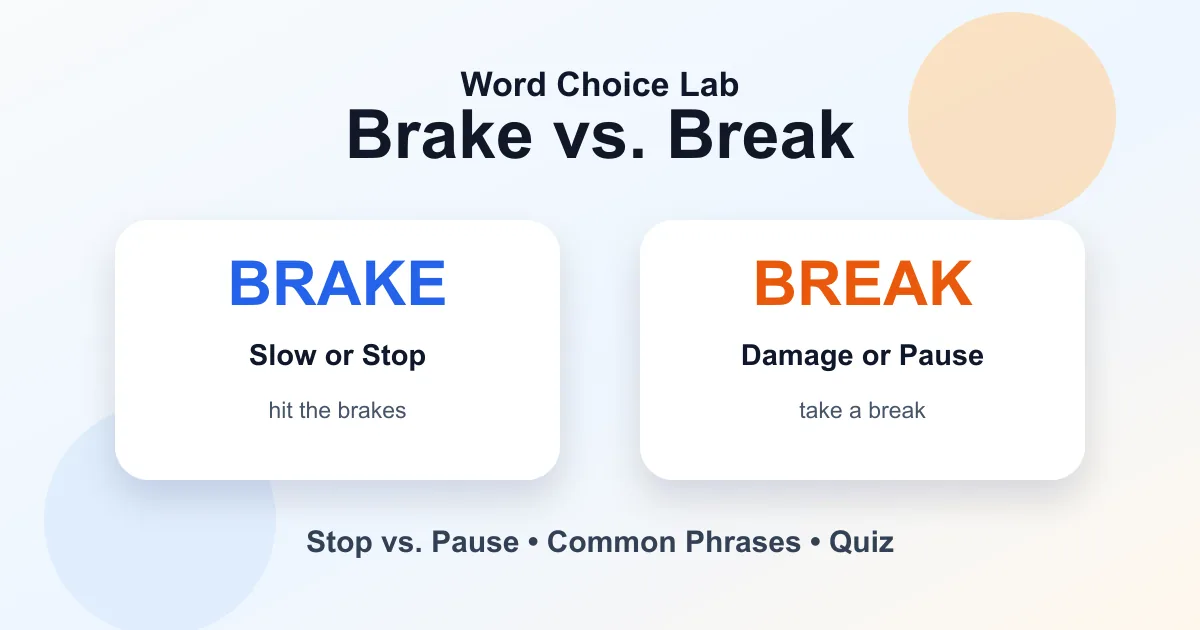
Brake means a device or action that slows or stops a vehicle or machine. Break means to damage, separate, interrupt, or take a pause.
- Press the brake before the stop sign.
- Let’s take a break after this meeting.
These words sound the same, so they are easy to confuse. If you mean stopping a car, bike, train, or machine, use brake. If you mean damage, separate, interrupt, or rest, use break.
Brake vs. break at a glance
| Word | Meaning | Example |
|---|---|---|
| brake | device/action for slowing or stopping | She hit the brake quickly. |
| break | damage, separate, interrupt, or pause | Don’t break the glass. |
Quick rule:
- Brake = slow or stop.
- Break = damage or pause.
- The correct phrase is hit the brakes, not hit the breaks.
When to use brake
Use brake when you mean the device that slows or stops a vehicle, or the action of using that device.
- The car’s brake made a strange noise.
- Press the brake gently on wet roads.
- The driver had to brake suddenly.
- My bike needs new brake pads.
Brake can be a noun or a verb.
As a noun:
- a car brake
- the emergency brake
- brake fluid
- brake pads
- brake lights
As a verb:
- The driver braked at the corner.
- You should brake before the curve.
- The train braked slowly.
If the sentence is about slowing or stopping motion, brake is usually correct.
When to use break
Use break when something is damaged, separated into pieces, interrupted, or paused.
- Please don’t break the cup.
- The storm may break the branches.
- We need to break the habit.
- I will take a break after lunch.
Break can also be a noun or a verb.
As a verb:
- break a window
- break a rule
- break a promise
- break the silence
- break the news
As a noun:
- a coffee break
- a lucky break
- a break in the fence
- a break from work
If the sentence is about damage, interruption, separation, or rest, break is usually correct.
The easiest memory trick
Use this memory trick:
> A brake helps a car take a safe break from moving.
More directly:
- brake has a like auto
- break has ea like rest after a hard day
The strongest practical trick is to connect brake with vehicles:
> Cars, bikes, trains, and machines use brakes.
Everything else is often break.
Hit the brakes or hit the breaks?
The correct phrase is hit the brakes.
Correct:
- The driver had to hit the brakes.
- I almost missed the turn, so I hit the brakes.
- The car in front of us suddenly hit the brakes.
Incorrect:
- The driver had to hit the breaks.
Why? Because the phrase refers to using the car’s braking system. It is about stopping, not damaging or resting.
Take a break or take a brake?
The correct phrase is take a break.
Correct:
- Let’s take a break.
- She took a short break after studying.
- I need a break from work.
Incorrect:
- Let’s take a brake.
Why? Because the phrase means rest or pause. It is not about a vehicle’s braking system.
Brake examples
Here are more sentences with brake.
- The mechanic checked the brakes.
- The brake pedal felt soft.
- The cyclist used the front brake carefully.
- The truck began to brake before the hill.
- The emergency brake was not working.
- The driver braked to avoid the dog.
In each sentence, brake is connected to slowing or stopping.
Break examples
Here are more sentences with break.
- Do not break the mirror.
- The child tried to break the cookie in half.
- We get a ten-minute break every hour.
- The news will break tomorrow morning.
- He needs to break a bad habit.
- A break in the pipe caused a leak.
In each sentence, break means damage, split, pause, interrupt, or change.
Brake pedal or break pedal?
The correct phrase is brake pedal.
Correct:
- Press the brake pedal slowly.
- The brake pedal felt loose.
- She placed her foot on the brake pedal.
Incorrect:
- Press the break pedal slowly.
The pedal is part of the braking system, so use brake.
Brake lights or break lights?
The correct phrase is brake lights.
Correct:
- Your brake lights are not working.
- The brake lights flashed suddenly.
Incorrect:
- Your break lights are not working.
The lights show when a vehicle is braking, so use brake.
Break down vs. brake down
The normal phrase is break down.
Correct:
- The car may break down.
- The machine broke down yesterday.
- Let’s break down the problem into steps.
Incorrect in normal use:
- The car may brake down.
Break down can mean stop working, become upset, or divide something into smaller parts. It is usually not about using brakes.
Common phrases with brake
Use brake in phrases about slowing or stopping.
- hit the brakes
- pump the brakes
- slam on the brakes
- brake pedal
- brake lights
- brake pads
- emergency brake
- parking brake
Examples:
- You should pump the brakes gently on icy roads.
- He slammed on the brakes when the deer appeared.
- The parking brake keeps the car from rolling.
Common phrases with break
Use break in phrases about damage, rest, change, or interruption.
- take a break
- coffee break
- break a rule
- break a promise
- break the news
- break the silence
- break down
- lucky break
Examples:
- We need to take a break.
- She did not want to break a promise.
- The teacher tried to break the silence.
Common mistakes
Mistake 1: Writing hit the breaks
Incorrect: The driver hit the breaks.
Correct: The driver hit the brakes.
Mistake 2: Writing take a brake
Incorrect: Let’s take a brake.
Correct: Let’s take a break.
Mistake 3: Writing break pedal
Incorrect: Press the break pedal.
Correct: Press the brake pedal.
Mistake 4: Writing brake a rule
Incorrect: Do not brake the rule.
Correct: Do not break the rule.
More example sentences
Brake
- The driver pressed the brake too late.
- My bicycle brakes need repair.
- The bus braked at the traffic light.
- The brake light came on.
- Always check your brakes before a long trip.
Break
- Please do not break the plate.
- I need a short break before the next task.
- The glass will break if you drop it.
- The speaker paused to break the tension.
- A lucky break helped her get the job.
Quick quiz
Choose the correct word.
- The driver hit the ___ before the crosswalk.
- Let’s take a short ___.
- Don’t ___ the rules.
- The mechanic fixed the ___ pads.
- The vase will ___ if it falls.
Answers:
- brakes
- break
- break
- brake
- break
FAQ
Is it hit the brakes or hit the breaks?
The correct phrase is hit the brakes. It means to use a vehicle’s braking system.
Is it take a break or take a brake?
The correct phrase is take a break. It means to rest or pause.
What does brake mean?
Brake means a device or action used to slow or stop a vehicle or machine.
What does break mean?
Break means to damage, separate, interrupt, or pause. It can be a verb or a noun.
What is the difference in one sentence?
Brake means slow or stop; break means damage, interrupt, separate, or rest.
The same context-first habit also helps with Bare vs. Bear and To vs. Too vs. Two. For a wider set of examples in this topic, use the Homophones archive as the category grows.
Final tip
Use brake for vehicles and stopping. Use break for damage, rules, promises, pauses, and rest.
Remember: hit the brakes, but take a break.