
Emigrate vs. Immigrate: Difference, Examples, and an Easy Memory Trick
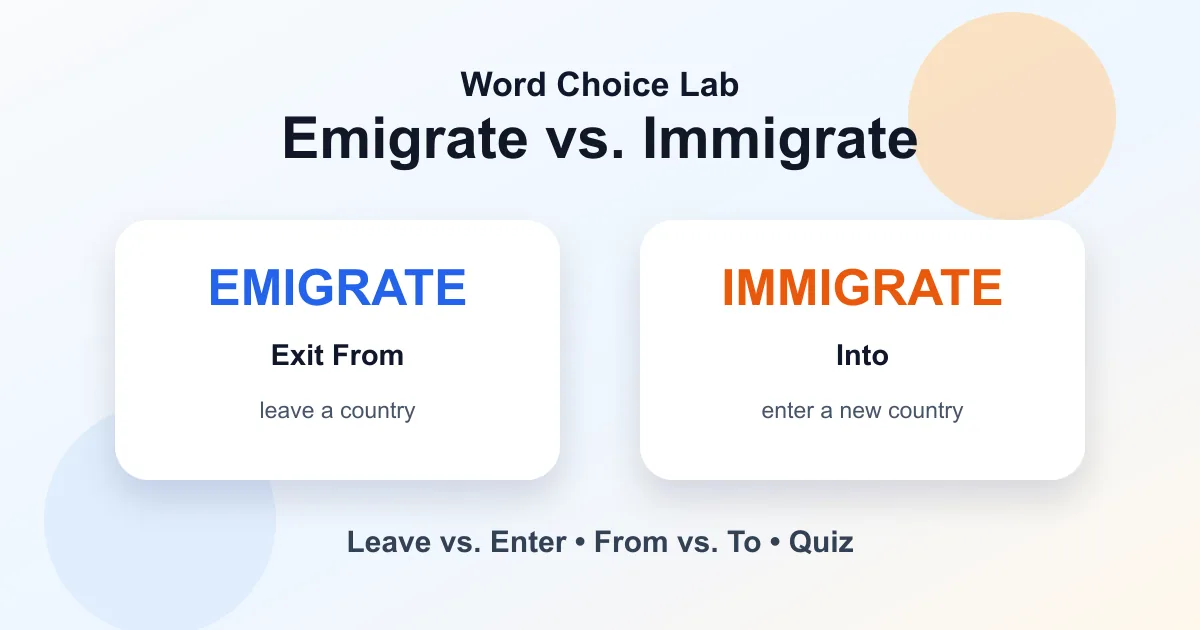
Emigrate means to leave one country or place to live in another. Immigrate means to come into a new country or place to live there.
- She emigrated from Ireland in 2010.
- She immigrated to Canada in 2010.
These two words can describe the same move, but from different points of view. Emigrate focuses on leaving. Immigrate focuses on entering or arriving.
Emigrate vs. immigrate at a glance
| Word | Meaning | Common preposition | Example |
|---|---|---|---|
| emigrate | leave a country to live elsewhere | from | He emigrated from Italy. |
| immigrate | enter a country to live there | to | He immigrated to the United States. |
Quick rule:
- Emigrate = exit.
- Immigrate = into.
- People emigrate from one country and immigrate to another.
When to use emigrate
Use emigrate when you are focusing on the country or place someone leaves.
- My grandparents emigrated from Poland.
- Many workers emigrated from rural areas to cities.
- She decided to emigrate from her home country.
- The family emigrated from Vietnam in the 1980s.
The most common pattern is:
> emigrate from + place
Examples:
- They emigrated from Mexico.
- He emigrated from Germany.
- She emigrated from South Korea.
If the sentence is about leaving a place permanently or long-term, emigrate is usually the correct word.
When to use immigrate
Use immigrate when you are focusing on the country or place someone enters to live.
- My grandparents immigrated to Canada.
- Many families immigrated to the United States.
- She plans to immigrate to Australia next year.
- The couple immigrated to New Zealand after the war.
The most common pattern is:
> immigrate to + place
Examples:
- They immigrated to Mexico.
- He immigrated to Germany.
- She immigrated to South Korea.
If the sentence is about arriving in a new place to live, immigrate is usually the correct word.
The easiest memory trick
Use this spelling trick:
> Emigrate starts with e, like exit.
And:
> Immigrate starts with im, like in.
So:
- emigrate = exit a country
- immigrate = move into a country
The person may do both at the same time. They emigrate from one place and immigrate to another.
Same move, different perspective
One person’s move can be described in two correct ways.
Example:
- Maria left Spain and moved to the United States.
From Spain’s point of view:
- Maria emigrated from Spain.
From the United States’ point of view:
- Maria immigrated to the United States.
Both sentences are correct. The difference is the direction you are emphasizing.
Emigrant vs. immigrant
The noun forms follow the same pattern.
| Word | Meaning | Example |
|---|---|---|
| emigrant | a person who leaves a country | The emigrant left Ireland for work. |
| immigrant | a person who enters a country to live there | The immigrant settled in Canada. |
The same person can be an emigrant from one country and an immigrant in another.
Example:
- A person who leaves India for the United States is an emigrant from India and an immigrant in the United States.
In everyday English, immigrant is more common than emigrant, especially when discussing people living in a new country.
Emigration vs. immigration
The noun forms are emigration and immigration.
- Emigration = the act or process of leaving a country
- Immigration = the act or process of entering a country to live there
Examples:
- The country experienced high emigration during the crisis.
- The city grew because of immigration.
- Emigration from the region increased after the war.
- Immigration to the country changed its population.
Again, the difference is perspective: out of a place or into a place.
Migrate vs. emigrate vs. immigrate
Migrate is the broader word. It means to move from one place to another, often for work, climate, family, safety, or opportunity.
- Birds migrate south in winter.
- Workers migrate to cities for jobs.
- People may migrate because of war, study, or work.
Use emigrate and immigrate when the direction matters:
- emigrate from a country
- immigrate to a country
Examples:
- The family migrated in 1995.
- The family emigrated from Brazil in 1995.
- The family immigrated to Portugal in 1995.
Common prepositions
The preposition often tells you which word to use.
Emigrate from
Use from with emigrate.
- She emigrated from China.
- They emigrated from France.
- He emigrated from Egypt.
Immigrate to
Use to with immigrate.
- She immigrated to China.
- They immigrated to France.
- He immigrated to Egypt.
You may also see immigrate into, but immigrate to is more common in everyday writing.
Emigrate and immigrate in family history
These words often appear in genealogy, biography, and family history.
- My great-grandfather emigrated from Norway.
- He immigrated to the United States in 1912.
- The family’s emigration from Europe changed their future.
- Their immigration to America is recorded in passenger lists.
When writing family history, be clear about the direction of the move. Readers need to know whether you are focusing on the place left or the place entered.
Common mistakes
Mistake 1: Using immigrate for leaving
Incorrect: She immigrated from Italy in 1990.
Better: She emigrated from Italy in 1990.
Also correct: She immigrated to Canada in 1990.
Mistake 2: Using emigrate for entering
Incorrect: They emigrated to the United States.
Better: They immigrated to the United States.
Also correct: They emigrated from their home country.
Mistake 3: Forgetting that one person can do both
Incorrect: If someone immigrates, they cannot emigrate.
Correct: A person can emigrate from one country and immigrate to another.
Mistake 4: Confusing immigrant and emigrant
Incorrect: He is an emigrant in Canada.
Better: He is an immigrant in Canada.
Also correct: He is an emigrant from his original country.
More example sentences
Emigrate
- Her parents emigrated from Greece before she was born.
- Many people emigrated from Europe in the nineteenth century.
- He wanted to emigrate from a place with few job opportunities.
- The family’s decision to emigrate was difficult.
- Economic pressure caused some residents to emigrate.
Immigrate
- Her parents immigrated to Canada before she was born.
- Many people immigrated to the United States in the nineteenth century.
- He wanted to immigrate to a place with more job opportunities.
- The family’s decision to immigrate changed their future.
- New residents may immigrate for work, study, safety, or family.
Quick quiz
Choose the correct word.
- She ___ from Italy in 2005.
- She ___ to Canada in 2005.
- An ___ enters a new country to live there.
- An ___ leaves a country to live elsewhere.
- People can ___ from one country and ___ to another.
Answers:
- emigrated
- immigrated
- immigrant
- emigrant
- emigrate, immigrate
FAQ
What is the difference between emigrate and immigrate?
Emigrate means to leave a country to live elsewhere. Immigrate means to enter a new country to live there.
Is it immigrate from or emigrate from?
Use emigrate from when focusing on the place someone leaves.
Is it emigrate to or immigrate to?
Use immigrate to when focusing on the place someone enters.
Can one person be both an emigrant and an immigrant?
Yes. A person can be an emigrant from one country and an immigrant in another.
What is the difference between migrate and immigrate?
Migrate means move from one place to another in a general sense. Immigrate means move into a country or place to live there.
The same context-first habit also helps with Elicit vs. Illicit and Discreet vs. Discrete. For a wider set of examples in this topic, use the Commonly Confused Words archive as the category grows.
Final tip
Use emigrate when the focus is leaving a country. Use immigrate when the focus is entering a new country.
Remember: emigrate = exit, immigrate = into.