
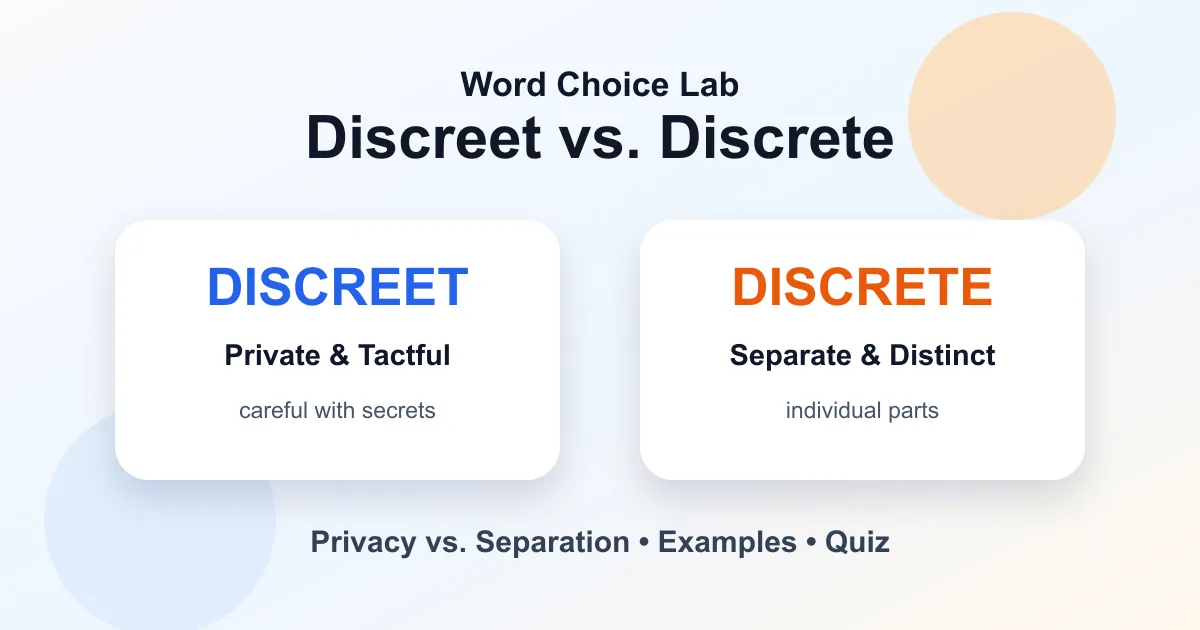
Discreet vs. Discrete: Difference, Examples, and an Easy Memory Trick
Discreet means careful, private, tactful, or intentionally not drawing attention. Discrete means separate, distinct, or individually separate from other things.
- Please be discreet about the surprise party.
- The report is divided into three discrete sections.
These words sound the same, but they are not interchangeable. If you mean quiet, careful, or private, use discreet. If you mean separate or distinct, use discrete.
Discreet vs. discrete at a glance
| Word | Meaning | Example |
|---|---|---|
| discreet | careful, private, tactful | She was discreet about the client’s personal details. |
| discrete | separate, distinct, individual | The course is split into five discrete units. |
Quick rule:
- Discreet = careful and private.
- Discrete = separate and distinct.
- Remember: in discrete, the two e letters are separated.
When to use discreet
Use discreet when someone behaves carefully, tactfully, or privately, especially to avoid embarrassment, attention, or harm.
- The manager was discreet about the employee’s situation.
- We need a discreet way to handle the complaint.
- She gave him a discreet warning before the meeting.
- The hotel is known for discreet service.
Discreet often appears in situations involving privacy, manners, secrets, sensitive information, or subtle behavior.
Common phrases include:
- a discreet conversation
- a discreet warning
- a discreet glance
- discreet service
- a discreet inquiry
- discreet handling of information
If the sentence is about tact, privacy, or not attracting attention, the correct word is discreet.
When to use discrete
Use discrete when you mean separate, individual, or clearly distinct.
- The project has three discrete phases.
- The data is divided into discrete categories.
- The machine performs several discrete steps.
- The issue should be treated as a discrete problem.
Discrete often appears in academic, technical, business, mathematical, and analytical writing.
Common phrases include:
- discrete units
- discrete steps
- discrete categories
- discrete parts
- discrete variables
- discrete events
If the sentence is about separate pieces, units, categories, or parts, the correct word is discrete.
The easiest memory trick
Use this visual trick:
> In discrete, the two e letters are separated by t.
That can remind you that discrete means separate.
For discreet, think:
> A discreet person keeps things quiet.
So:
- discreet = quiet, careful, tactful
- discrete = separate, distinct, individual
Discreet examples
Here are more sentences with discreet.
- Please be discreet when discussing salary.
- He made a discreet exit before the crowd noticed.
- The assistant handled the matter in a discreet way.
- She gave a discreet nod to show she understood.
- The company promised discreet customer support.
- A good therapist is calm, respectful, and discreet.
In each sentence, discreet means careful, private, tactful, or not obvious.
Discrete examples
Here are more sentences with discrete.
- The book is organized into ten discrete chapters.
- The software stores data in discrete fields.
- The experiment measured three discrete outcomes.
- The problem has several discrete causes.
- The teacher presented the lesson in discrete steps.
- Each department has a discrete responsibility.
In each sentence, discrete means separate, distinct, or individual.
Discreet in privacy and customer service
Discreet is useful when discussing sensitive situations.
- The clinic offers discreet appointments.
- The concierge provided discreet assistance.
- The HR team made a discreet inquiry.
- The lawyer gave discreet advice to the client.
In these examples, discreet suggests respect for privacy and careful behavior.
It does not mean secret in a suspicious way. It usually means tactful, respectful, and appropriate.
Discrete in math, data, and analysis
Discrete often appears in technical writing.
- Discrete data can be counted in separate values.
- Discrete variables have distinct possible values.
- Discrete math studies separate structures.
- The system records discrete events.
For example, the number of emails you receive is discrete because you can count separate emails. Temperature, measured on a smooth scale, is often treated as continuous rather than discrete.
You do not need to be writing about math to use discrete, but the word is especially common in analytical contexts.
Discreet vs. discrete in business writing
Both words can appear in business writing, but they mean different things.
Use discreet for privacy and tact:
- We handled the client issue with discreet communication.
- The executive asked for a discreet meeting.
Use discrete for separate parts or units:
- The campaign includes four discrete stages.
- Each product line has a discrete budget.
Mixing these words can change the meaning sharply. A discreet meeting is private. A discrete meeting would sound like one meeting that is separate from other meetings.
Common mistakes
Mistake 1: Using discrete for privacy
Incorrect: Please be discrete about this personal matter.
Correct: Please be discreet about this personal matter.
Mistake 2: Using discreet for separate parts
Incorrect: The system has three discreet modules.
Correct: The system has three discrete modules.
Mistake 3: Confusing discreetly and discretely
Discreetly means in a careful, private, or tactful way.
- She discreetly changed the subject.
Discretely means separately or as separate units.
- The values were measured discretely.
In everyday writing, discreetly is much more common than discretely.
Mistake 4: Thinking one spelling is more formal
These are two different words, not formal and informal versions of the same word.
- Discreet is not a casual version of discrete.
- Discrete is not a fancy version of discreet.
The spelling determines the meaning.
More example sentences
Discreet
- She made a discreet phone call from the hallway.
- The staff was trained to be discreet with guest information.
- He asked a discreet question after the meeting.
- The sign was small and discreet.
- The consultant gave discreet advice during the transition.
Discrete
- The training program has six discrete lessons.
- The research separated the results into discrete groups.
- The device records data at discrete intervals.
- The task can be broken into discrete steps.
- Each image is stored as a discrete file.
Quick quiz
Choose the correct word.
- Please be ___ about the confidential email.
- The lesson is divided into four ___ parts.
- She gave him a ___ signal to leave.
- The data was grouped into ___ categories.
- The hotel is known for ___ service.
Answers:
- discreet
- discrete
- discreet
- discrete
- discreet
FAQ
What is the difference between discreet and discrete?
Discreet means careful, private, or tactful. Discrete means separate, distinct, or individual.
Is it discreet or discrete about something private?
Use discreet. Example: Please be discreet about the news.
Is it discrete or discreet parts?
Use discrete. Example: The project has three discrete parts.
Is discreetly or discretely correct?
Use discreetly for private or tactful behavior. Use discretely only when something happens separately or in separate units.
Are discreet and discrete homophones?
Yes. They are usually pronounced the same, which is why writers often confuse them.
The same context-first habit also helps with Stationary vs. Stationery and Compliment vs. Complement. For a wider set of examples in this topic, use the Commonly Confused Words archive as the category grows.
Final tip
Use discreet for privacy and tact. Use discrete for separate parts, steps, groups, or values.
Remember: in discrete, the two e letters are separate.