
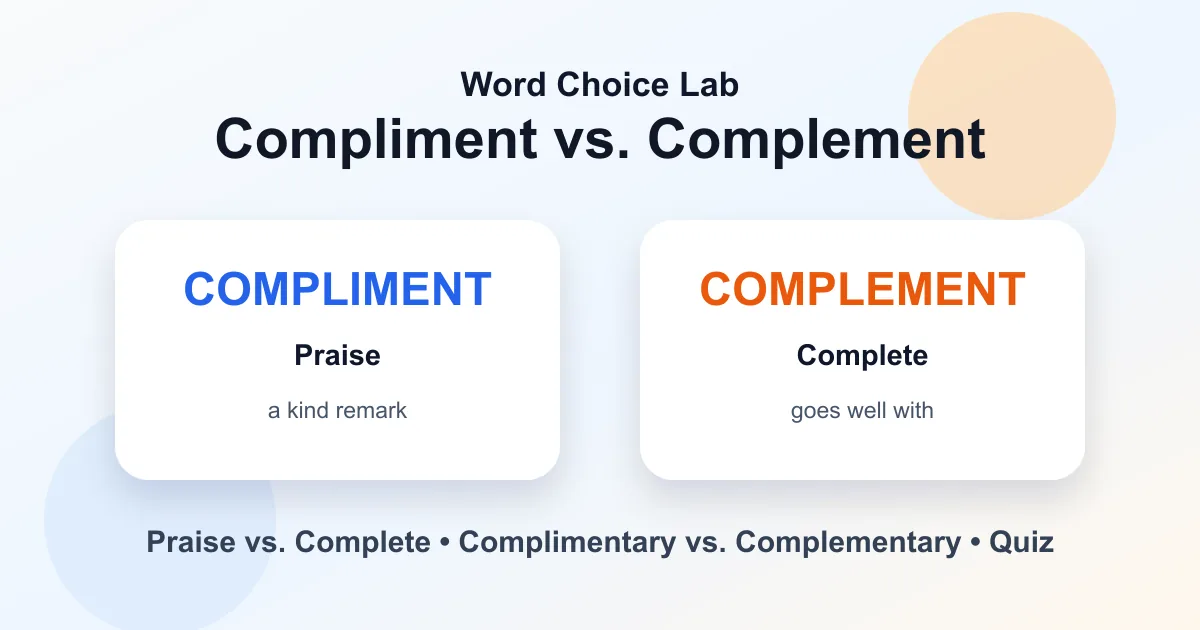
Compliment vs. Complement: Difference, Examples, and an Easy Memory Trick
Compliment means praise or a kind remark. Complement means something that completes another thing or goes well with it.
- She gave me a compliment about my presentation.
- The blue scarf complements her gray coat.
These two words sound exactly the same, so they are easy to mix up. The spelling changes the meaning completely. If someone says something nice, use compliment with an i. If something completes, improves, or matches something else, use complement with an e.
Compliment vs. complement at a glance
| Word | Meaning | Example |
|---|---|---|
| compliment | praise; a kind remark | He gave her a compliment. |
| complement | something that completes or fits well with another thing | The sauce is a perfect complement to the fish. |
Quick rule:
- Compliment = praise.
- Complement = complete.
- Complimentary can mean free or praising.
- Complementary means completing or working well together.
When to use compliment
Use compliment when you mean praise, admiration, approval, or a kind remark.
- Thank you for the compliment.
- She paid him a compliment on his writing.
- The teacher complimented the class on its hard work.
- I received several compliments after the speech.
Compliment can be a noun or a verb.
As a noun:
- That was a generous compliment.
- A sincere compliment can make someone’s day.
As a verb:
- He complimented her on the design.
- My manager complimented the team’s effort.
If the sentence is about saying something nice, the word you want is almost always compliment.
When to use complement
Use complement when you mean something completes, improves, balances, or goes well with something else.
- The wine is a good complement to the meal.
- Her skills complement his experience.
- The new software complements the existing system.
- The red pillows complement the white sofa.
Complement can also be a noun or a verb.
As a noun:
- The salad is a fresh complement to the main dish.
- His calm style is a useful complement to her energy.
As a verb:
- The colors complement each other.
- The report complements the earlier research.
If the sentence is about matching, completing, balancing, or making something better as a pair, use complement.
The easiest memory trick
Use this spelling trick:
> Compliment has i because I say something nice.
And:
> Complement has e because it helps make something complete.
So:
- compliment = praise
- complement = complete
This trick works because complement and complete both use e.
Compliment examples
Here are more sentences with compliment.
- I appreciated your kind compliment.
- She gave a compliment to the chef.
- The review was full of compliments.
- He complimented my pronunciation.
- They complimented the speaker after the event.
- A good compliment should sound honest, not forced.
In each sentence, the word means praise or a positive comment.
Complement examples
Here are more sentences with complement.
- The lemon flavor is a nice complement to the fish.
- Her editing skills complement his writing skills.
- The jacket complements the dress.
- The second chart complements the first chart.
- Exercise can complement a healthy diet.
- The two tools are designed to complement each other.
In each sentence, the word means complete, support, match, or work well with.
Complimentary vs. complementary
This is where many writers get stuck. Complimentary and complementary are different too.
| Word | Meaning | Example |
|---|---|---|
| complimentary | praising; free of charge | The hotel offers complimentary breakfast. |
| complementary | completing or working well together | The two products are complementary. |
Complimentary
Complimentary can mean full of praise.
- She made a complimentary remark about the artwork.
- The review was very complimentary.
It can also mean free of charge.
- Guests receive a complimentary drink.
- The hotel provides complimentary Wi-Fi.
This “free” meaning is very common in business, hotels, restaurants, and events.
Complementary
Complementary means working well together or completing each other.
- The colors are complementary.
- The two businesses offer complementary services.
- Her practical skills and his creative ideas are complementary.
If you mean “free,” do not use complementary. Use complimentary.
Common phrases with compliment
Use compliment in phrases about praise:
- give someone a compliment
- pay someone a compliment
- take something as a compliment
- return the compliment
- fish for compliments
Examples:
- I took that as a compliment.
- He was fishing for compliments.
- Let me return the compliment: your work was excellent too.
Common phrases with complement
Use complement in phrases about matching or completing:
- a perfect complement
- complement each other
- complement the design
- complement the meal
- complement the existing system
Examples:
- The dessert was a perfect complement to the dinner.
- Their personalities complement each other.
- The new feature complements the old one.
Grammar note: complement has a second meaning
In grammar, a complement can also be a word or phrase that completes the meaning of another part of a sentence.
Example:
- She seems happy.
In that sentence, happy completes the meaning of seems. Grammar books may call it a complement.
This grammar meaning is still connected to the idea of completion. A complement completes something.
Common mistakes
Mistake 1: Using complement for praise
Incorrect: She gave me a nice complement.
Correct: She gave me a nice compliment.
Mistake 2: Using compliment for matching
Incorrect: The shoes compliment the outfit.
Correct: The shoes complement the outfit.
Mistake 3: Confusing complimentary and complementary
Incorrect: The hotel offers complementary breakfast.
Correct: The hotel offers complimentary breakfast.
Incorrect: The two colors are complimentary.
Correct: The two colors are complementary.
Mistake 4: Forgetting that both can be verbs
Correct:
- He complimented her work. = praised it
- The photo complemented the article. = completed or improved it
More example sentences
Compliment
- The coach gave the player a compliment.
- I meant that as a compliment, not a criticism.
- She complimented him on his clear explanation.
- The customer left a complimentary review.
- A thoughtful compliment should be specific.
Complement
- The music is a good complement to the scene.
- His strengths complement hers.
- The new lesson complements last week’s lesson.
- The red and green tones are complementary.
- The chart complements the written explanation.
Quick quiz
Choose the correct word.
- She gave me a kind ___ after the meeting.
- The sauce is a perfect ___ to the pasta.
- The hotel offers ___ coffee in the lobby.
- Their skills are ___ because one is creative and the other is practical.
- He ___ the team on its excellent work.
Answers:
- compliment
- complement
- complimentary
- complementary
- complimented
FAQ
Is it compliment or complement someone?
If you are praising someone, use compliment. Example: I want to compliment your work.
Is it complement or compliment an outfit?
Use complement if one item matches or improves another. Example: The shoes complement the outfit.
Does complimentary mean free?
Yes. Complimentary can mean free of charge, especially in hotels, restaurants, travel, and business contexts.
Does complementary mean free?
No. Complementary means completing or working well together. Use complimentary for “free.”
What is the difference in one sentence?
Compliment means praise; complement means complete or go well with.
The same context-first habit also helps with Principal vs. Principle and Then vs. Than. For a wider set of examples in this topic, use the Commonly Confused Words archive as the category grows.
Final tip
Use compliment when someone says something nice. Use complement when something completes or matches something else.
Remember: compliment = I praise you; complement = complete.