
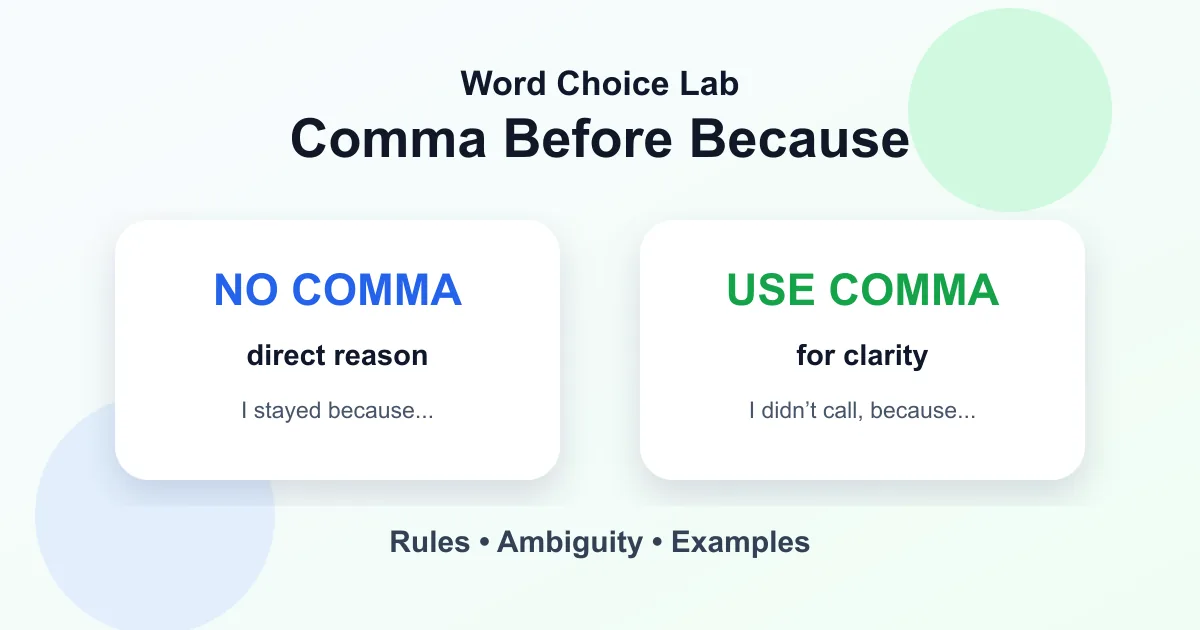
Comma Before Because: Rules, Examples, and an Easy Test
You usually do not need a comma before because when the because-clause explains the reason for the main idea.
- I stayed home because I was sick.
- She left early because the meeting ended.
Use a comma before because only when the comma helps prevent confusion, adds contrast, or separates an extra comment.
Comma before because at a glance
| Situation | Comma? | Example |
|---|---|---|
| because gives the main reason | no | I called because I had a question. |
| because-clause starts the sentence | comma after clause | Because I had a question, I called. |
| comma prevents confusion | yes | I didn’t leave, because I was angry. |
| because introduces an extra aside | often yes | The answer matters, because clarity matters. |
Quick rule:
- If because gives the direct reason, skip the comma.
- If the because clause comes first, put a comma after that clause.
- If the sentence could be misunderstood, use a comma for clarity.
Usually, do not use a comma before because
When because introduces the reason for the main clause, no comma is usually needed.
- I brought an umbrella because it might rain.
- The website was slow because the image was too large.
- She missed the call because her phone was on silent.
- We revised the article because the first version was unclear.
The because-clause is essential to the meaning. It tells the reader why something happened.
Use a comma after a because-clause at the beginning
When a sentence starts with because, use a comma after the opening dependent clause.
- Because it was raining, we stayed inside.
- Because the file was large, the upload took longer.
- Because she practiced every day, her writing improved.
- Because the rule is confusing, examples help.
This comma does not come before because. It comes after the full because-clause.
Use a comma before because to prevent confusion
Sometimes a comma before because changes or clarifies the meaning.
Compare:
- I didn’t call because I was angry.
- I didn’t call, because I was angry.
The first sentence can mean: anger was not the reason I called. Maybe I called for another reason. The second sentence clearly means: I did not call, and the reason was anger.
More examples:
- She didn’t leave because she was bored.
- She didn’t leave, because she was bored.
Without the comma, the sentence can sound like boredom was not the reason she left. With the comma, the meaning is clearer: she did not leave because she was bored.
The “not because” problem
Commas are especially useful with negative sentences.
- I didn’t apologize because I was afraid.
This can mean two different things:
- I did not apologize, and the reason was fear.
- I apologized, but not because I was afraid.
If you mean the first idea, add a comma:
- I didn’t apologize, because I was afraid.
If you mean the second idea, rewrite for clarity:
- I apologized, but not because I was afraid.
Clear writing matters more than trying to force one comma rule into every sentence.
Comma before because for extra explanation
Sometimes a writer uses a comma before because when the reason feels like an afterthought or extra explanation.
- The rule is worth learning, because it prevents confusion.
- This example helps, because it shows the meaning clearly.
- We should revise the headline, because readers may misunderstand it.
In many of these sentences, the comma is a style choice. If the reason is tightly connected to the main clause, no comma is also possible.
- The rule is worth learning because it prevents confusion.
Both versions can be acceptable, but the no-comma version is usually cleaner when the reason is essential.
Because of and commas
Because of is followed by a noun or noun phrase.
- The flight was delayed because of bad weather.
- She stayed home because of a headache.
- The page loaded slowly because of large images.
You usually do not need a comma before because of when it gives the direct reason.
If the because of phrase comes first, use a comma after the opening phrase when it is long or when the sentence is easier to read with one.
- Because of bad weather, the flight was delayed.
- Because of several large images on the page, the website loaded slowly.
Because vs. since with commas
Use because when you want to give a clear reason.
- I left early because I had an appointment.
Use since when the reason is more like background information, or when it means from a past time until now.
- Since you are already here, let’s begin.
- I have lived here since 2020.
When a reason clause starts the sentence, use a comma after it:
- Because I had an appointment, I left early.
- Since you are already here, let’s begin.
Common mistakes and corrections
Incorrect: I stayed home, because I was sick.
Better in most cases: I stayed home because I was sick.
The because-clause gives the direct reason, so no comma is usually needed.
Incorrect: Because I was tired I went to bed early.
Correct: Because I was tired, I went to bed early.
Use a comma after an opening because-clause.
Unclear: I didn’t respond because I was upset.
Clearer: I didn’t respond, because I was upset.
Use a comma if the negative sentence could be misread.
Incorrect: The upload failed, because of the file size.
Better: The upload failed because of the file size.
No comma is needed when because of gives the direct reason.
Wordy: I called, because, I had a question.
Correct: I called because I had a question.
Do not put commas around because by itself.
Examples with and without a comma
- I saved the file because I did not want to lose my work.
- Because I did not want to lose my work, I saved the file.
- I didn’t save the file, because I thought autosave was on.
- The meeting ended early because everyone had finished.
- Because everyone had finished, the meeting ended early.
These examples show the main pattern: no comma for a direct reason, comma after an opening because-clause, and comma before because when clarity requires it.
How to remember the comma rule
Use this simple test:
- Does because give the main reason? Usually no comma.
- Does the sentence start with because? Put a comma after the opening clause.
- Could the sentence be misunderstood, especially with not? Add a comma or rewrite.
Quick quiz
Choose the better punctuation.
- I studied hard because the test was difficult.
- Because the test was difficult I studied hard.
- I didn’t call because I was angry. Meaning: I did not call, and the reason was anger.
- The game was canceled because of rain.
- Because of heavy rain the game was canceled.
- She smiled because the answer was correct.
- I didn’t choose this option because it was cheap. Meaning: price was not the reason I chose it.
- We added examples because the rule was confusing.
Answers
- No comma needed.
- Because the test was difficult, I studied hard.
- I didn’t call, because I was angry.
- No comma needed.
- Because of heavy rain, the game was canceled.
- No comma needed.
- Better: I chose this option, but not because it was cheap.
- No comma needed.
FAQ
Do you put a comma before because?
Usually, no. Do not use a comma before because when it gives the direct reason for the main clause.
When should I use a comma before because?
Use a comma before because when it prevents confusion, especially in negative sentences, or when the because-clause is an extra explanation.
Do you use a comma after because?
Not immediately after because. But if a sentence starts with a because-clause, use a comma after the full clause: “Because it rained, we stayed home.”
Is “because of” the same as because?
No. Because comes before a full clause. Because of comes before a noun or noun phrase.
Is it wrong to start a sentence with because?
No. A sentence can start with because if it has a complete main clause: “Because I was tired, I went home.”
Why can a comma before because change meaning?
The comma can show that the because-clause explains the whole main clause, not just a nearby word or negative phrase.
The same context-first habit also helps with A vs. An and Who’s vs. Whose. For a wider set of examples in this topic, use the Grammar & Usage archive as the category grows.
Final tip
Do not automatically put a comma before because. Use one only when it makes the sentence clearer.
Remember: no comma for a direct reason; comma for clarity.