
Who’s vs. Whose: Difference, Examples, and an Easy Test
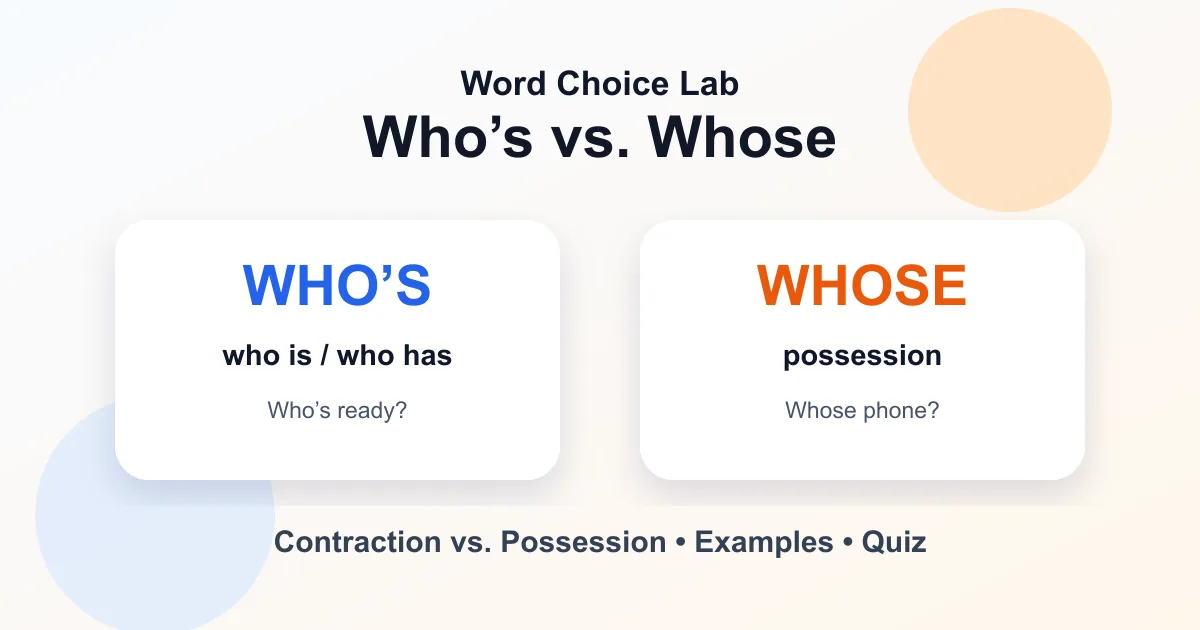
Use who’s as a contraction of who is or who has. Use whose to show possession or connection.
- Who’s coming to dinner? = Who is coming?
- Whose jacket is this? = Who owns this jacket?
The easiest test is: if you can replace the word with who is or who has, use who’s. If not, use whose.
Who’s vs. whose at a glance
| Word | Meaning | Main job | Example |
|---|---|---|---|
| who’s | who is; who has | contraction | Who’s ready? |
| whose | belonging to whom | possessive form | Whose phone is ringing? |
Quick test:
- Try replacing the word with who is or who has.
- If the sentence still works, use who’s.
- If the sentence is about ownership or connection, use whose.
When to use who’s
Who’s is a contraction. The apostrophe replaces missing letters.
- Who’s at the door? = Who is at the door?
- Who’s responsible for this task? = Who is responsible?
- Who’s been using my laptop? = Who has been using my laptop?
- Do you know who’s coming? = who is coming
In each sentence, who’s can expand to who is or who has.
Who’s meaning “who is”
Use who’s when the sentence means who is.
- Who’s your teacher?
- Who’s ready to start?
- I wonder who’s in charge.
- Tell me who’s available this afternoon.
If who is works, who’s is correct.
Who’s meaning “who has”
Use who’s when the sentence means who has.
- Who’s finished the assignment?
- Who’s seen my keys?
- Do you know who’s been calling?
- Who’s had experience with this software?
If who has works, who’s is correct.
When to use whose
Whose is the possessive form of who. It asks or tells who something belongs to or is connected with.
- Whose backpack is this?
- I know the student whose essay won.
- Whose idea was that?
- The woman whose car broke down called a tow truck.
In these examples, whose shows ownership or association.
Whose in questions
Use whose to ask about ownership.
- Whose phone is on the table?
- Whose turn is it?
- Whose name is on the list?
- Whose notes did you borrow?
The answer usually identifies a person:
- It is Maya’s phone.
- It is your turn.
Whose in relative clauses
Use whose to connect a person with something they have, own, or are associated with.
- The student whose laptop crashed got extra time.
- The author whose book we read visited our class.
- The manager whose team won gave a short speech.
- I thanked the neighbor whose dog found my wallet.
In these sentences, whose means something like of whom or belonging to whom.
The who is/who has test
This test solves most mistakes.
- Who’s calling? → Who is calling? ✅
- Whose calling? → Who is calling? ❌
- Whose car is this? → Who is car is this? ❌
- Who’s car is this? → Who is car is this? ❌
Because who is car does not make sense, the correct word is whose.
Why does who’s have an apostrophe?
The apostrophe in who’s does not show possession. It shows missing letters.
- who is → who’s
- who has → who’s
This is similar to:
- it is → it’s
- they are → they’re
- you are → you’re
Possession uses whose, not who’s.
Whose for things, animals, and organizations
Whose often refers to people, but it can also refer to animals, organizations, and sometimes things when the sentence is clear and natural.
- The dog whose collar was missing followed us home.
- The company whose app we use released an update.
- A house whose windows face west can get hot in the afternoon.
Some writers prefer of which for things, but whose is often smoother and widely accepted.
Common mistakes and corrections
Incorrect: Who’s jacket is this?
Correct: Whose jacket is this?
Use whose because the sentence asks about ownership.
Incorrect: Whose going to the meeting?
Correct: Who’s going to the meeting?
Use who’s because the meaning is who is.
Incorrect: I know the person who’s car is outside.
Correct: I know the person whose car is outside.
Use whose because the car is connected to the person.
Incorrect: Whose been using my account?
Correct: Who’s been using my account?
Use who’s because the meaning is who has.
Incorrect: Do you know who’s turn it is?
Correct: Do you know whose turn it is?
Use whose because the turn belongs to someone.
Examples with who’s and whose together
- Who’s the student whose project won first prize?
- I don’t know who’s calling, but I know whose phone is ringing.
- Who’s responsible for finding out whose keys these are?
- The teacher who’s leading the trip is the one whose class finished early.
- Who’s been helping the writer whose article was published?
These examples show the contrast: who’s expands to who is/who has, while whose shows ownership or connection.
How to remember who’s and whose
Use this memory trick:
- who’s has an apostrophe because letters are missing.
- whose asks who owns?
Ask yourself:
- Can I say who is or who has? Use who’s.
- Am I asking about ownership or connection? Use whose.
Quick quiz
Choose who’s or whose.
- ___ coming to lunch?
- ___ book is on the desk?
- I know the woman ___ son won the award.
- ___ been editing this document?
- ___ idea was this?
- Do you know ___ in charge?
- The student ___ phone rang apologized.
- ___ ready to begin?
Answers
- Who’s — who is
- Whose — ownership
- whose — connection/possession
- Who’s — who has
- Whose — ownership
- who’s — who is
- whose — phone belongs to the student
- Who’s — who is
FAQ
What is the difference between who’s and whose?
Who’s means who is or who has. Whose shows possession or connection.
Is who’s possessive?
No. Who’s is a contraction, not a possessive form. Use whose for possession.
Is it who’s car or whose car?
Use whose car. The sentence asks who owns or is connected to the car.
Is it whose there or who’s there?
Use who’s there because it means who is there.
Can whose refer to things?
Yes, whose can refer to things in many natural sentences, especially when of which would sound awkward.
What is the easiest way to choose who’s or whose?
Replace the word with who is or who has. If the sentence works, use who’s. If not, use whose.
The same context-first habit also helps with Can vs. May and Good vs. Well. For a wider set of examples in this topic, use the Grammar & Usage archive as the category grows.
Final tip
Use who’s only when it means who is or who has. Use whose when the sentence is about ownership or connection.
Remember: who’s = who is/who has, whose = who owns.