
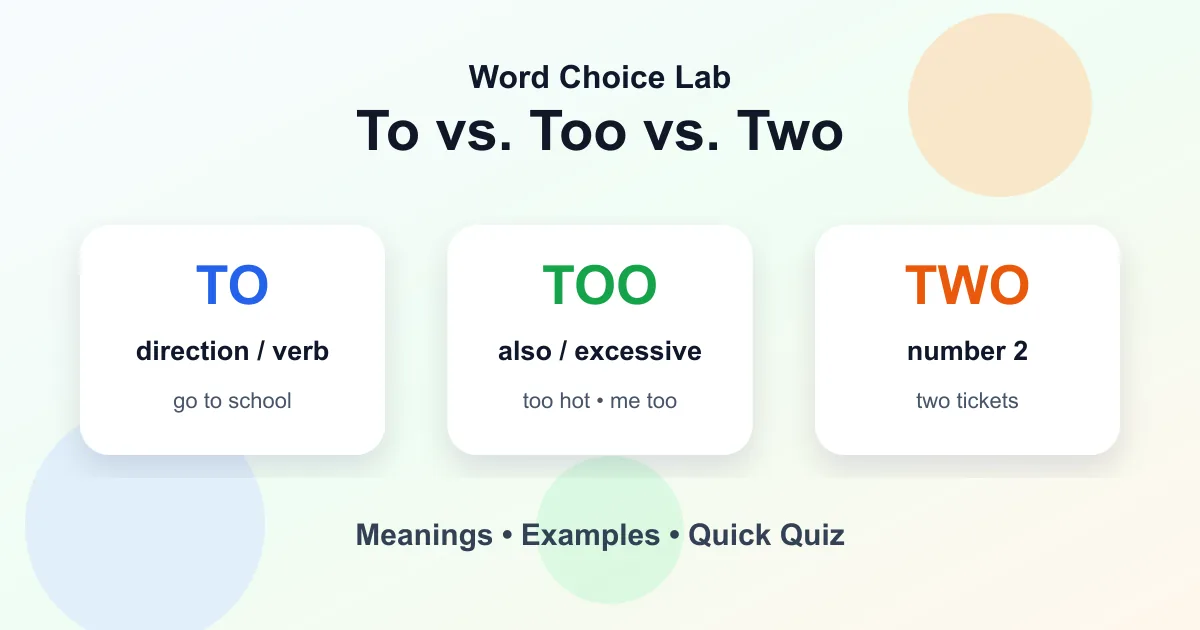
To vs. Too vs. Two: Meanings, Examples, and an Easy Test
Use to for direction, destination, purpose, or an infinitive verb. Use too to mean also or more than needed. Use two for the number 2.
- We went to the store.
- I want to go too.
- We bought two notebooks.
The three words sound the same in everyday English, but they have different meanings and different jobs in a sentence.
To, too, and two at a glance
| Word | Main job | Simple meaning | Example |
|---|---|---|---|
| to | preposition or infinitive marker | toward, for, or before a verb | She drove to work. |
| too | adverb | also; more than enough | I’m coming too. |
| two | number | 2 | We need two chairs. |
The quickest test is:
- If you mean the number 2, use two.
- If you mean also or excessively, use too.
- For direction, purpose, or a verb like to learn, use to.
When to use to
To is the most common of the three words. It often shows movement, direction, connection, purpose, or a verb form.
To for direction or destination
Use to when someone or something moves toward a place, person, or point.
- I’m going to Boston next week.
- Please send the file to Maria.
- The dog ran to the door.
- We walked to the station.
In these sentences, to points toward a destination or receiver.
To before a verb
Use to before the base form of a verb in an infinitive phrase.
- I want to improve my writing.
- She needs to call her doctor.
- They plan to launch the project soon.
- It is important to read the instructions.
If the word comes directly before a simple verb such as go, learn, write, call, or eat, to is usually correct.
To for purpose
To can explain why someone does something.
- I called to ask a question.
- He saved money to buy a car.
- We met early to review the plan.
- She opened the window to let in fresh air.
Here, to means something like in order to.
To in common phrases
You will also see to in many everyday expressions:
- listen to
- talk to
- next to
- according to
- from Monday to Friday
- five to six people
- close to home
Example: I need to talk to you after class.
When to use too
Too is an adverb. It has two main meanings: also and more than is good, needed, or expected.
Too meaning “also”
Use too when you can replace it with also.
- I want coffee too.
- Maya is coming too.
- This rule applies too.
- We enjoyed the movie too.
In this meaning, too often appears at the end of a sentence or clause.
Too meaning “excessively”
Use too before an adjective or adverb when something is more than enough.
- The soup is too hot.
- This bag is too heavy.
- You are driving too fast.
- The instructions were too confusing.
This use of too usually has a negative or limiting meaning. If something is too expensive, the price is higher than acceptable. If someone is too tired, they may not have enough energy to continue.
Too much and too many
Use too much with uncountable nouns and too many with countable plural nouns.
- There is too much noise in the room.
- I drank too much coffee.
- There are too many tabs open.
- We received too many emails.
Use too because the idea is more than the right amount.
Too with “to”
The words too and to often appear together in the pattern too + adjective/adverb + to + verb.
- The box is too heavy to lift.
- It is too late to cancel.
- She spoke too quietly to hear.
- The problem is too complex to solve quickly.
The first word is too because it means excessively. The second word is to because it comes before a verb.
When to use two
Two is the spelling for the number 2.
- I have two questions.
- The meeting starts in two hours.
- She bought two tickets.
- We need two examples for each rule.
If you could replace the word with the numeral 2, use two.
Two in common phrases
- two people
- two days
- two of them
- the two of us
- in two parts
- one or two
Example: The two of us finished the project on time.
How to remember to, too, and two
Use these memory clues:
- two has a w, and w can remind you of one, two.
- too has an extra o, so it can mean an extra amount or also.
- to is the short everyday word for direction or before a verb.
A simple reminder is: two = 2, too = also or excessive, to = direction or verb helper.
To or too?
Choose to when the word points somewhere or comes before a verb.
- Correct: I’m going to the office.
- Correct: I need to study tonight.
Choose too when you mean also or more than enough.
- Correct: I want one too.
- Correct: The room is too cold.
If you can replace the word with also, use too. If the next word is a verb like go, eat, or write, use to.
Too or two?
Choose two only for the number.
- Correct: We need two copies.
- Correct: I waited for two hours.
Choose too for also or excessively.
- Correct: I waited too long.
- Correct: I will join too.
The sentence “I waited too hours” is wrong because hours needs a number. The correct sentence is “I waited two hours.”
Common mistakes and corrections
Incorrect: I want too learn English.
Correct: I want to learn English.
Use to before the verb learn.
Incorrect: This coffee is to hot.
Correct: This coffee is too hot.
Use too because the coffee is hotter than desired.
Incorrect: I have too brothers.
Correct: I have two brothers.
Use two because the sentence gives a number.
Incorrect: Can I come to?
Correct: Can I come too?
Use too because the meaning is also.
Incorrect: We went too school.
Correct: We went to school.
Use to for direction or destination.
Examples with to, too, and two together
- I want to invite two friends too.
- The box is too heavy for two people to carry.
- We need two more chairs to make room for them too.
- It is too early to call the two clients.
- I’m going to buy two tickets, and Sam wants one too.
Seeing all three words together makes the difference easier to feel: to connects ideas, too adds or intensifies, and two counts.
Quick quiz
Choose to, too, or two.
- I need ___ finish this email.
- The music is ___ loud.
- We ordered ___ pizzas.
- Are you coming ___?
- Please give this note ___ your teacher.
- The file is ___ large ___ upload.
- She has ___ younger sisters.
- I want ___ practice every day.
Answers
- to — before the verb finish
- too — more than desired
- two — the number 2
- too — also
- to — toward a receiver
- too, to — excessively large; before the verb upload
- two — the number 2
- to — before the verb practice
FAQ
What is the difference between to, too, and two?
To shows direction, purpose, or comes before a verb. Too means also or more than enough. Two is the number 2.
Is it “me to” or “me too”?
Use me too when you mean I feel the same way or I am included also.
- I’m tired.
- Me too.
Me to can appear only when to belongs to a larger phrase, such as “Give it to me,” but me to alone is usually not the phrase you want.
Is it “love you to” or “love you too”?
Use love you too when you are replying to someone and mean I love you also.
- I love you.
- I love you too.
Is it “too late” or “to late”?
Use too late. The word too means the time is later than acceptable or useful.
- It is too late to change the reservation.
Is it “to much” or “too much”?
Use too much when something is more than needed or wanted.
- There is too much sugar in this drink.
Is it “two many” or “too many”?
Use too many when there are more countable things than needed.
- There are too many mistakes in the report.
The same context-first habit also helps with Its vs. It’s and Your vs. You’re. For a wider set of examples in this topic, use the Homophones archive as the category grows.
Final tip
If you are unsure, ask what the word is doing:
- Is it a number? Use two.
- Does it mean also or excessively? Use too.
- Is it showing direction, purpose, or coming before a verb? Use to.
That one check will solve most to vs. too vs. two mistakes.