
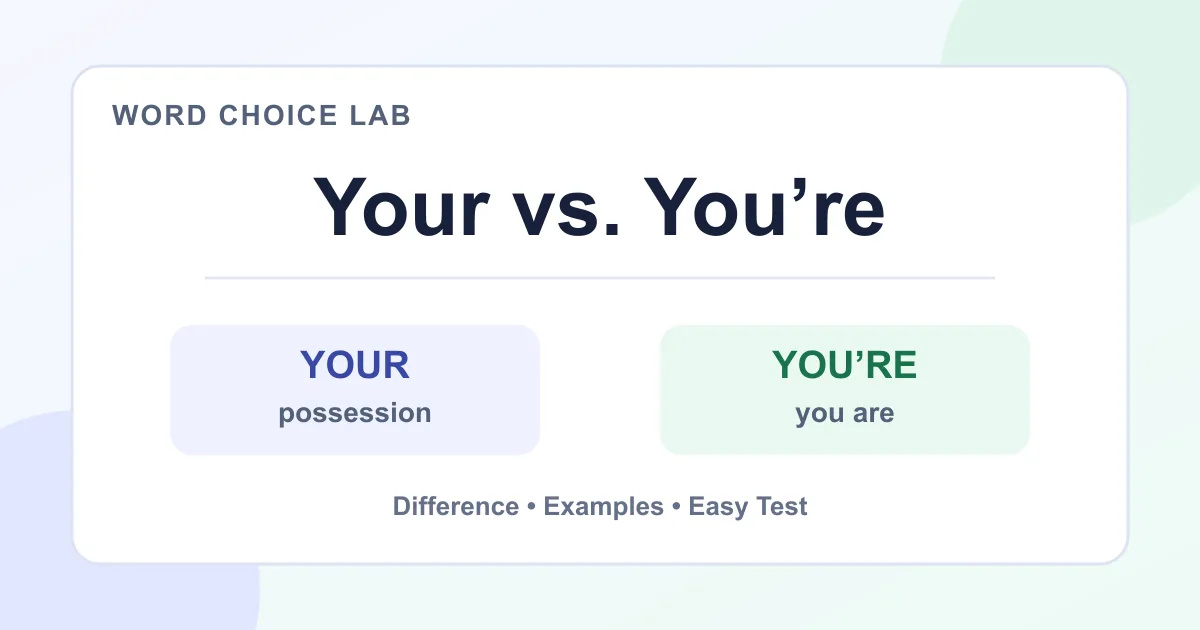
Your vs. You’re: Difference, Examples, and an Easy Test
Use your to show possession or association. Use you’re as the contraction of you are.
- Is this your jacket?
- You’re wearing the wrong size.
The fastest test is to replace the word with you are. If the sentence still makes sense, choose you’re. If it does not, your may be the correct choice.
Your and you’re at a glance
| Word | Grammatical job | Meaning | Example |
|---|---|---|---|
| your | possessive determiner | belonging or relating to you | Please check your email. |
| you’re | contraction | you are | You’re on the guest list. |
Both words usually sound the same in natural American English. Their spelling depends on their job in the sentence, not their pronunciation.
When to use your
Your is a possessive determiner. It comes before a noun or noun phrase and shows that something belongs to, relates to, or is associated with the person or people being addressed.
- Where are your keys?
- I appreciate your help.
- Please bring your photo ID.
- Your appointment begins at 2:30 p.m.
- We reviewed your application.
The noun after your tells us what belongs or relates to “you”: keys, help, ID, appointment, or application.
Your before an adjective and noun
Sometimes an adjective appears between your and the noun.
- Your new laptop has arrived.
- I read your detailed response.
- Please confirm your current address.
The adjective does not change the rule. Your still introduces a noun phrase and shows possession or association.
Your with body parts and relationships
- Raise your hand if you have a question.
- I met your sister yesterday.
- Protect your eyes from bright sunlight.
- Is your manager available?
English commonly uses a possessive word such as your before body parts, relatives, and other personal connections.
When to use you’re
You’re is a contraction of you are. The apostrophe replaces the missing letter a in are.
- You’re early. (You are early.)
- I think you’re correct. (I think you are correct.)
- You’re going to enjoy the concert. (You are going to enjoy the concert.)
- Let me know when you’re ready. (Let me know when you are ready.)
- You’re the first person to arrive. (You are the first person to arrive.)
If the expanded version sounds natural and keeps the same meaning, use you’re.
You’re before an adjective
You’re often comes before an adjective that describes the listener.
- You’re helpful.
- You’re welcome.
- You’re right.
- You’re responsible for the final report.
- You’re more patient than I am.
Each sentence can begin with you are.
You’re before an -ing verb
- You’re working late tonight.
- You’re making excellent progress.
- You’re driving in the wrong direction.
- You’re asking an important question.
Here, you’re combines with a present participle to form a continuous verb phrase.
You’re before a noun phrase
You’re can also precede a noun phrase when the sentence identifies or classifies the listener.
- You’re a great friend.
- You’re the team leader.
- You’re our next speaker.
Do not assume that a following noun always requires your. Apply the you are test to the whole sentence.
How to remember your vs. you’re
Use the apostrophe as a warning light: you’re contains missing letters and must expand to you are.
Try this two-step check:
- Replace the word with you are.
- If the sentence works, use you’re. If it does not and the sentence shows possession or association, use your.
Example:
- “___ phone is ringing.”
- “You are phone is ringing” does not work.
- Correct: Your phone is ringing.
Your welcome or you’re welcome?
The standard expression is you’re welcome, meaning you are welcome.
- Thank you for your assistance. — You’re welcome.
- You’re welcome to join us.
Your welcome is possible only when welcome is a noun belonging or relating to someone, which is uncommon:
- The guests appreciated your welcome.
In everyday replies to “thank you,” always write you’re welcome.
Your right or you’re right?
Use you’re right when you mean you are correct.
- You’re right about the deadline.
- I believe you’re right.
Use your right when right is a noun meaning an entitlement or the side belonging to the listener.
- You have your right to remain silent.
- The exit is on your right.
The intended meaning determines the spelling.
Your the best or you’re the best?
Use you’re the best because the expression means you are the best.
- Thanks for helping me—you’re the best!
“Your the best” is incorrect because your should introduce something belonging or related to the listener, not replace you are.
Is it “your 5” or “you’re 5”?
Use you’re 5 when stating someone’s age because the full sentence is you are 5.
- You’re 5 years old today.
- When you’re 18, you can register to vote in the United States.
Use your when age modifies a noun connected to the listener:
- We celebrated your fifth birthday.
- Please enter your age on the form.
Do your and you’re sound different?
In ordinary American English, your and you’re are generally homophones, although pronunciation can vary slightly by speaker and emphasis. Because pronunciation is not a reliable guide, use grammar and the replacement test when writing.
Common mistakes and corrections
Incorrect: Your doing a great job.
Correct: You’re doing a great job.
The sentence means you are doing.
Incorrect: You’re package has arrived.
Correct: Your package has arrived.
The package belongs or relates to the listener. “You are package” is not grammatical.
Incorrect: I hope your feeling better.
Correct: I hope you’re feeling better.
The expanded phrase is you are feeling.
Incorrect: Please update you’re password.
Correct: Please update your password.
Your introduces the noun password and shows possession.
Incorrect: Your invited to the meeting.
Correct: You’re invited to the meeting.
The sentence means you are invited.
Examples by context
At work
- Your report is ready for review.
- You’re scheduled to present at 10:00 a.m.
- Let me know when you’re available to discuss your findings.
At school
- Remember to submit your assignment.
- You’re allowed to use a calculator.
- If you’re unsure, ask your instructor for help.
While traveling
- Keep your passport in a safe place.
- You’re at the correct gate.
- Check your seat number before you’re seated.
In everyday messages
- Your dinner is in the refrigerator.
- You’re going to love this movie.
- Call me when you’re on your way.
You can practice a similar apostrophe test in our guide to their vs. there vs. they’re. For another common word-choice problem, read accept vs. except.
Quick practice quiz
Choose your or you’re.
- Please take ___ seat.
- ___ going to receive a confirmation email.
- I like ___ idea.
- Tell me when ___ finished.
- ___ welcome to stay for dinner.
- Is this ___ first visit to Boston?
- I think ___ right about the total.
- Don’t forget ___ umbrella when ___ leaving.
Answers
- your — the seat is intended for the listener
- you’re — means you are going
- your — the idea belongs or relates to the listener
- you’re — means you are finished
- you’re — means you are welcome
- your — introduces the noun phrase first visit
- you’re — means you are right
- your, you’re — the umbrella belongs to the listener; you’re leaving means you are leaving
The same context-first habit also helps with Their vs. There vs. They’re and Then vs. Than. For a wider set of examples in this topic, use the Homophones archive as the category grows.
Frequently asked questions
What is the difference between your and you’re?
Your shows possession or association and appears before a noun phrase. You’re is a contraction that always means you are.
Is “your” a pronoun?
Your is usually classified as a possessive determiner because it comes before a noun, as in “your book.” The related possessive pronoun is yours, as in “The book is yours.”
Is you’re one word or two words?
You’re is written as one contraction with an apostrophe, but it represents the two-word phrase you are.
Can you’re show possession?
No. You’re only means you are. Use your before a noun to show possession or association: “your car,” “your opinion,” or “your appointment.”
What is the easiest way to avoid mistakes?
Read the sentence with you are in place of the disputed word. If it works, use you’re. If it does not and the next idea belongs or relates to the listener, use your.
The rule to remember
Use your for something belonging or relating to “you.” Use you’re only when you can expand it to you are. That one replacement test correctly resolves most your-versus-you’re questions.