
Their vs. There vs. They’re: Meanings, Examples, and an Easy Test
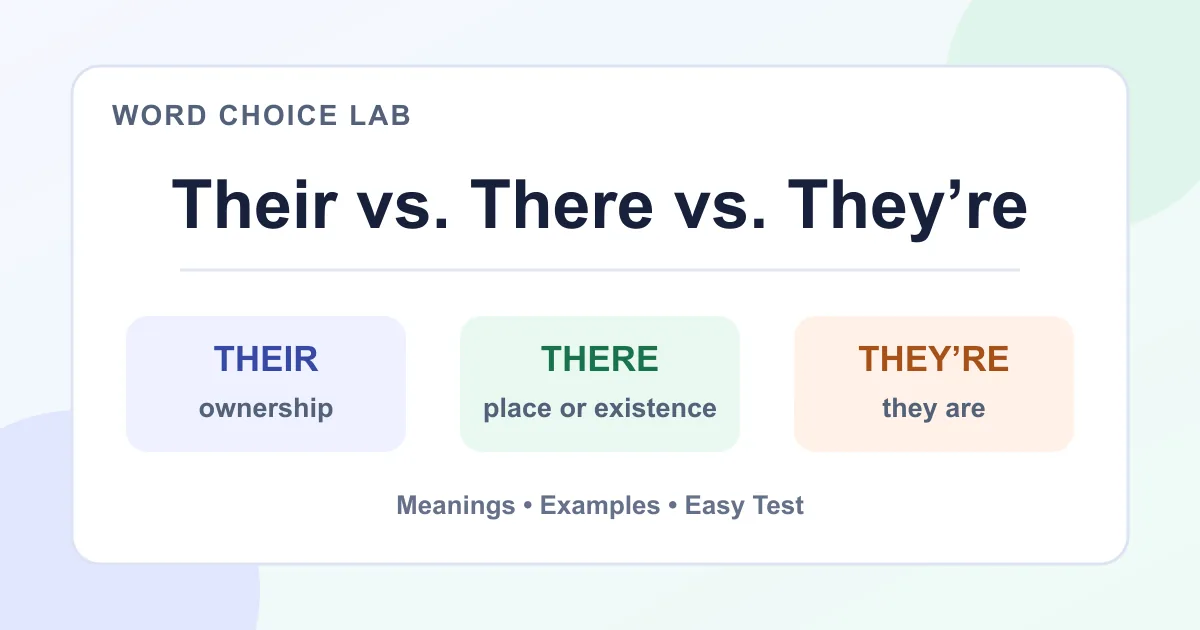
Use their for possession, there for a place or the existence of something, and they’re as the shortened form of they are.
- The students left their notebooks over there.
- They’re returning to get them.
The three words sound alike, but they have different spellings and grammatical jobs.
Their, there, and they’re at a glance
| Word | Main job | Simple meaning | Example |
|---|---|---|---|
| their | possessive determiner | belonging to them | The neighbors sold their car. |
| there | adverb or introductory word | in that place; something exists | Your keys are over there. |
| they’re | contraction | they are | They’re ready to leave. |
Try this quick decision process:
- Can you replace the word with they are? Use they’re.
- Does something belong to people, animals, or things? Use their.
- Does the sentence point to a place or state that something exists? Use there.
When to use their
Their shows that something belongs to, relates to, or is associated with people, animals, or things already mentioned. It normally appears before a noun.
- The players packed their uniforms.
- The companies changed their policies.
- Mia and Carlos invited us to their apartment.
- The dogs wagged their tails.
In each sentence, the noun after their identifies what is connected to the owners: uniforms, policies, apartment, or tails.
Their with a singular person
Their can also refer to one person when that person’s gender is unknown, irrelevant, or represented by the singular pronoun they.
- Each applicant should bring their identification.
- Someone left their umbrella in the lobby.
- Taylor said their appointment starts at noon.
Singular they/their is standard in contemporary English and helps writers avoid unnecessarily using his or her.
Their own
Add own for emphasis.
- The children decorated their own rooms.
- Every team developed their own strategy.
When to use there
There has two especially common uses: it points to a place, or it introduces the existence or presence of something.
There referring to a place
- Please put the package there.
- We stopped there on our way home.
- The nearest pharmacy is over there.
- I have never been there before.
This use of there is often the opposite of here.
There is and there are
Use there is or there are to say that something exists, happens, or is present.
- There is a message for you.
- There are two seats near the window.
- There was a delay this morning.
- There have been several updates.
The noun that follows usually determines whether the verb is singular or plural:
- There is one problem.
- There are three problems.
In informal speech, people sometimes use there’s before a plural noun. In edited writing, there are is usually the clearer choice: “There are several reasons,” not “There’s several reasons.”
Common phrases with there
- here and there
- over there
- there is no doubt
- there you go
- then and there
- from there
Example: We reviewed the instructions and continued from there.
When to use they’re
They’re is a contraction of they are. The apostrophe marks the missing letter a.
- They’re waiting outside. (They are waiting outside.)
- I think they’re correct. (I think they are correct.)
- They’re the new owners. (They are the new owners.)
- Call me when they’re ready. (Call me when they are ready.)
If expanding the word to they are keeps the sentence grammatical and preserves its meaning, they’re is correct.
When not to use they’re
Do not use they’re before a noun to show ownership.
- Incorrect: They forgot they’re tickets.
- Correct: They forgot their tickets.
“They are tickets” does not make sense, so the contraction fails the replacement test.
Contractions are normal in conversation, emails, and most general writing. In highly formal documents, a writer may choose the full form they are.
Do their, there, and they’re sound different?
In standard American English, their, there, and they’re are usually pronounced the same. That makes them homophones: words with the same pronunciation but different meanings or spellings.
Because sound does not reliably identify the correct spelling, focus on the word’s job in the sentence.
How to remember the difference
Use these built-in clues:
- there contains here, and both can refer to a place.
- they’re contains an apostrophe, reminding you that letters are missing from they are.
- their is the remaining choice when you need to show possession.
A three-part reminder is: their owns, there points, they’re expands.
Is it “their cute” or “they’re cute”?
Use they’re cute because the sentence means they are cute.
- Correct: They’re cute puppies.
- Correct: The puppies are playing with their toys.
- Correct: Their toys are over there.
Before an adjective such as cute, helpful, late, or ready, they’re is often correct because they are + adjective forms a complete idea.
Use all three in one sentence
Seeing the words together makes their separate jobs easier to recognize.
- They’re meeting their friends over there.
- They’re hoping their table will be ready when they get there.
- There is a chance they’re bringing their children.
- When they’re finished, ask them to leave their forms there.
Common mistakes and corrections
Incorrect: Their going to arrive early.
Correct: They’re going to arrive early.
The sentence means they are going.
Incorrect: The employees parked there cars outside.
Correct: The employees parked their cars outside.
The cars belong to the employees.
Incorrect: Your order is waiting over their.
Correct: Your order is waiting over there.
The sentence refers to a place.
Incorrect: They’re office is near the station.
Correct: Their office is near the station.
The office is associated with them; “they are office” is not grammatical.
Examples by context
At school
- The students placed their projects over there.
- They’re presenting them after lunch.
- There are six groups in the class.
At work
- They’re discussing their budget in the conference room.
- Leave the signed contracts there.
- There is a deadline at the end of the week.
During travel
- The passengers checked their bags.
- They’re standing near the departure screen.
- Our gate is just over there.
In everyday conversation
- They’re picking up their children from school.
- Is there enough food for everyone?
- I left the extra plates over there.
For more easy-to-confuse pairs, see our guides to affect vs. effect and accept vs. except.
Quick practice quiz
Choose their, there, or they’re.
- The musicians are tuning ___ instruments.
- ___ planning to start at 8:00 p.m.
- Please place the chairs over ___.
- ___ are several ways to solve the problem.
- The guests said ___ ready for dinner.
- Every student should check ___ answer.
- We went ___ during our last vacation.
- ___ bringing ___ own equipment.
Answers
- their — the instruments belong to the musicians
- they’re — means they are planning
- there — points to a place
- there — introduces the existence of several ways
- they’re — means they are ready
- their — shows association or possession; singular their can follow every student
- there — refers to a place
- they’re, their — means they are bringing equipment that belongs to them
The same context-first habit also helps with Then vs. Than and Between vs. Among. For a wider set of examples in this topic, use the Homophones archive as the category grows.
Frequently asked questions
What is the main difference between their, there, and they’re?
Their shows possession, there refers to a place or introduces something that exists, and they’re means they are.
Is “their” a pronoun?
Their is normally classified as a possessive determiner because it appears before a noun, as in “their house.” The related possessive pronoun is theirs, as in “The house is theirs.”
Can “there” begin a sentence?
Yes. There often begins a sentence that announces the existence or presence of something: “There is a solution” or “There are two options.”
Is “they’re” correct English?
Yes. They’re is the standard contraction of they are. It is common in speech and general writing, though the full form may be preferred in very formal contexts.
What is the fastest way to choose the right word?
First replace the word with they are. If the sentence still works, choose they’re. Otherwise, use their for possession and there for place or existence.
The simple rule to remember
Use their when something belongs to them, there for a place or something that exists, and they’re whenever you can say they are. Before submitting your writing, perform the they are test first; it catches many of the most common errors immediately.