
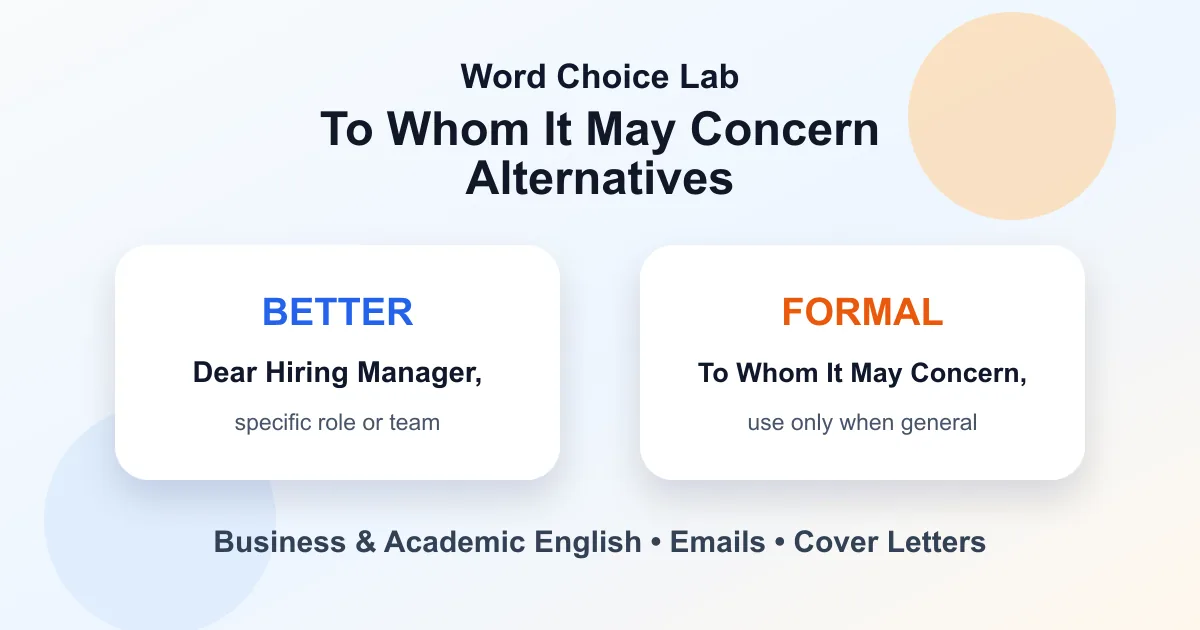
To Whom It May Concern Alternatives: Better Greetings for Professional Emails
To Whom It May Concern is a formal greeting used when you do not know the reader’s name. It is grammatically correct, but it often sounds old-fashioned, distant, and impersonal.
Better alternatives include:
- Dear Hiring Manager,
- Dear Admissions Committee,
- Hello Customer Support Team,
- Dear Human Resources Team,
The best alternative depends on who will receive your message. If you can identify a person, team, department, or role, use that instead of To Whom It May Concern.
To Whom It May Concern alternatives at a glance
| Situation | Better greeting |
|---|---|
| job application | Dear Hiring Manager, |
| college application question | Dear Admissions Office, |
| customer service message | Hello Customer Support Team, |
| HR question | Dear Human Resources Team, |
| unknown department | Hello, |
Quick rule:
- Use the person’s name if you know it.
- Use the team or role if you do not know the name.
- Use To Whom It May Concern only when no better option fits.
Is “To Whom It May Concern” still acceptable?
Yes, To Whom It May Concern is still acceptable in some formal situations. It may work for reference letters, general formal notices, or documents that could be read by different people.
However, in many emails and cover letters, it can feel too generic.
Weak:
- To Whom It May Concern,
Better:
- Dear Hiring Manager,
The second greeting feels more specific because it names the likely reader’s role.
Best alternatives for job applications
For job applications, use a greeting that matches the hiring process.
Good options:
- Dear Hiring Manager,
- Dear Recruiting Team,
- Dear [Company Name] Hiring Team,
- Dear Talent Acquisition Team,
- Dear Ms. Johnson,
- Dear Dr. Patel,
Examples:
- Dear Hiring Manager,
- Dear Greenfield Media Hiring Team,
- Dear Recruiting Team,
Avoid:
- Hey,
- Hi guys,
- Dear Sir or Madam,
- To whoever reads this,
If you can find the hiring manager’s name from the job posting, company website, or LinkedIn, use the name. If not, Dear Hiring Manager is usually safe.
Best alternatives for cover letters
Cover letters should feel professional and targeted. A specific greeting helps.
Best options:
- Dear Hiring Manager,
- Dear [Department] Team,
- Dear [Company Name] Team,
- Dear Search Committee,
- Dear [Title] [Last Name],
Example:
Dear Hiring Manager,
I am excited to apply for the project coordinator position because my experience managing deadlines and client communication aligns with the responsibilities listed in your posting.
If you are applying for an academic position, Dear Search Committee may be more appropriate.
Best alternatives for business emails
For business emails, use the person’s name, team name, or department.
Good options:
- Hello Ms. Rivera,
- Hello Jordan,
- Dear Client Services Team,
- Hello Accounting Department,
- Dear Support Team,
Examples:
- Hello Customer Success Team,
- Dear Billing Department,
- Hello Product Support Team,
Business writing should be professional, but it should also sound natural. Hello [Team Name] is often a good modern choice.
Best alternatives for school or university emails
For school, college, and university messages, try to name the office, department, or professor.
Good options:
- Dear Admissions Office,
- Dear Financial Aid Office,
- Dear Registrar’s Office,
- Dear Professor Lee,
- Hello Academic Advising Team,
Examples:
- Dear Admissions Committee,
- Hello Financial Aid Team,
- Dear Professor Nguyen,
If you are emailing a professor, use their title unless they have told you to use their first name.
When should you use “To Whom It May Concern”?
Use To Whom It May Concern only when the message or document is truly general and could be read by different people.
It may be acceptable for:
- general reference letters
- formal recommendation letters
- official statements
- open letters
- documents with no known recipient
Example:
To Whom It May Concern,
I am writing to confirm that Jordan Ellis volunteered with our organization from January 2024 to May 2025.
Even here, if you know the reader or office, use a more specific greeting.
“Dear Sir or Madam” vs. “To Whom It May Concern”
Dear Sir or Madam is also formal, but it can sound outdated. It also assumes a binary gender choice and may not fit modern professional writing.
Usually better:
- Dear Hiring Manager,
- Dear Admissions Office,
- Hello Support Team,
- Dear Selection Committee,
Use a role, team, or office name instead of guessing the reader’s gender.
What if you do not know the person’s name?
If you do not know the person’s name, use the best available role or group.
Try this order:
- Person’s name: Dear Dr. Williams,
- Role: Dear Hiring Manager,
- Team: Dear Recruiting Team,
- Department: Dear Human Resources Department,
- General greeting: Hello,
This is more professional than using a greeting that sounds disconnected from the reader.
Common mistakes
Mistake 1: Using To Whom It May Concern when a name is available
Weak:
- To Whom It May Concern,
Better:
- Dear Ms. Carter,
If the name is easy to find, use it.
Mistake 2: Using a greeting that is too casual
Too casual:
- Hey there,
Better:
- Hello Customer Support Team,
Mistake 3: Guessing the reader’s title
Avoid guessing Mrs., Miss, or Dr. if you are not sure.
Safer:
- Hello Taylor Morgan,
Mistake 4: Using no greeting at all
Weak:
- I need help with my application.
Better:
- Dear Admissions Office, I am writing to ask about my application status.
Mistake 5: Overusing old-fashioned greetings
Old-fashioned:
- Dear Sir or Madam,
More modern:
- Dear Hiring Manager,
Quick templates
Job application
Dear Hiring Manager,
I am writing to apply for the administrative assistant position listed on your website.
Sincerely, Your Name
Customer support
Hello Customer Support Team,
I am writing to request help with my recent order.
Thank you, Your Name
University office
Dear Admissions Office,
I am writing to ask whether my application materials have been received.
Best regards, Your Name
Quick quiz
Choose the better greeting.
- You are applying for a job but do not know the manager’s name.
- You are emailing a university about admission requirements.
- You are contacting customer support.
- You know the professor’s last name.
- You are writing a general reference letter with no known recipient.
Answers:
- Dear Hiring Manager,
- Dear Admissions Office,
- Hello Customer Support Team,
- Dear Professor [Last Name],
- To Whom It May Concern,
FAQ
What can I say instead of To Whom It May Concern?
Use a more specific greeting, such as Dear Hiring Manager, Dear Admissions Office, Hello Customer Support Team, or Dear Human Resources Team.
Is To Whom It May Concern outdated?
It is not wrong, but it can sound outdated or impersonal in many emails and cover letters.
Is Dear Hiring Manager better than To Whom It May Concern?
Yes, for most job applications, Dear Hiring Manager is usually better because it names the likely reader’s role.
Should I use Dear Sir or Madam?
Usually no. It can sound old-fashioned. A role or team greeting is often better.
What if I do not know the recipient’s name?
Use the role, team, department, or office name. Examples: Dear Recruiting Team or Hello Billing Department.
Can I start a professional email with Hello?
Yes. Hello [Name/Team] is professional enough for many modern business emails.
The same context-first habit also helps with Cover Letter vs. Resume and Resume vs. CV. For a wider set of examples in this topic, use the Business & Academic English archive as the category grows.
Final tip
Use To Whom It May Concern only when your message is truly general and no better recipient is available.
For most professional emails, choose something more specific:
- Dear Hiring Manager,
- Dear Admissions Office,
- Hello Support Team,
- Dear Human Resources Team,
A specific greeting makes your message feel more careful, modern, and professional.