
Resume vs. CV: Differences, Examples, and Which One to Use
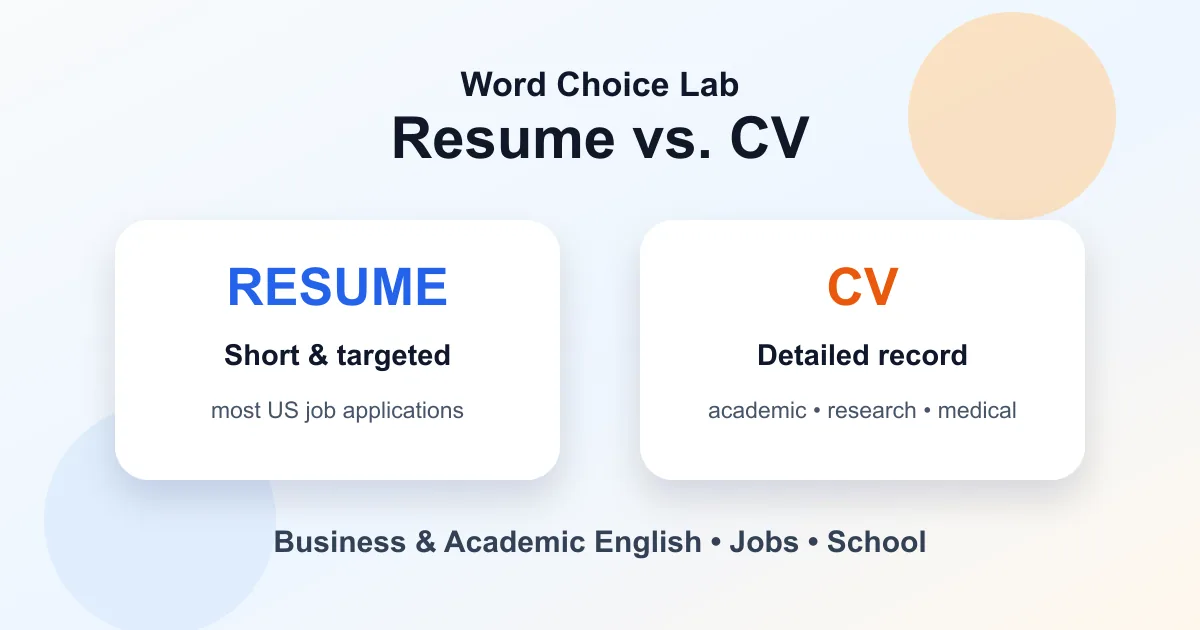
A resume is a short job-focused document that summarizes your skills, experience, and achievements. A CV is usually a longer, more detailed document used for academic, research, medical, or international applications.
- Resume: a one- or two-page job application document
- CV: a detailed career history, often used in academia or research
In the United States, most job applications ask for a resume, not a CV. However, universities, research positions, fellowships, grants, and some medical roles may ask for a CV.
Resume vs. CV at a glance
| Document | Main purpose | Typical length |
|---|---|---|
| resume | job applications | 1–2 pages |
| CV | academic, research, medical, or detailed career record | 2+ pages, sometimes much longer |
Quick rule:
- Use a resume for most US jobs.
- Use a CV for academic, research, medical, or grant-related applications.
- Always follow the employer’s or institution’s instructions.
What is a resume?
A resume is a brief, targeted document used to apply for a job. It highlights the experience, skills, education, and achievements most relevant to a specific role.
A resume usually includes:
- contact information
- professional summary
- work experience
- skills
- education
- certifications
- selected achievements
Example use:
- You apply for a marketing assistant job.
- You submit a one-page resume focused on marketing, writing, social media, and project experience.
A good resume is not a complete life history. It is a focused argument that says: “I am a strong fit for this job.”
What is a CV?
CV stands for curriculum vitae, a Latin phrase that means “course of life.” A CV is a more detailed document that lists a person’s education, academic background, research, publications, presentations, grants, awards, teaching experience, and professional history.
A CV may include:
- contact information
- education
- research experience
- teaching experience
- publications
- conference presentations
- grants and fellowships
- awards and honors
- professional memberships
- academic service
- certifications or licenses
- selected work experience
Example use:
- You apply for a university research position.
- You submit a CV that includes your degrees, research projects, publications, and conference presentations.
A CV can be several pages long because it is meant to show a fuller academic or professional record.
Key differences between a resume and a CV
The biggest differences are length, purpose, and level of detail.
| Feature | Resume | CV |
|---|---|---|
| Length | usually 1–2 pages | often 2+ pages |
| Focus | job fit | full academic/professional record |
| Customization | highly customized for each job | updated over time, less shortened |
| Common in US | most jobs | academia, research, medicine |
| Includes publications | only if relevant | usually yes |
| Includes full work history | not always | often more complete |
If the application is for a regular job in the US, a resume is usually expected. If the application is academic or research-based, a CV may be expected.
Which one should you use in the US?
For most US job applications, use a resume.
Use a resume for:
- business jobs
- marketing jobs
- customer service jobs
- administrative jobs
- technology jobs
- sales jobs
- internships
- most entry-level jobs
- most corporate roles
Use a CV for:
- academic positions
- research roles
- PhD applications
- postdoctoral positions
- university teaching roles
- grants and fellowships
- medical academic roles
- some international applications
If an employer says “submit your resume,” send a resume. If an institution says “submit your CV,” send a CV.
Resume example sections
A basic resume might look like this:
- Name and contact information
- Professional summary
- Work experience
- Skills
- Education
- Certifications
Example summary:
> Detail-oriented administrative assistant with three years of experience managing schedules, preparing reports, and supporting customer communication.
Example bullet:
- Managed weekly reports for a team of 12 and reduced data-entry errors by 20%.
Resume writing should be concise, specific, and achievement-focused.
CV example sections
A CV may include more sections than a resume:
- Name and contact information
- Education
- Research interests
- Teaching experience
- Publications
- Conference presentations
- Grants and fellowships
- Awards and honors
- Professional memberships
- Academic service
Example publication entry:
- Smith, J. (2025). Language learning and memory in adult learners. Journal of Applied Linguistics.
Example teaching entry:
- Teaching Assistant, Introduction to Academic Writing, University of Example, Fall 2025
A CV should be organized, complete, and easy to scan.
Resume vs. CV outside the United States
The meaning of resume and CV can change by country.
In the United States:
- resume = common job application document
- CV = academic or detailed professional document
In some other countries:
- CV may mean the standard job application document
- resume may be less commonly used
This is why context matters. If you are applying internationally, read the instructions carefully and research local expectations.
Should a resume be one page?
Many resumes are one page, especially for students, new graduates, and early-career applicants. However, a two-page resume can be acceptable if you have enough relevant experience.
Use one page if:
- you are a student
- you are applying for an internship
- you have limited work experience
- your experience fits clearly on one page
Use two pages if:
- you have several years of relevant experience
- you need space for measurable achievements
- the job is senior or technical
- cutting to one page would remove important information
Do not make a resume longer just to look more experienced. A strong resume is focused.
Common mistakes
Mistake 1: Sending a CV when the job asks for a resume
If a US employer asks for a resume, do not send a long academic CV unless the role specifically requires it.
Mistake 2: Making a resume too long
A resume should be targeted. Remove unrelated details that do not help your application.
Mistake 3: Treating a CV like a short resume
A CV should include detailed academic, research, or professional accomplishments when relevant.
Mistake 4: Not customizing the resume
Weak: one generic resume for every job
Better: a resume adjusted to match the job description
Mistake 5: Ignoring the application instructions
The safest rule is simple: submit the document the employer or institution requests.
Quick quiz
Choose resume or CV.
- You are applying for a retail job in the US.
- You are applying for a PhD program.
- You are applying for a corporate marketing role.
- You are listing publications and conference presentations.
- A US job posting asks for a one-page document.
Answers:
- resume
- CV
- resume
- CV
- resume
FAQ
What is the main difference between a resume and a CV?
A resume is a short, targeted job application document. A CV is a longer, more detailed document often used for academic, research, medical, or grant-related applications.
Do US employers want a resume or CV?
Most US employers want a resume. Academic, research, and medical institutions may ask for a CV.
What does CV stand for?
CV stands for curriculum vitae.
Is a CV longer than a resume?
Usually yes. A CV is often longer because it includes more detailed academic and professional history.
Can I use the same document for every job?
No. You should customize your resume for each job. A CV should also be updated and organized for the specific opportunity.
Should students use a resume or CV?
For most internships and jobs, students should use a resume. For graduate school, research, or academic opportunities, a CV may be required.
The same context-first habit also helps with Professional Email Greetings and Closings and Formal vs. Informal Writing. For a wider set of examples in this topic, use the Business & Academic English archive as the category grows.
Final tip
Use a resume for most US job applications. Use a CV for academic, research, medical, grant, or detailed professional contexts.
If the instructions are clear, follow them exactly. If they are not clear, a resume is usually the safer choice for a standard US job application.