
Cover Letter vs. Resume: Differences, Examples, and When You Need Both
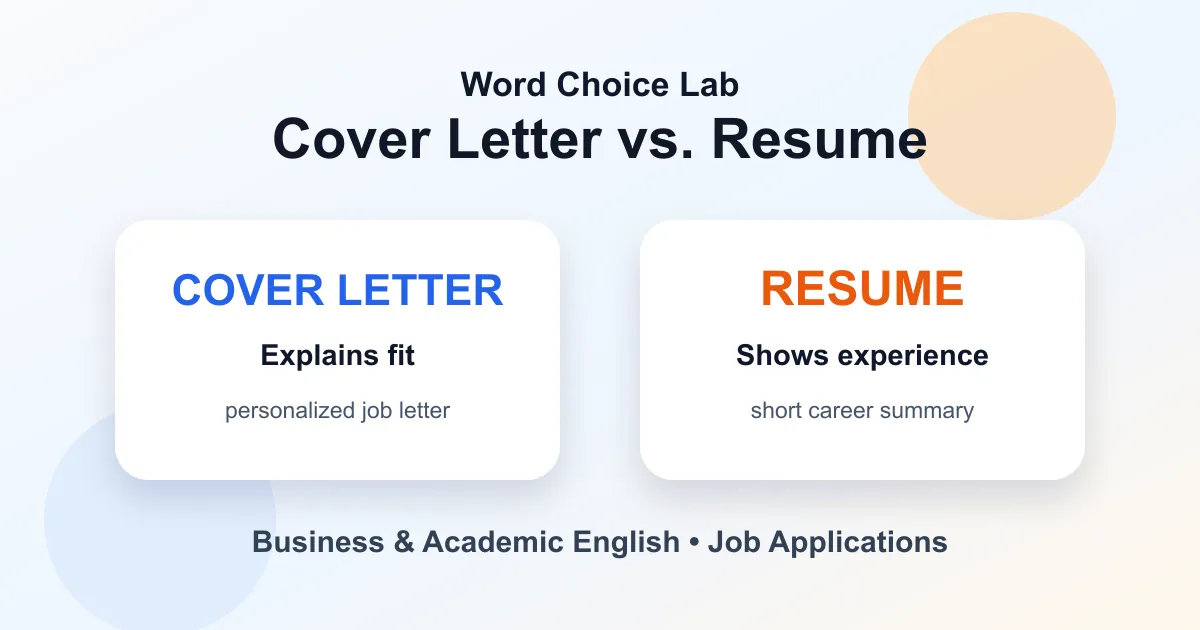
A resume summarizes your skills, experience, education, and achievements. A cover letter explains why you are interested in a specific job and why you are a strong fit.
- Resume: a short career summary
- Cover letter: a personalized job application letter
Most job applications use a resume. Some also ask for a cover letter. If both are requested, they should work together, not repeat the same information word for word.
Cover letter vs. resume at a glance
| Document | Main purpose | Typical length |
|---|---|---|
| resume | summarizes your qualifications | 1–2 pages |
| cover letter | explains your interest and fit | about 3–5 paragraphs |
Quick rule:
- Use a resume to show what you have done.
- Use a cover letter to explain why it matters for this job.
- If the employer asks for both, send both.
What is a resume?
A resume is a job application document that highlights your work experience, skills, education, certifications, and achievements.
A resume usually includes:
- name and contact information
- professional summary
- work experience
- skills
- education
- certifications
- selected achievements
Example resume bullet:
- Increased customer response speed by 25% by organizing support templates and follow-up procedures.
A resume should be clear, concise, and easy to scan. It gives the employer a quick picture of your background.
What is a cover letter?
A cover letter is a short letter sent with a job application. It introduces you, explains your interest in the role, and connects your experience to the employer’s needs.
A cover letter usually includes:
- a professional greeting
- the job you are applying for
- why you are interested
- why your skills fit the role
- one or two strong examples
- a polite closing
Example cover letter sentence:
- I am excited to apply for the customer support specialist position because my experience in client communication and problem-solving matches the needs of your team.
A cover letter should feel specific to the job, not generic.
Key differences between a cover letter and a resume
The biggest difference is format and purpose. A resume is a structured list of qualifications. A cover letter is a written explanation.
| Feature | Resume | Cover letter |
|---|---|---|
| Format | bullet points and sections | paragraphs |
| Purpose | show qualifications | explain fit and interest |
| Length | usually 1–2 pages | usually one page |
| Tone | concise and factual | professional and persuasive |
| Customization | tailored to job keywords | tailored to employer and role |
| Best for | scanning experience quickly | adding context and motivation |
Both documents should be customized for the job.
Do you always need a cover letter?
No. You do not always need a cover letter. Some job postings require one, some make it optional, and some do not ask for it at all.
You should include a cover letter when:
- the job posting asks for one
- the application system has a cover letter field
- you want to explain a career change
- you want to explain a gap or special situation
- you have a strong reason for wanting that company
- the role involves writing or communication
You may skip it when:
- the posting says not to include one
- the application only allows a resume
- the employer specifically asks for a short application only
If a cover letter is optional and you can write a strong one, it can help.
What should a resume include?
A strong resume usually includes these sections:
- Contact information
- Professional summary
- Work experience
- Skills
- Education
- Certifications or licenses
- Relevant projects or achievements
Resume writing should focus on evidence.
Weak bullet:
- Responsible for emails.
Stronger bullet:
- Responded to 40+ customer emails per day while maintaining a 95% satisfaction rating.
Use numbers and specific outcomes when possible.
What should a cover letter include?
A strong cover letter usually includes:
- A professional greeting
- A clear opening sentence
- One paragraph connecting your experience to the job
- One paragraph showing interest in the company or role
- A polite closing
Simple structure:
- Paragraph 1: What role you want and why you are writing
- Paragraph 2: Why your experience fits the role
- Paragraph 3: Why you are interested and what you hope to contribute
- Closing: Thank the reader and invite next steps
Good closing sentence:
- Thank you for your time and consideration. I would welcome the opportunity to discuss how my experience can support your team.
Example: resume vs. cover letter
Here is how the same experience might appear in both documents.
Resume:
- Managed social media content for three platforms and increased monthly engagement by 32%.
Cover letter:
- In my previous role, I managed content for three social media platforms and helped increase monthly engagement by 32%. I would be excited to bring that same combination of planning, writing, and audience awareness to your marketing team.
The resume gives the fact quickly. The cover letter explains why the fact is relevant.
Common mistakes
Mistake 1: Repeating the resume exactly
A cover letter should not simply copy your resume in paragraph form. It should add context, interest, and connection.
Mistake 2: Sending a generic cover letter
Weak:
- I am applying for the position at your company.
Better:
- I am applying for the project coordinator role because my experience managing deadlines, client communication, and team updates matches the responsibilities listed in your posting.
Mistake 3: Making the resume too personal
A resume should focus on qualifications, not personal stories.
Mistake 4: Making the cover letter too long
Most cover letters should fit on one page. Keep it focused and easy to read.
Mistake 5: Ignoring instructions
If the job posting says to include a cover letter, include one. If it says not to, do not include one.
Quick quiz
Choose cover letter or resume.
- Lists your work experience in bullet points.
- Explains why you want the job.
- Usually includes a professional summary and skills section.
- Uses paragraphs to connect your background to the role.
- Is usually required for most job applications.
Answers:
- resume
- cover letter
- resume
- cover letter
- resume
FAQ
What is the main difference between a cover letter and a resume?
A resume summarizes your qualifications. A cover letter explains your interest in the job and connects your experience to the role.
Do I need both a cover letter and a resume?
You need a resume for most job applications. You need a cover letter when the employer requests one or when a strong letter can support your application.
Can a cover letter replace a resume?
No. A cover letter should not replace a resume. It supports the resume.
Should my cover letter repeat my resume?
No. It can mention key experience from your resume, but it should add explanation and context.
How long should a cover letter be?
Most cover letters should be one page, usually three to five short paragraphs.
Which is more important, a resume or a cover letter?
For most jobs, the resume is more important because it is the main document employers scan. A strong cover letter can still help when it is requested or well written.
The same context-first habit also helps with Resume vs. CV and Professional Email Greetings and Closings. For a wider set of examples in this topic, use the Business & Academic English archive as the category grows.
Final tip
Use your resume to show your experience, skills, and achievements quickly.
Use your cover letter to explain why you are interested in the role and how your background fits the employer’s needs.
Best pattern:
- Resume = what you have done
- Cover letter = why you are a good fit
When both are requested, send both and make sure they support each other.