
Onto vs. On To: Difference, Examples, and an Easy Rule
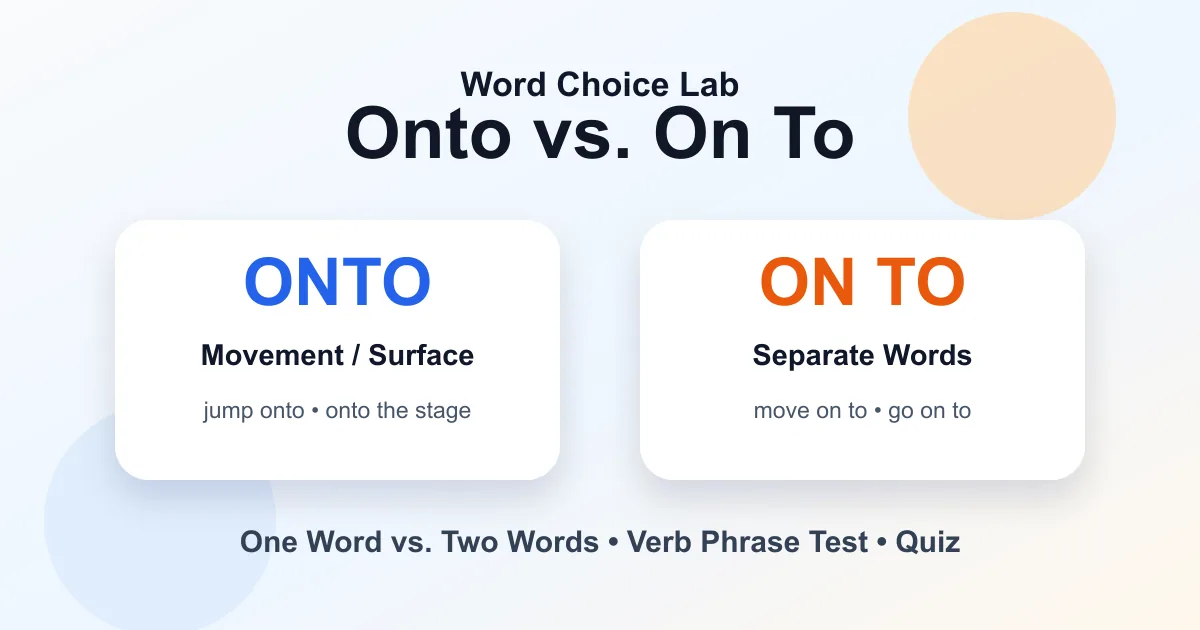
Onto is one word when it shows movement to a surface, position on something, or awareness of something. On to is two words when on and to do separate jobs in the sentence.
- The cat jumped onto the table.
- Let’s move on to the next question.
This pair is similar to into vs. in to. If something moves to a surface or ends up on something, use onto. If on belongs to the verb before it, and to starts the next phrase, use on to.
Onto vs. on to at a glance
| Form | Use | Example |
|---|---|---|
| onto | movement to a surface; position; awareness | She climbed onto the roof. |
| on to | two separate words doing separate jobs | We moved on to chapter two. |
Quick rule:
- Onto = movement to or position on a surface.
- On to = on + to as separate words.
- Use on to in phrases like move on to, go on to, and pass on to.
When to use onto
Use onto when something moves to a surface or position on something.
- The child climbed onto the chair.
- Put the box onto the shelf.
- The dog jumped onto the couch.
- Snow fell onto the roof.
Onto often answers the question “to where?” The answer is a surface or position.
Common examples:
- step onto the platform
- climb onto the ladder
- fall onto the floor
- move onto the stage
- load boxes onto a truck
If the sentence is about movement that ends on a surface, onto is usually correct.
When to use on to
Use on to when on belongs to the verb or phrase before it, and to begins the next phrase.
- Let’s move on to the next topic.
- She went on to become a doctor.
- Please pass this message on to the team.
- The teacher held on to the old notes.
In these examples, on belongs with the verb:
- move on + to the next topic
- go on + to become a doctor
- pass on + to the team
- hold on + to the notes
The words are next to each other, but they are not forming the single preposition onto.
The easiest memory trick
Ask this question:
> Is something moving to a surface or ending up on something?
If yes, use onto.
- The bird landed onto the fence.
- She stepped onto the bus.
Ask this second question:
> Does on belong with the verb before it?
If yes, use on to.
- We moved on to the next lesson.
- He held on to the rope.
So:
- onto = movement/position on a surface
- on to = two separate grammar jobs
Onto examples
Here are more sentences with onto.
- The actor walked onto the stage.
- The cat leaped onto the windowsill.
- The movers loaded the sofa onto the truck.
- The spilled water ran onto the floor.
- She copied the file onto a flash drive.
- The poster fell onto the desk.
In each sentence, something moves to a surface, position, or place where it is on something.
On to examples
Here are more sentences with on to.
- Let’s go on to the next example.
- The speaker moved on to a new topic.
- He went on to win the championship.
- Please pass the file on to your manager.
- She held on to the railing.
- The company carried on to the final stage.
In each sentence, on is part of a verb phrase, and to begins the next phrase.
Move onto or move on to?
Both can be correct, but they mean different things.
Use move onto for physical movement to a surface or place.
- Move the boxes onto the truck.
- The dancers moved onto the stage.
Use move on to for continuing to the next thing.
- Let’s move on to the next question.
- After grammar, we’ll move on to vocabulary.
This is one of the most common places where spacing changes meaning.
Go onto or go on to?
Use go onto when someone or something physically goes to a surface or platform.
- The singer went onto the stage.
- The child went onto the balcony.
Use go on to when someone continues and later does something.
- She went on to become a lawyer.
- The team went on to win the final.
The second meaning is about sequence, not physical movement.
Hold onto or hold on to?
Both hold onto and hold on to are common.
- Hold onto the railing.
- Hold on to the railing.
Many style guides and careful editors prefer hold on to because hold on is the verb phrase. However, hold onto is widely used and often accepted, especially in everyday writing.
For a clear learner rule:
- Use hold on to when you want to show the verb phrase clearly.
- Use onto when the meaning is more clearly movement to a surface.
Onto meaning “aware of”
Onto can also mean aware of, suspicious of, or understanding something.
- The detective was onto the thief.
- I think she is onto our plan.
- The teacher is onto the students’ trick.
In this meaning, onto does not describe physical movement. It means someone has discovered or understood something.
This use is informal but common.
Onto vs. on to in technology
Use onto when copying, loading, or putting something on a device or platform.
- Save the file onto the drive.
- Upload the video onto the website.
- Copy the photos onto your laptop.
Use on to when continuing to another step or passing something along.
- Move on to the next screen.
- Pass the request on to support.
Common mistakes
Mistake 1: Using on to for physical movement
Incorrect: The cat jumped on to the table.
Better: The cat jumped onto the table.
Mistake 2: Using onto for continuing
Incorrect: Let’s move onto the next topic.
Better: Let’s move on to the next topic.
Mistake 3: Confusing go onto and go on to
Correct:
- She went onto the stage. = physical movement
- She went on to become famous. = later continued and achieved something
Mistake 4: Forgetting the awareness meaning
Correct:
- The police are onto the suspect.
Here onto means aware of or suspicious of.
More example sentences
Onto
- The ball rolled onto the road.
- She stepped onto the train.
- He placed the laptop onto the desk.
- The spotlight moved onto the singer.
- The app saved the backup onto the cloud server.
On to
- Let’s move on to the next rule.
- He passed the message on to his assistant.
- She held on to her ticket.
- The winner went on to compete nationally.
- After the break, we went on to the final exercise.
Quick quiz
Choose the correct form.
- The dog jumped ___ the bed.
- Let’s move ___ the next question.
- She went ___ become a scientist.
- Put the suitcase ___ the cart.
- The detective is ___ the truth.
Answers:
- onto
- on to
- on to
- onto
- onto
FAQ
What is the difference between onto and on to?
Onto shows movement to a surface, position on something, or awareness. On to is two words when on belongs to the verb and to starts the next phrase.
Is it move onto or move on to?
Use move onto for physical movement to a surface. Use move on to when continuing to the next topic, step, or activity.
Is it go onto or go on to?
Use go onto for physical movement onto a place. Use go on to when someone later does something.
Is hold onto correct?
Yes, hold onto is common. Hold on to is also correct and often clearer because hold on is the verb phrase.
Is onto one word?
Yes, onto is one word when it means movement to a surface, position, or awareness.
The same context-first habit also helps with Into vs. In To and Cannot vs. Can Not. For a wider set of examples in this topic, use the One Word or Two archive as the category grows.
Final tip
Use onto for movement to a surface or awareness. Use on to when on and to are doing separate jobs.
Remember: jump onto, but move on to.