
Into vs. In To: Difference, Examples, and an Easy Rule
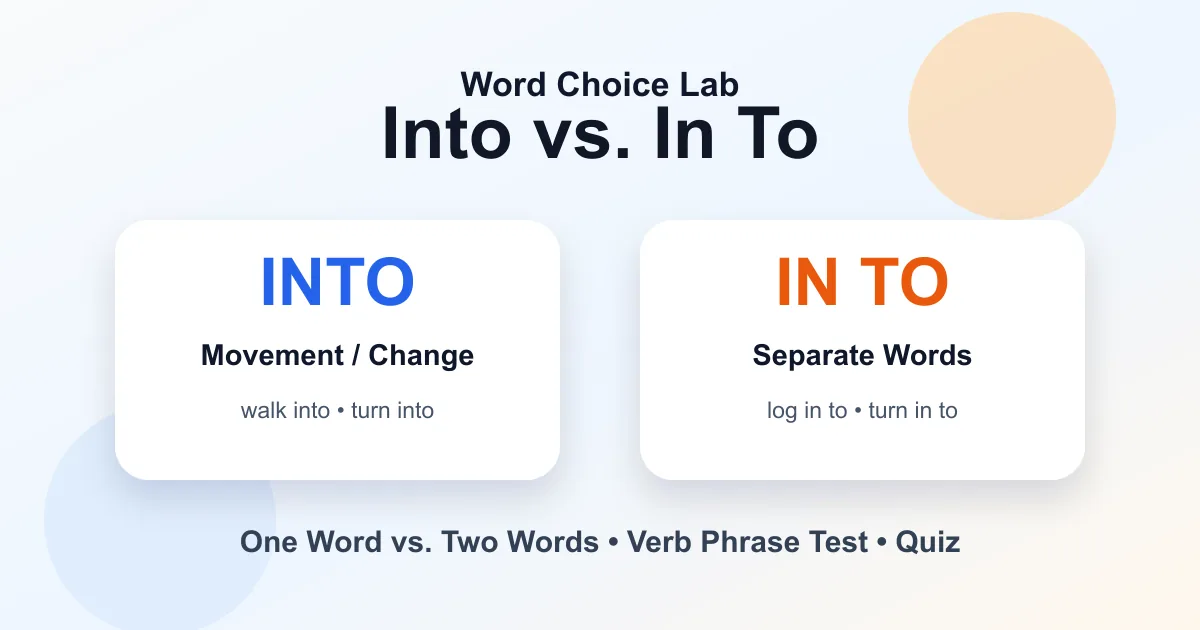
Into is one word when it shows movement, direction, entry, or change. In to is two words when in and to belong to separate parts of the sentence.
- She walked into the room.
- She logged in to her account.
This pair is confusing because both forms can appear before a noun or phrase. The easiest rule is this: use into for movement or transformation. Use in to when in is part of a verb phrase, such as log in, check in, or turn in.
Into vs. in to at a glance
| Form | Use | Example |
|---|---|---|
| into | movement, entry, direction, change | He went into the kitchen. |
| in to | two separate words doing separate jobs | Please sign in to continue. |
Quick rule:
- Into = movement or change.
- In to = in + to as separate words.
- If the verb is log in, sign in, check in, or turn in, you may need in to.
When to use into
Use into when something moves from outside to inside, toward a place, or from one state to another.
- She walked into the office.
- The cat jumped into the box.
- Pour the milk into the bowl.
- The caterpillar turns into a butterfly.
Into often shows physical movement:
- run into the house
- climb into the car
- fall into the water
- step into the elevator
It can also show change:
- turn into a problem
- grow into a leader
- change into a different outfit
- develop into a strong habit
If the sentence is about entering, moving toward the inside, or changing form, into is usually correct.
When to use in to
Use in to when in belongs to the verb before it and to begins the next phrase.
- Please log in to your account.
- We checked in to the hotel.
- She came in to ask a question.
- He turned the form in to the teacher.
In these examples, in is not joining with to to show movement into a place. Instead, the words are separate:
- log in + to your account
- check in + to the hotel
- come in + to ask
- turn in + to the teacher
This is why in to sometimes looks strange but is correct.
The easiest memory trick
Ask this question:
> Is something entering, moving inside, or changing?
If yes, use into.
- She walked into the room.
- The ice melted into water.
Ask this second question:
> Does in belong with the verb before it?
If yes, use in to.
- Sign in to your account.
- Turn in to the teacher.
So:
- into = movement or change
- in to = two separate grammar jobs
Into examples
Here are more sentences with into.
- The child ran into the garden.
- Put the files into the folder.
- The road leads into the city.
- She divided the cake into eight pieces.
- The meeting turned into a long debate.
- He translated the article into Spanish.
In each sentence, into shows movement, direction, division, translation, or change.
In to examples
Here are more sentences with in to.
- You need to sign in to the website.
- I stopped in to say hello.
- She handed the report in to her manager.
- The guests checked in to the hotel at noon.
- He came in to get his coat.
- Please turn in to the parking lot slowly.
Some of these may feel close to into, so look at the structure. If in belongs with the verb, two words may be better.
Log into or log in to?
Both forms appear, but many careful writers prefer log in to when log in is the verb phrase.
Clear:
- Please log in to your account.
- I can’t log in to the dashboard.
Also common:
- Please log into your account.
For a grammar guide, log in to is the cleaner explanation because log in is the action and to your account tells where.
Related forms:
- noun/adjective: login details
- verb phrase: log in
- full phrase: log in to your account
Examples:
- I forgot my login password.
- I need to log in.
- I need to log in to my account.
Sign into or sign in to?
Like log in to, many careful writers prefer sign in to when sign in is the verb phrase.
Clear:
- Sign in to your email account.
- She signed in to the app.
Also common:
- Sign into your email account.
For consistency in careful writing, sign in to is a good choice when the verb is sign in.
Turn into or turn in to?
These two forms have different meanings.
Turn into means become or change into.
- The rain turned into snow.
- The small idea turned into a business.
Turn in to can mean submit something to someone.
- Turn the assignment in to your teacher.
- She turned the keys in to the office.
This is one of the clearest examples of why spacing matters.
Check into or check in to?
Use check into when you mean investigate.
- The manager will check into the complaint.
- We should check into the problem.
Use check in to when check in is the action, especially at a hotel, airport, or event.
- We checked in to the hotel.
- Please check in to the conference desk.
In casual writing, many people write check into a hotel, but check in to a hotel shows the verb phrase more clearly.
Come into or come in to?
Use come into for entering a place or receiving something.
- She came into the room.
- He came into a large inheritance.
Use come in to when in belongs with come in and to introduces a purpose.
- She came in to ask a question.
- He came in to get his coat.
In the second group, to means “in order to.”
Common mistakes
Mistake 1: Using in to for movement
Incorrect: She walked in to the room.
Correct: She walked into the room.
Mistake 2: Using into after log in
Less clear: Please log into your account.
Clearer for careful grammar: Please log in to your account.
Mistake 3: Confusing turn into and turn in to
Incorrect: Turn the homework into the teacher.
Better: Turn the homework in to the teacher.
Correct with a different meaning:
- The homework turned into a bigger project.
Mistake 4: Forgetting change meanings
Incorrect: The water froze in to ice.
Correct: The water froze into ice.
More example sentences
Into
- The bird flew into the tree.
- The teacher split the class into groups.
- The discussion turned into an argument.
- He put the letter into an envelope.
- The company grew into a national brand.
In to
- I came in to see the doctor.
- She checked in to the hotel early.
- Please turn your form in to the office.
- He logged in to the system.
- They stopped in to ask for directions.
Quick quiz
Choose the correct form.
- She walked ___ the kitchen.
- Please log ___ your account.
- The problem turned ___ a serious issue.
- He came ___ ask a question.
- Turn the paper ___ your teacher.
Answers:
- into
- in to
- into
- in to
- in to
FAQ
What is the difference between into and in to?
Into shows movement, entry, direction, or change. In to is two separate words when in belongs to the verb and to starts the next phrase.
Is it log into or log in to?
Both are common, but log in to is clearer when log in is the verb phrase.
Is it turn into or turn in to?
Use turn into for become. Use turn in to for submit to someone.
Is it walk into or walk in to?
Use walk into when someone enters a place.
Is it check into or check in to?
Use check into for investigate. Use check in to when checking in at a hotel, airport, or event.
The same context-first habit also helps with Cannot vs. Can Not and Anymore vs. Any More. For a wider set of examples in this topic, use the One Word or Two archive as the category grows.
Final tip
Use into for movement, entry, or change. Use in to when in and to have separate jobs in the sentence.
Remember: walk into, but log in to.