
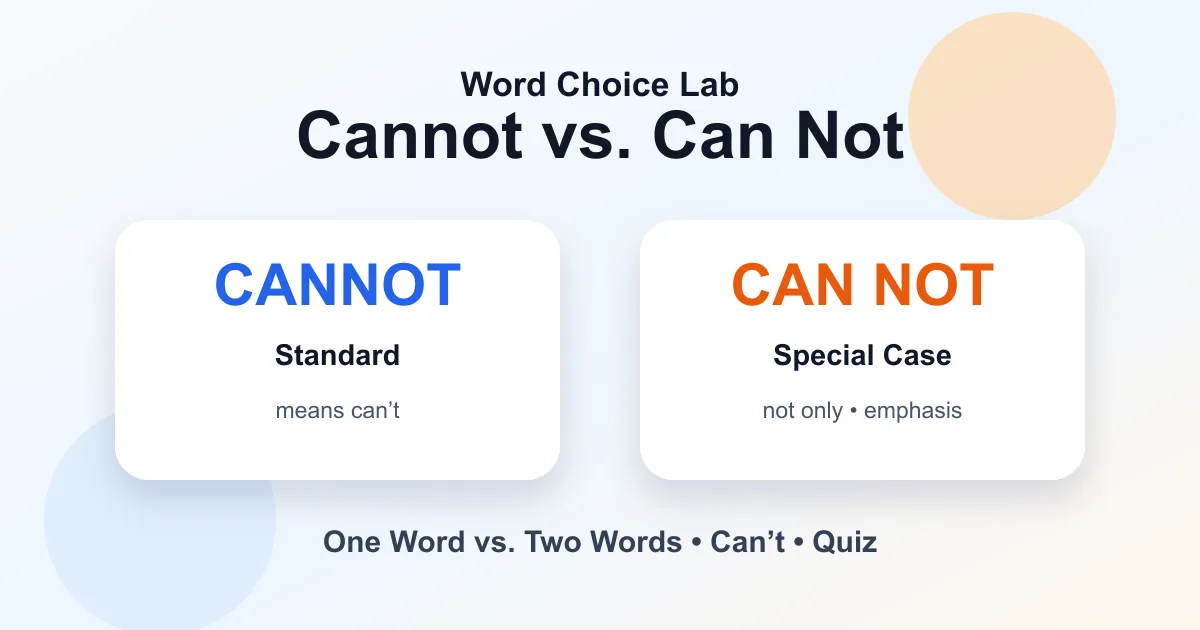
Cannot vs. Can Not: Difference, Examples, and an Easy Rule
Cannot is the standard spelling when you mean “can’t” or “am/is/are not able to.” Can not is less common and is mainly used when not belongs to a separate phrase or when you want special emphasis.
- Standard: I cannot attend the meeting.
- Special emphasis: You can not only study harder, but also study smarter.
For most everyday writing, cannot as one word is the safest choice. Use can not only when you have a clear reason to separate the words.
Cannot vs. can not at a glance
| Form | Use | Example |
|---|---|---|
| cannot | standard negative form of can | I cannot open the file. |
| can not | emphasis, contrast, or when not starts another phrase | You can not go, if you choose. |
Quick rule:
- Use cannot for the normal meaning of can’t.
- Use can not only when not is separate or strongly emphasized.
- In most school, business, and SEO writing, cannot is the better default.
When to use cannot
Use cannot when you mean someone or something is not able, not allowed, or not possible.
- I cannot find my keys.
- We cannot accept late applications.
- She cannot drive at night.
- This password cannot be changed.
Cannot is one word because it functions as the usual negative form of can.
It can mean:
- not able to
- not allowed to
- not possible to
Examples:
- I cannot hear you clearly.
- Students cannot use phones during the test.
- The file cannot be opened.
- You cannot be serious.
If you could naturally use can’t, cannot is usually correct.
When to use can not
Use can not as two words when not is part of a separate phrase or when you are creating a contrast.
- You can not only read the guide, but also take the quiz.
- Employees can not just complain; they should suggest solutions.
- You can not go, if that feels safer.
In the first two examples, not belongs with only or just, not simply with can.
Compare:
- You cannot only read the guide. = You are unable to only read the guide.
- You can not only read the guide, but also take the quiz. = You can do both things.
That second sentence is often clearer if rewritten:
- You can not only read the guide, but also take the quiz.
This is why can not is less common. Many sentences with can not can be rewritten for clarity.
The easiest memory trick
Use this rule:
> If you mean can’t, write cannot.
Examples:
- I cannot come today. = I can’t come today.
- We cannot finish by noon. = We can’t finish by noon.
Use can not only when you could put strong stress on not or when not starts a phrase like not only.
Example:
- You can not only save time, but also reduce mistakes.
Cannot examples
Here are more sentences with cannot.
- I cannot believe this happened.
- The printer cannot connect to Wi-Fi.
- We cannot make a decision without more facts.
- She cannot remember the address.
- The team cannot afford another delay.
- This rule cannot be ignored.
In each sentence, cannot means can’t, not able to, not allowed to, or not possible.
Can not examples
Here are sentences where can not can make sense.
- You can not go, if you prefer to stay.
- We can not only fix the problem, but improve the system.
- They can not attend and still send written comments.
- You can not say anything, if silence is better.
These examples involve choice, emphasis, or a separate not phrase.
However, many of them can sound clearer if rewritten:
- You can choose not to go.
- We can not only fix the problem, but also improve the system.
- They can skip the meeting and still send written comments.
- You can say nothing if silence is better.
For everyday writing, cannot is more common and less risky.
Cannot or can’t?
Can’t is the contraction of cannot.
- I cannot attend.
- I can’t attend.
Both mean the same thing. The difference is tone.
| Form | Tone |
|---|---|
| cannot | more formal, clear, written |
| can’t | more conversational, casual |
Use cannot in formal writing, business writing, instructions, legal-style text, and SEO guides. Use can’t when a conversational tone is acceptable.
Can not only or cannot only?
This phrase often causes confusion.
Correct:
- You can not only learn the rule, but also practice it.
- This tool can not only save time, but also reduce errors.
Less clear:
- You cannot only learn the rule, but also practice it.
The clearer pattern is:
> can not only X, but also Y
Here not only works as a pair with but also. The word not belongs to the phrase not only, so it should remain separate from can.
Cannot help but
The phrase cannot help but means you feel unable to avoid doing something.
- I cannot help but laugh.
- She cannot help but notice the mistake.
- We cannot help but wonder what happened.
This phrase uses cannot as one word because it means “can’t help but.”
Cannot be or can not be?
Most of the time, use cannot be.
Correct:
- This cannot be true.
- The issue cannot be ignored.
- The meeting cannot be moved.
Use can not be only if you are emphasizing choice or contrast.
Possible:
- The answer can be true, or it can not be true, depending on the data.
Even there, many writers would choose a clearer rewrite:
- The answer may or may not be true.
Cannot with passive voice
Cannot is common before passive verbs.
- The file cannot be opened.
- The order cannot be canceled.
- The document cannot be edited.
- The rule cannot be changed.
This is normal and correct. Do not split it unless you have a special reason.
Common mistakes
Mistake 1: Using can not as the default
Less common: I can not attend the meeting.
Better: I cannot attend the meeting.
Mistake 2: Using cannot with not only
Less clear: You cannot only read the article, but also take notes.
Better: You can not only read the article, but also take notes.
Mistake 3: Thinking can not is always wrong
Incorrect idea: Can not is never acceptable.
Better: Can not is possible, but cannot is the normal default.
Mistake 4: Using can’t in very formal writing
Casual: We can’t approve the request.
More formal: We cannot approve the request.
More example sentences
Cannot
- I cannot answer that question yet.
- The system cannot process the request.
- We cannot guarantee delivery by Friday.
- She cannot join the call today.
- They cannot agree on the final design.
Can not
- You can not only read the article, but also save it.
- The team can not attend and still submit feedback.
- He can not reply if he needs more time.
- You can not choose that option, if it feels wrong.
- The result can be accepted, or it can not be accepted.
Quick quiz
Choose the better form.
- I ___ open this file.
- You can ___ only watch the lesson, but also take the quiz.
- We ___ accept incomplete forms.
- She ___ attend the event tomorrow.
- This issue ___ be ignored.
Answers:
- cannot
- not
- cannot
- cannot
- cannot
FAQ
Is cannot one word or two?
Cannot is normally one word.
Is can not ever correct?
Yes, but it is less common. Use can not when not is emphasized or part of a phrase like not only.
Is cannot the same as can’t?
Yes. Can’t is the contraction of cannot.
Which is more formal: cannot or can’t?
Cannot is more formal. Can’t is more conversational.
Should I use cannot or can not in SEO writing?
Use cannot as the default. Use can not only when the grammar requires separation, such as can not only.
The same context-first habit also helps with Anymore vs. Any More and Every Time vs. Everytime. For a wider set of examples in this topic, use the One Word or Two archive as the category grows.
Final tip
Use cannot when you mean can’t. Use can not only for special emphasis, contrast, or phrases like not only.
Remember: cannot = standard, can not = special case.