
Anyone vs. Any One: Difference, Examples, and an Easy Rule
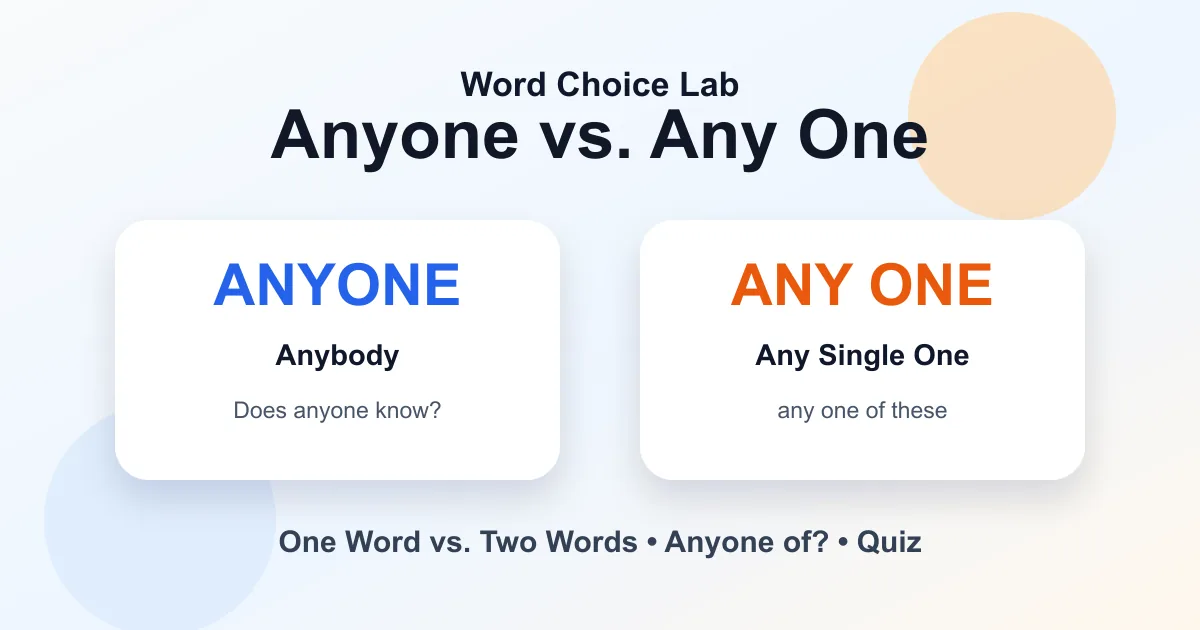
Anyone means “any person” or “anybody.” Any one means “any single one” from a group of people or things.
- Can anyone answer this question?
- You may choose any one of these books.
These forms look almost identical, but the spacing changes the meaning. If you mean any person, use anyone as one word. If you mean any single person or thing from a specific group, use any one as two words.
Anyone vs. any one at a glance
| Form | Meaning | Example |
|---|---|---|
| anyone | anybody; any person | Does anyone know the answer? |
| any one | any single one from a group | Pick any one of the cards. |
Quick rule:
- Anyone = any person.
- Any one = any single one.
- Use any one of when choosing from a group.
When to use anyone
Use anyone as an indefinite pronoun when you mean any person.
- Is anyone home?
- Anyone can join the class.
- I don’t know anyone at the party.
- Did anyone call while I was out?
Anyone is about people, not things. It usually means the same as anybody.
Examples:
- Anyone can make a mistake.
- I haven’t told anyone yet.
- Does anyone need help?
- She didn’t recognize anyone in the room.
If you can replace the word with anybody, use anyone.
When to use any one
Use any one when you mean any single one from a group.
- Choose any one of the options.
- Any one of these keys might open the door.
- You can borrow any one of my jackets.
- Any one of the players could win.
Any one can refer to people or things.
Examples with people:
- Any one of the students may answer.
- Any one of the candidates could be selected.
Examples with things:
- Any one of these chairs will work.
- You may take any one of the samples.
If the meaning is “any single one,” use two words.
The easiest memory trick
Use this test:
> If you can replace it with anybody, use anyone.
Example:
- Does anyone know? = Does anybody know?
Use this second test:
> If you can add of them after it, use any one.
Example:
- Choose any one. = Choose any one of them.
So:
- anyone = anybody
- any one = any single one
Anyone examples
Here are more sentences with anyone.
- Anyone is welcome to attend.
- I didn’t see anyone outside.
- Has anyone finished the assignment?
- You can ask anyone on the team.
- She hardly knew anyone in the city.
- Anyone can learn with enough practice.
In each sentence, anyone means any person or anybody.
Any one examples
Here are more sentences with any one.
- Any one of these answers could be correct.
- Take any one of the notebooks.
- Any one of the witnesses may be called.
- You can select any one of the colors.
- Any one of those roads will take you downtown.
- The coach said any one of the players could start.
In each sentence, any one means any single one from a group.
Anyone of or any one of?
The correct phrase is usually any one of.
Correct:
- Any one of these books is fine.
- Any one of the students can answer.
- Choose any one of the three options.
Incorrect in standard writing:
- Anyone of these books is fine.
Why? Because anyone means any person. It does not work naturally before of when you mean a single member of a group.
Anyone can or any one can?
Both can be correct, but they mean slightly different things.
Use anyone can when you mean any person in general.
- Anyone can learn to cook.
- Anyone can make a mistake.
Use any one can when you mean any single member of a specific group.
- Any one of these employees can help you.
- Any one of the three plans can work.
The difference is general person vs. one selected from a group.
Anyone else or any one else?
The normal phrase is anyone else.
Correct:
- Does anyone else have a question?
- I don’t know anyone else here.
- Ask anyone else on the team.
Any one else is uncommon and usually unnecessary. If you mean any other person, use anyone else.
Any one thing
Use any one when talking about one thing from many possible things.
- If I could change any one thing, I would change the deadline.
- Any one reason would be enough.
- We don’t depend on any one customer.
In these examples, one is important. The meaning is any single thing, reason, or customer.
Common mistakes
Mistake 1: Writing anyone of
Incorrect: Anyone of these answers might be correct.
Correct: Any one of these answers might be correct.
Mistake 2: Writing any one for anybody
Incorrect: Does any one know where my keys are?
Better: Does anyone know where my keys are?
Mistake 3: Writing anyone for a single item
Incorrect: Choose anyone of the colors.
Correct: Choose any one of the colors.
Mistake 4: Forgetting that anyone refers to people
Incorrect: You can use anyone of the tools.
Correct: You can use any one of the tools.
More example sentences
Anyone
- I don’t think anyone noticed.
- Anyone who wants to help may stay.
- Did anyone leave a message?
- She would not tell anyone the secret.
- Anyone could see that he was tired.
Any one
- Any one of these routes is safe.
- You can invite any one of your friends.
- Any one mistake could change the result.
- Select any one file from the folder.
- Any one of the judges may ask a question.
Quick quiz
Choose the correct form.
- Does ___ know the answer?
- Choose ___ of these pens.
- I don’t know ___ at this school.
- ___ of the players could score.
- Can ___ join the meeting?
Answers:
- anyone
- any one
- anyone
- Any one
- anyone
FAQ
What is the difference between anyone and any one?
Anyone means anybody or any person. Any one means any single one from a group.
Is it anyone of or any one of?
Use any one of. Example: Choose any one of the options.
Is anyone one word?
Yes. Anyone is one word when it means any person.
Can any one refer to things?
Yes. Any one can refer to people or things. Example: Take any one of these books.
Is anyone singular or plural?
Anyone is grammatically singular. Example: Anyone is welcome to join.
The same context-first habit also helps with A Lot vs. Alot and Altogether vs. All Together. For a wider set of examples in this topic, use the One Word or Two archive as the category grows.
Final tip
Use anyone when you mean anybody. Use any one when you mean any single one from a group.
Remember: anyone = anybody, any one = any single one.