
Altogether vs. All Together: Difference, Examples, and an Easy Rule
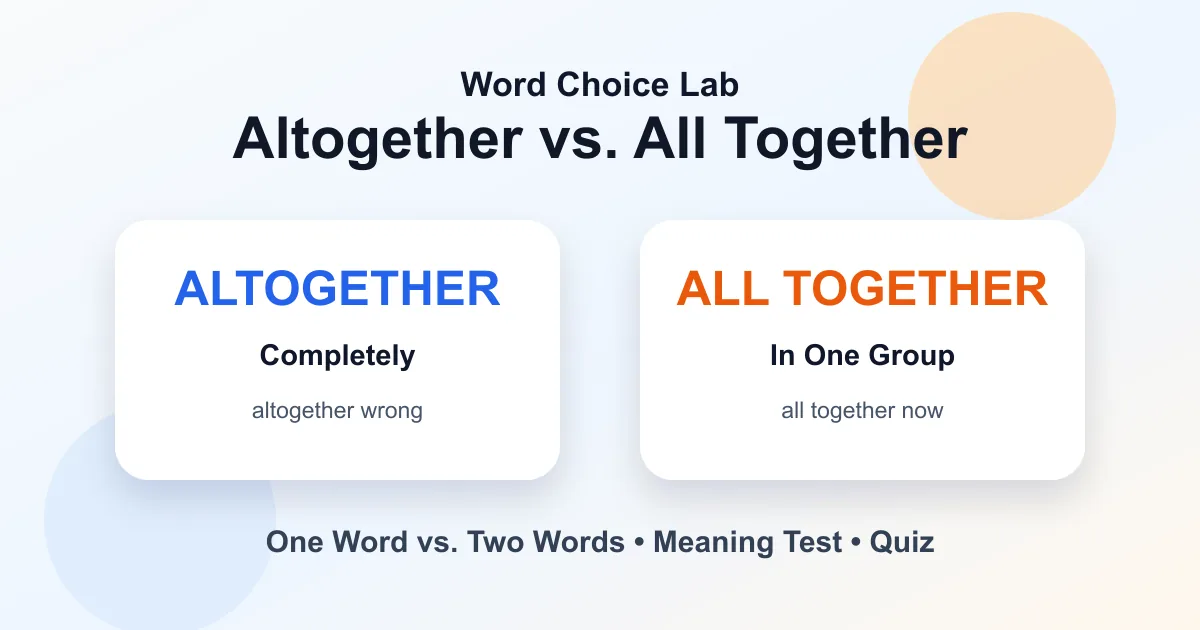
Altogether means completely, totally, or overall. All together means everyone or everything in one group, in one place, or at the same time.
- The plan is altogether too expensive.
- Let’s put the chairs all together in the corner.
These forms sound almost the same, but the spacing changes the meaning. If you mean completely or overall, use altogether as one word. If you mean all people or things together, use all together as two words.
Altogether vs. all together at a glance
| Form | Meaning | Example |
|---|---|---|
| altogether | completely, totally, overall | The answer is altogether wrong. |
| all together | everyone/everything in one group | The students stood all together. |
Quick rule:
- Altogether = completely or overall.
- All together = all in one group or place.
- If you can put a word between all and together, use two words.
When to use altogether
Use altogether as an adverb when you mean completely, entirely, totally, or when you are summarizing an overall idea.
- The movie was altogether too long.
- I am not altogether sure.
- The problem is altogether different.
- Altogether, the trip cost $900.
In these examples, altogether does not mean people or things are standing in a group. It means completely, entirely, or in total.
Common meanings of altogether include:
- completely
- entirely
- totally
- overall
- in total
- on the whole
If one of those replacements works, altogether is probably correct.
When to use all together
Use all together when you mean all people or things are together in the same place, group, time, or action.
- The children sang all together.
- Put the books all together on the shelf.
- We arrived all together at noon.
- The family sat all together at one table.
In these examples, all describes the people or things, and together describes how they are arranged or acting.
You can often add another word between all and together.
- The children sang all together.
- The children sang all of them together.
If that kind of expansion makes sense, use all together as two words.
The easiest memory trick
Use this test:
> If you can replace the phrase with completely, use altogether.
Example:
- The idea is altogether wrong.
- The idea is completely wrong.
Use this second test:
> If you can replace it with all in one group, use all together.
Example:
- The boxes are all together.
- The boxes are all in one group.
So:
- altogether = completely
- all together = all in one group
Altogether examples
Here are more sentences with altogether.
- The answer is altogether incorrect.
- I am not altogether convinced.
- The new design is altogether better.
- The cost was $250 altogether.
- Altogether, we had a successful week.
- This is an altogether different situation.
In each sentence, altogether means completely, in total, or overall.
All together examples
Here are more sentences with all together.
- The guests arrived all together.
- Keep the documents all together in one folder.
- The team practiced all together before the game.
- The students stood all together for the photo.
- We moved the tables all together to one side.
- The musicians played all together at the end.
In each sentence, all together means all people or things are together in one place, group, or action.
Not altogether sure or not all together sure?
The correct phrase is usually not altogether sure.
Correct:
- I’m not altogether sure what happened.
- She was not altogether happy with the result.
- We are not altogether convinced.
Incorrect:
- I’m not all together sure what happened.
Why? Because the meaning is “not completely sure,” not “all people together sure.”
All together now or altogether now?
The correct phrase is usually all together now when you are asking people to do something as a group.
Correct:
- Sing all together now.
- Everyone clap all together now.
- Let’s say it all together now.
Here the meaning is “everyone together,” so two words are correct.
Altogether too much or all together too much?
The correct phrase is altogether too much when you mean completely too much.
Correct:
- That is altogether too much work.
- The price is altogether too high.
- The explanation was altogether too complicated.
Incorrect:
- That is all together too much work.
Use one word because the meaning is “completely” or “entirely.”
All together in one place
The phrase all together is especially common when talking about people or objects being gathered in one place.
- Keep the receipts all together.
- Put the files all together in this folder.
- The family is finally all together again.
- The tools are all together in the garage.
If you are talking about a group, collection, or gathering, choose all together.
Altogether as a summary word
Altogether can also introduce a summary or total.
- Altogether, the event went well.
- Altogether, we sold 500 tickets.
- Altogether, the repairs cost $1,200.
- Altogether, it was a good decision.
In this use, altogether means “overall” or “in total.”
Common mistakes
Mistake 1: Using all together for completely
Incorrect: The answer is all together wrong.
Correct: The answer is altogether wrong.
Mistake 2: Using altogether for a group
Incorrect: The students stood altogether for the photo.
Correct: The students stood all together for the photo.
Mistake 3: Writing all together too expensive
Incorrect: The trip was all together too expensive.
Correct: The trip was altogether too expensive.
Mistake 4: Writing altogether in one place
Incorrect: Keep the files altogether in one drawer.
Correct: Keep the files all together in one drawer.
More example sentences
Altogether
- The plan is altogether unrealistic.
- I’m not altogether certain.
- The meal cost $80 altogether.
- Altogether, the results were encouraging.
- This version is altogether simpler than the old one.
All together
- The class answered all together.
- Put the pens all together in the box.
- The singers entered all together.
- We were all together for the holidays.
- The pieces fit all together in one bag.
Quick quiz
Choose the correct form.
- The idea is ___ wrong.
- The children stood ___ for the picture.
- ___, the repairs cost $600.
- Keep the receipts ___ in one folder.
- I’m not ___ sure about the answer.
Answers:
- altogether
- all together
- Altogether
- all together
- altogether
FAQ
What is the difference between altogether and all together?
Altogether means completely, totally, overall, or in total. All together means everyone or everything together in one group, place, or action.
Is it altogether wrong or all together wrong?
Use altogether wrong. It means completely wrong.
Is it all together now or altogether now?
Use all together now when you mean everyone should do something together.
Is it altogether too much or all together too much?
Use altogether too much. It means completely or entirely too much.
How can I remember the difference?
Replace altogether with completely. Replace all together with all in one group.
The same context-first habit also helps with Awhile vs. A While and Everyday vs. Every Day. For a wider set of examples in this topic, use the One Word or Two archive as the category grows.
Final tip
Use altogether for completely, overall, or in total. Use all together when people or things are gathered or acting as a group.
Remember: altogether = completely, all together = all in one group.