
Awhile vs. A While: Difference, Examples, and an Easy Rule
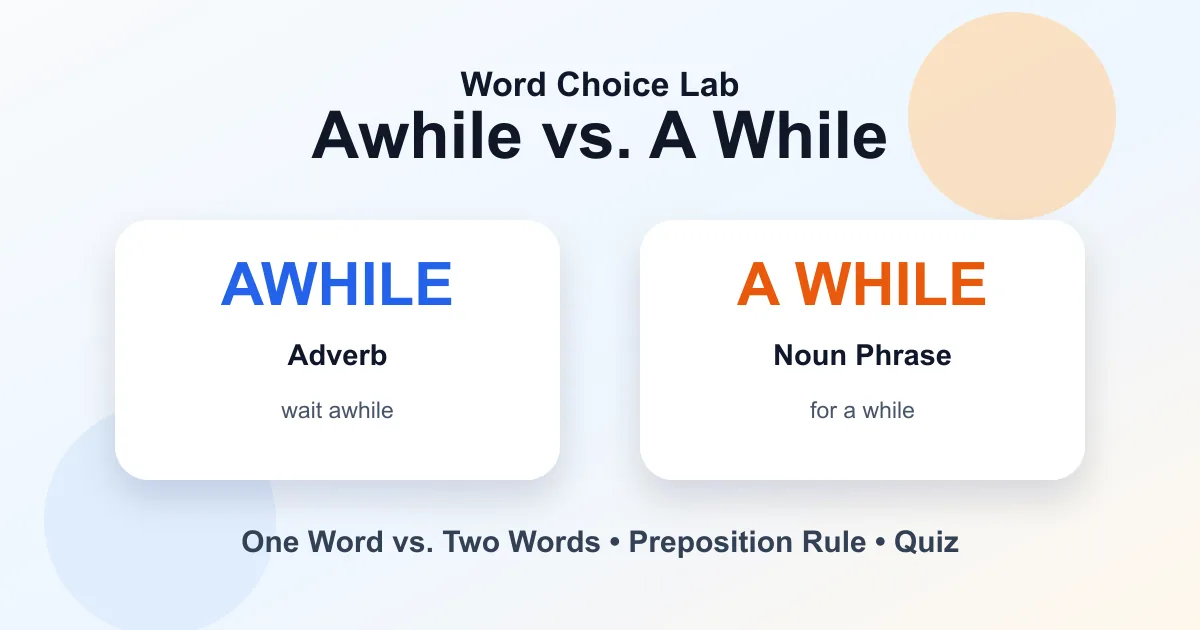
Awhile means “for a short time.” A while means “a period of time.”
- Stay awhile.
- Stay for a while.
The easiest rule is this: use awhile when it acts like an adverb. Use a while after a preposition such as for, in, or after.
Awhile vs. a while at a glance
| Form | Part of speech | Meaning | Example |
|---|---|---|---|
| awhile | adverb | for a short time | Please wait awhile. |
| a while | noun phrase | a period of time | Please wait for a while. |
Quick rule:
- Use awhile when it means for a while.
- Use a while after prepositions like for, in, after, and within.
- The phrase for a while is two words.
When to use awhile
Use awhile as an adverb meaning “for a short time” or “for some time.”
- Sit awhile and rest.
- We talked awhile after dinner.
- The children played awhile before bedtime.
- She stayed awhile after the meeting.
In these examples, awhile modifies the verb. It tells how long the action happened.
You can test it by replacing awhile with for a short time.
- Sit awhile. = Sit for a short time.
- We talked awhile. = We talked for a short time.
If that replacement works smoothly, awhile may be correct.
When to use a while
Use a while as a noun phrase meaning “a period of time.”
- It has been a while since we talked.
- We waited for a while.
- Come back in a while.
- After a while, the rain stopped.
A while is two words because while is a noun here, and a is the article before it.
Use a while after prepositions:
- for a while
- in a while
- after a while
- within a while
- once in a while
If a preposition comes before it, two words are usually the safe choice.
The easiest memory trick
Use this test:
> If you can replace it with “for a short time,” use awhile.
Example:
- Stay awhile. = Stay for a short time.
But if the sentence already has for, do not write for awhile.
Correct:
- Stay awhile.
- Stay for a while.
Incorrect in careful writing:
- Stay for awhile.
Why? Because awhile already includes the idea of for.
For awhile or for a while?
The standard phrase is for a while.
Correct:
- I waited for a while.
- She lived there for a while.
- We talked for a while after class.
Incorrect in careful writing:
- I waited for awhile.
Use two words after for because for needs a noun phrase as its object. A while is the noun phrase.
In awhile or in a while?
The standard phrase is in a while.
Correct:
- I’ll call you in a while.
- Dinner will be ready in a while.
- We haven’t seen them in a while.
Incorrect in careful writing:
- I’ll call you in awhile.
Again, in is a preposition, so use the two-word noun phrase a while.
Stay awhile or stay a while?
Both can be acceptable depending on grammar, but they work slightly differently.
Correct:
- Stay awhile.
- Stay for a while.
You may also see:
- Stay a while.
That sentence is common and understandable because a while can function like a time expression. But the clearest rule for learners is:
- no preposition: awhile often works
- after a preposition: a while
For SEO and learner-friendly writing, Stay awhile and Stay for a while are the cleanest examples.
Awhile examples
Here are more sentences with awhile.
- Rest awhile before you leave.
- The baby slept awhile in the stroller.
- We waited awhile before trying again.
- She paused awhile before answering.
- The guests remained awhile after dessert.
- Let the soup cool awhile before serving.
In each sentence, awhile means “for a short time.”
A while examples
Here are more sentences with a while.
- It has been a while since I visited.
- We stayed for a while and then left.
- Come back after a while.
- I will finish this in a while.
- Once in a while, we go hiking.
- The repair may take a while.
In each sentence, a while means “a period of time.”
A while ago or awhile ago?
The standard phrase is a while ago.
Correct:
- I saw him a while ago.
- She moved away a while ago.
- We discussed this a while ago.
Incorrect in careful writing:
- I saw him awhile ago.
Why? Because ago works with a noun phrase that names a period of time:
- a week ago
- a year ago
- a while ago
Once in a while or once in awhile?
The standard phrase is once in a while.
Correct:
- We eat out once in a while.
- Once in a while, I like to reread old letters.
Incorrect in careful writing:
- We eat out once in awhile.
Because in is a preposition, use a while as two words.
Common phrases with a while
These phrases usually use a while as two words:
- for a while
- in a while
- after a while
- a while ago
- once in a while
- quite a while
- a little while
- a long while
Examples:
- It may take quite a while.
- I’ll be back in a little while.
- We waited for a long while.
Common phrases with awhile
These phrases can use awhile as one word:
- stay awhile
- wait awhile
- rest awhile
- sit awhile
- sleep awhile
- pause awhile
Examples:
- Please wait awhile.
- Sit awhile and relax.
- Rest awhile before the next round.
Common mistakes
Mistake 1: Writing for awhile
Incorrect: We talked for awhile.
Correct: We talked for a while.
Mistake 2: Writing in awhile
Incorrect: I’ll call you in awhile.
Correct: I’ll call you in a while.
Mistake 3: Writing awhile ago
Incorrect: I saw her awhile ago.
Correct: I saw her a while ago.
Mistake 4: Thinking awhile and a while are always interchangeable
They are close in meaning, but grammar matters.
Correct:
- Wait awhile.
- Wait for a while.
More example sentences
Awhile
- The dog slept awhile by the door.
- We walked awhile before heading home.
- She listened awhile before speaking.
- The music played awhile in the background.
- Let the paint dry awhile before touching it.
A while
- It has been a while since lunch.
- The meeting lasted for a while.
- He returned after a while.
- We go there once in a while.
- This project may take a while to finish.
Quick quiz
Choose the correct form.
- Please wait ___.
- We talked for ___.
- I saw him ___ ago.
- Sit ___ and rest.
- I’ll call you in ___.
Answers:
- awhile
- a while
- a while
- awhile
- a while
FAQ
What is the difference between awhile and a while?
Awhile is an adverb meaning “for a short time.” A while is a noun phrase meaning “a period of time.”
Is it for awhile or for a while?
Use for a while. After the preposition for, use the two-word noun phrase.
Is it in awhile or in a while?
Use in a while. After the preposition in, use two words.
Is it awhile ago or a while ago?
Use a while ago.
Is stay awhile correct?
Yes. Stay awhile is correct because awhile means “for a short time.”
The same context-first habit also helps with Everyday vs. Every Day and Hole vs. Whole. For a wider set of examples in this topic, use the One Word or Two archive as the category grows.
Final tip
Use awhile when it means “for a short time.” Use a while after prepositions like for, in, and after.
Remember: wait awhile, but wait for a while.