
Bare vs. Bear: Difference, Examples, and an Easy Memory Trick
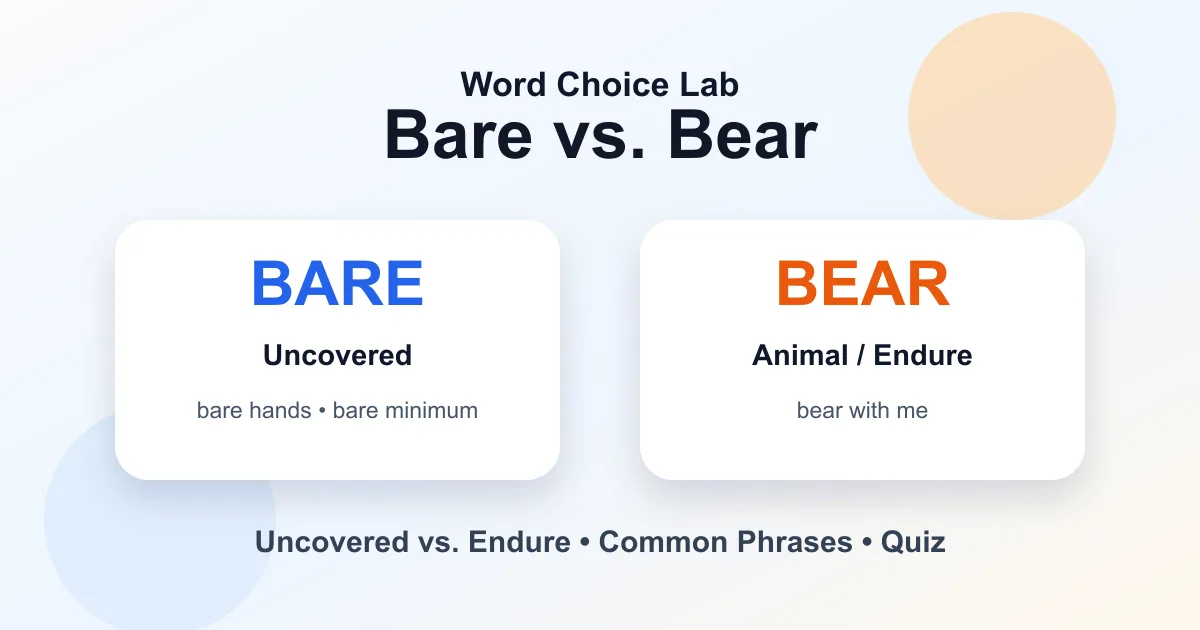
Bare means uncovered, exposed, empty, or minimal. Bear can mean a large animal, or it can mean to carry, support, tolerate, or endure.
- The room had bare walls.
- Please bear with me while I check the file.
These two words sound the same, so they are easy to mix up. But their meanings are very different. If you mean uncovered or empty, use bare. If you mean the animal or the idea of carrying or enduring something, use bear.
Bare vs. bear at a glance
| Word | Meaning | Example |
|---|---|---|
| bare | uncovered, exposed, empty, minimal | He walked on the bare floor. |
| bear | animal; carry; support; endure | I can’t bear the noise. |
Quick rule:
- Bare = uncovered or plain.
- Bear = animal or endure.
- The correct phrase is bear with me, not bare with me.
When to use bare
Use bare when something is uncovered, not decorated, not hidden, empty, or reduced to the minimum.
- The tree had bare branches.
- The room looked bare without furniture.
- He touched the hot pan with his bare hand.
- The report gives only the bare facts.
Bare is often an adjective, but it can also be a verb meaning to uncover or reveal.
As an adjective:
- bare feet
- bare walls
- bare skin
- bare minimum
- bare essentials
As a verb:
- The dog bared its teeth.
- She bared her feelings in the letter.
If the sentence is about something uncovered, plain, or exposed, bare is usually correct.
When to use bear
Use bear when you mean the animal or the verb meaning to carry, support, tolerate, or endure.
- We saw a bear near the river.
- The bridge can bear heavy traffic.
- I can’t bear the smell.
- She had to bear the cost herself.
Bear can be a noun or a verb.
As a noun:
- a black bear
- a polar bear
- a mother bear
As a verb:
- bear responsibility
- bear the weight
- bear the pain
- bear with someone
If the sentence is about an animal, carrying something, supporting something, or enduring something, use bear.
The easiest memory trick
Use this memory trick:
> A bear can bear weight.
Both the animal and the “carry/endure” verb are spelled bear.
For bare, think:
> Bare means almost nothing is there.
So:
- bare = uncovered, plain, empty, minimal
- bear = animal, carry, support, endure
Bear with me or bare with me?
The correct phrase is bear with me.
Correct:
- Please bear with me for a moment.
- Bear with me while I explain.
- Thanks for bearing with me during the delay.
Incorrect:
- Please bare with me.
Why? Because bear with me means “be patient with me” or “endure this with me.” It comes from the verb bear, meaning tolerate or endure.
Bare with me would sound like “get uncovered with me,” which is not what you mean in normal writing.
Bare examples
Here are more sentences with bare.
- She stepped onto the grass in bare feet.
- The apartment was almost bare when they moved in.
- The shelves were bare after the sale.
- He told the bare truth.
- The company kept only the bare minimum of staff.
- The winter trees looked bare against the sky.
In each sentence, bare means uncovered, empty, plain, or minimal.
Bear examples
Here are more sentences with bear.
- The hiker saw a bear in the woods.
- The table cannot bear that much weight.
- She could not bear another delay.
- Parents often bear many responsibilities.
- The document must bear the official seal.
- This decision may bear serious consequences.
In these sentences, bear means animal, support, tolerate, carry, show, or produce.
Bare minimum or bear minimum?
The correct phrase is bare minimum.
Correct:
- We brought the bare minimum of supplies.
- The plan covers only the bare minimum.
Incorrect:
- We brought the bear minimum.
Bare minimum means the least amount needed. It uses bare because it suggests something stripped down to almost nothing.
Bare hands or bear hands?
The correct phrase is bare hands.
Correct:
- He caught the ball with his bare hands.
- Do not touch the wire with bare hands.
Incorrect:
- He caught the ball with his bear hands.
Unless you are talking about the paws of an actual bear, use bare hands for uncovered hands.
Bear responsibility or bare responsibility?
The correct phrase is bear responsibility.
Correct:
- Leaders must bear responsibility for their decisions.
- The company will bear the cost of repairs.
Incorrect:
- Leaders must bare responsibility.
Here bear means carry or accept.
Bare vs. bear in common phrases
| Correct phrase | Meaning |
|---|---|
| bare feet | feet without shoes |
| bare hands | hands without gloves |
| bare minimum | the least amount needed |
| bare facts | basic facts only |
| bear with me | be patient with me |
| bear the cost | pay or carry the cost |
| bear responsibility | accept responsibility |
| bear fruit | produce results |
These phrases are useful because most mistakes happen in fixed expressions.
Common mistakes
Mistake 1: Writing bare with me
Incorrect: Please bare with me.
Correct: Please bear with me.
Mistake 2: Writing bear minimum
Incorrect: We need the bear minimum.
Correct: We need the bare minimum.
Mistake 3: Writing bear hands
Incorrect: She picked it up with her bear hands.
Correct: She picked it up with her bare hands.
Mistake 4: Writing bare the cost
Incorrect: The customer must bare the cost.
Correct: The customer must bear the cost.
More example sentences
Bare
- The walls were bare after the paintings were removed.
- The children ran outside in bare feet.
- The cupboard was completely bare.
- The article explains the bare essentials.
- She bared her arm for the injection.
Bear
- A bear crossed the trail.
- I cannot bear loud music in the morning.
- The roof can bear the weight of snow.
- This policy may bear little relation to reality.
- The trees will bear fruit in summer.
Quick quiz
Choose the correct word.
- Please ___ with me while I find the answer.
- The room had ___ walls.
- The bridge can ___ a heavy load.
- He walked outside in ___ feet.
- We saw a ___ near the campsite.
Answers:
- bear
- bare
- bear
- bare
- bear
FAQ
Is it bear with me or bare with me?
The correct phrase is bear with me. It means “be patient with me.”
Is it bare minimum or bear minimum?
The correct phrase is bare minimum. It means the least amount needed.
Does bare mean naked?
Yes, bare can mean uncovered or without clothing, but it can also mean empty, plain, or minimal.
Does bear only mean the animal?
No. Bear can also mean to carry, support, tolerate, produce, or show.
What is the difference in one sentence?
Bare means uncovered or minimal; bear means the animal or to carry, support, or endure.
The same context-first habit also helps with To vs. Too vs. Two and Its vs. It’s. For a wider set of examples in this topic, use the Homophones archive as the category grows.
Final tip
Use bare for something uncovered, empty, or minimal. Use bear for the animal or for carrying, supporting, or enduring something.
Remember: bear with me means “be patient with me.”