
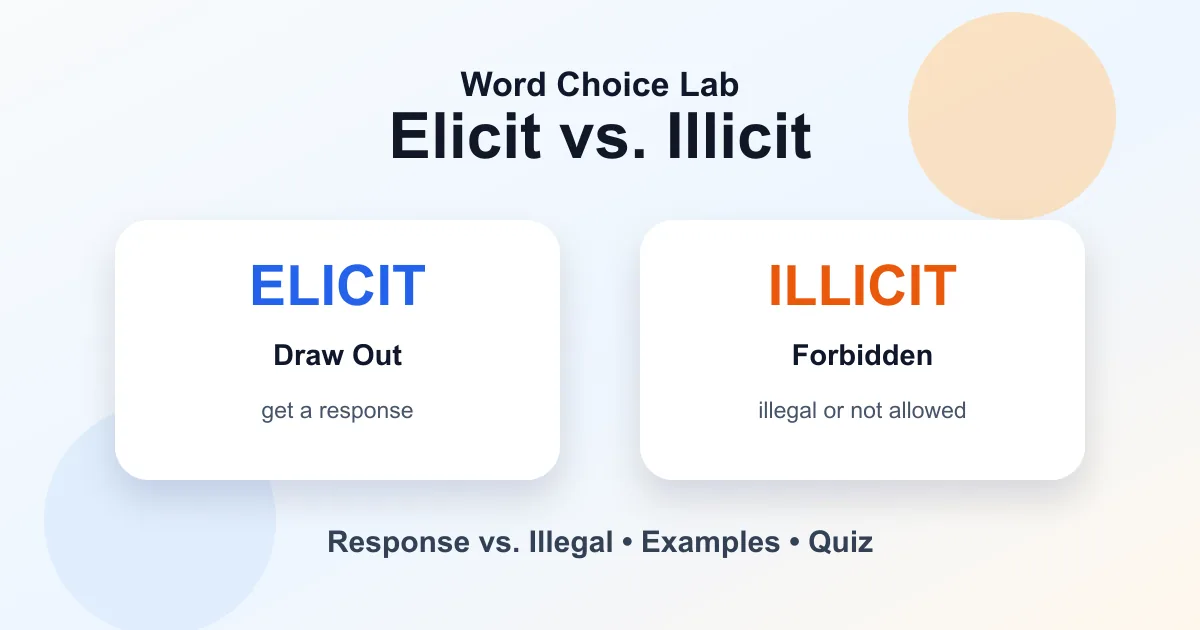
Elicit vs. Illicit: Difference, Examples, and an Easy Memory Trick
Elicit means to draw out, bring out, or get a response. Illicit means illegal, forbidden, or not allowed.
- The question may elicit an honest answer.
- The police investigated the illicit trade.
These words sound very similar, so they are easy to confuse. But they are completely different words. Elicit is usually a verb. Illicit is usually an adjective.
Elicit vs. illicit at a glance
| Word | Part of speech | Meaning | Example |
|---|---|---|---|
| elicit | verb | to draw out or get a response | The joke elicited laughter. |
| illicit | adjective | illegal or forbidden | They found illicit goods. |
Quick rule:
- Elicit = get a reaction, answer, or information.
- Illicit = illegal, forbidden, or improper.
- If you mean “bring out a response,” use elicit.
- If you mean “not allowed,” use illicit.
When to use elicit
Use elicit when someone or something brings out a response, reaction, answer, emotion, or piece of information.
- The teacher asked questions to elicit discussion.
- The survey was designed to elicit honest feedback.
- His comment elicited laughter from the audience.
- The interview may elicit new details.
Elicit is a verb. It describes an action.
Common things you can elicit include:
- a response
- an answer
- information
- feedback
- laughter
- sympathy
- emotion
- a reaction
If the sentence means “cause someone to respond” or “draw something out,” the correct word is elicit.
When to use illicit
Use illicit when something is illegal, forbidden, unauthorized, or socially unacceptable.
- The company denied any illicit activity.
- The border agents found illicit goods.
- The report described illicit financial transactions.
- The athlete was accused of using illicit substances.
Illicit is an adjective. It describes a noun.
Common phrases include:
- illicit drugs
- illicit trade
- illicit activity
- illicit goods
- illicit funds
- illicit relationship
- illicit behavior
If the sentence means “illegal” or “not allowed,” the correct word is illicit.
The easiest memory trick
Use this memory trick:
> Illicit starts like illegal.
Both illicit and illegal begin with il-, and both can mean not allowed by law or rules.
For elicit, think:
> Elicit means to extract a response.
Both elicit and extract begin with e.
So:
- elicit = extract or draw out a response
- illicit = illegal or forbidden
Elicit examples
Here are more sentences with elicit.
- The comedian’s story elicited a loud laugh.
- The detective tried to elicit a confession.
- The campaign was designed to elicit public support.
- Her speech elicited strong emotions.
- The question did not elicit a clear answer.
- The researcher used open-ended questions to elicit detailed responses.
In each sentence, elicit means bring out, draw out, or get.
Illicit examples
Here are more sentences with illicit.
- The government is trying to stop illicit trade.
- The investigation focused on illicit payments.
- The rules prohibit illicit substances.
- The officers seized illicit goods.
- The company found evidence of illicit activity.
- The article discussed the dangers of illicit drug use.
In each sentence, illicit means illegal, forbidden, or not permitted.
Elicit is usually followed by an object
Because elicit is a verb, it often needs an object: the thing being drawn out.
Correct:
- The question elicited a response.
- The evidence elicited surprise.
- The story elicited sympathy.
Less complete:
- The question elicited.
That sentence feels unfinished because readers expect to know what the question elicited.
Illicit usually describes a noun
Because illicit is an adjective, it usually comes before a noun or after a linking verb.
Before a noun:
- illicit trade
- illicit drugs
- illicit funds
- illicit activity
After a linking verb:
- The payment was illicit.
- The activity may be illicit.
If the word is describing a thing as illegal or forbidden, use illicit.
Elicit vs. solicit
Elicit and solicit can sometimes overlap, but they are not identical.
Elicit means to draw out a response, often through a question, action, or situation.
- The story elicited sympathy.
- The survey elicited useful feedback.
Solicit means to ask for something, often formally or directly.
- The charity solicited donations.
- The company solicited bids from contractors.
You can solicit feedback in order to elicit honest responses.
Illicit vs. illegal
Illicit and illegal are close, but illegal is usually more direct.
Illegal means against the law.
- The sale was illegal.
Illicit can mean illegal, but it can also suggest secrecy, wrongdoing, or social disapproval.
- The sale involved illicit goods.
- They had an illicit relationship.
In many cases, both words are possible, but illicit often sounds more formal or more associated with hidden activity.
Common mistakes
Mistake 1: Using illicit for “bring out”
Incorrect: The speech illicited applause.
Correct: The speech elicited applause.
Mistake 2: Using elicit for “illegal”
Incorrect: The police found elicit drugs.
Correct: The police found illicit drugs.
Mistake 3: Misspelling elicited
Incorrect: The joke illicited laughter.
Correct: The joke elicited laughter.
Mistake 4: Forgetting the part of speech
Elicit is a verb:
- The question elicited a response.
Illicit is an adjective:
- The response involved illicit activity.
More example sentences
Elicit
- The photo elicited memories of childhood.
- The manager asked questions to elicit suggestions.
- The news elicited concern from parents.
- His apology elicited a mixed reaction.
- The experiment was designed to elicit a measurable response.
Illicit
- The agency tracks illicit financial flows.
- The officers discovered illicit materials.
- The group was accused of illicit activity.
- The article examined the illicit market.
- The school has strict rules against illicit substances.
Quick quiz
Choose the correct word.
- The interview may ___ new information.
- The police investigated ___ trade.
- Her comment ___ laughter from the room.
- The athlete denied using ___ substances.
- The survey was designed to ___ honest feedback.
Answers:
- elicit
- illicit
- elicited
- illicit
- elicit
FAQ
What is the difference between elicit and illicit?
Elicit means to draw out or get a response. Illicit means illegal, forbidden, or not allowed.
Is elicit a verb?
Yes. Elicit is a verb. Example: The question elicited a response.
Is illicit a verb?
No. Illicit is usually an adjective. Example: The police found illicit goods.
Is it elicit or illicit drugs?
Use illicit drugs. That means illegal or forbidden drugs.
Is it elicit or illicit a response?
Use elicit a response. That means to draw out or get a response.
The same context-first habit also helps with Discreet vs. Discrete and Stationary vs. Stationery. For a wider set of examples in this topic, use the Commonly Confused Words archive as the category grows.
Final tip
Use elicit when something draws out a response. Use illicit when something is illegal, forbidden, or not allowed.
Remember: illicit starts like illegal.