
Active Voice vs. Passive Voice: Difference, Examples, and When to Use Each
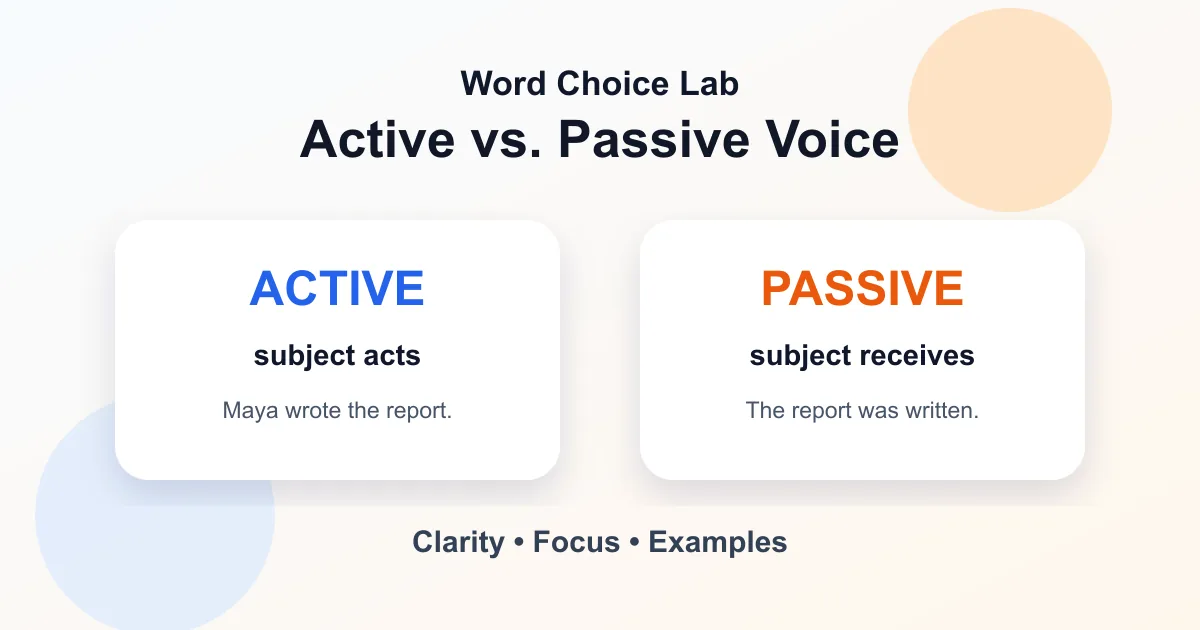
Use active voice when the subject does the action. Use passive voice when the subject receives the action.
- Active: The editor reviewed the article.
- Passive: The article was reviewed by the editor.
Active voice is usually clearer and more direct. Passive voice is useful when the action or receiver matters more than the person doing the action.
Active voice vs. passive voice at a glance
| Voice | Subject role | Pattern | Example |
|---|---|---|---|
| active voice | does the action | subject + verb + object | The team fixed the bug. |
| passive voice | receives the action | subject + be/get + past participle | The bug was fixed by the team. |
Quick test:
- If the subject performs the action, the sentence is active.
- If the subject receives the action, the sentence is passive.
What is active voice?
In active voice, the subject of the sentence performs the action.
- The dog chased the ball.
- Maria wrote the report.
- The storm damaged the roof.
- Our team launched the website.
These sentences are direct because the reader quickly sees who or what is doing the action.
Active voice pattern
The basic active pattern is:
doer + action + receiver
- The designer created the logo.
- The teacher explained the rule.
- The company changed the policy.
Active voice often makes writing shorter, stronger, and easier to read.
What is passive voice?
In passive voice, the subject receives the action. The person or thing doing the action may appear after by, or it may be left out.
- The ball was chased by the dog.
- The report was written by Maria.
- The roof was damaged by the storm.
- The website was launched last week.
The passive pattern often uses a form of be plus a past participle:
- is written
- was approved
- were chosen
- has been updated
- will be reviewed
How to identify passive voice
Look for this pattern:
form of be + past participle
Examples:
- The file was deleted.
- The rules were changed.
- The article has been edited.
- The application will be reviewed.
But be careful: not every sentence with be is passive.
- The file was large. = not passive
- The article was interesting. = not passive
Passive voice needs an action received by the subject.
How to change passive voice to active voice
To change passive to active:
- Find the doer of the action.
- Move the doer to the subject position.
- Change the verb to active form.
- Keep the receiver as the object.
Example:
- Passive: The article was edited by Maya.
- Active: Maya edited the article.
More examples:
- Passive: The window was broken by the ball.
- Active: The ball broke the window.
- Passive: The decision was made by the committee.
- Active: The committee made the decision.
- Passive: The email was sent by the manager.
- Active: The manager sent the email.
When active voice is better
Active voice is usually better when you want clear, direct writing.
- Active: We found three errors.
- Passive: Three errors were found by us.
- Active: The developer fixed the issue.
- Passive: The issue was fixed by the developer.
Active voice is especially useful in:
- instructions
- emails
- business writing
- blog posts
- explanations
- most everyday sentences
It helps readers understand who did what.
When passive voice is useful
Passive voice is not always wrong. It is useful when the doer is unknown, unimportant, obvious, or less important than the action.
When the doer is unknown
- My bike was stolen.
- The window was broken last night.
- The files were deleted.
You may not know who did the action.
When the doer is unimportant
- The road was repaired last week.
- The package was delivered yesterday.
- The form must be submitted by Friday.
The action matters more than the person who did it.
When the receiver is the focus
- The patient was treated immediately.
- The law was passed in 2024.
- The product was tested for safety.
In these examples, the focus is on the patient, law, or product.
In formal or scientific writing
Passive voice is common in scientific and technical writing when the process matters more than the researcher.
- The samples were heated for ten minutes.
- The results were recorded in a spreadsheet.
- The data were analyzed using the same method.
Active voice is often clearer, but passive voice can be appropriate in formal contexts.
Active or passive with “by”
Passive voice often includes a by phrase.
- The article was written by Sophia.
- The cake was made by my brother.
- The rule was explained by the teacher.
If the by phrase names the doer, you can often rewrite the sentence in active voice.
- Sophia wrote the article.
- My brother made the cake.
- The teacher explained the rule.
Common mistakes and corrections
Wordy passive: The report was written by me.
Better: I wrote the report.
Use active voice when the doer is known and important.
Weak passive: Mistakes were made.
Clearer: The team made mistakes.
Passive voice can hide responsibility. Use active voice when the reader needs to know who did the action.
Unnecessary passive: The meeting was scheduled by Sarah.
Better: Sarah scheduled the meeting.
Active voice is shorter and clearer.
Useful passive: The car was stolen.
Acceptable: The car was stolen.
Passive voice works because the thief is unknown or not the focus.
Useful passive: The form must be submitted by Friday.
Acceptable: The form must be submitted by Friday.
The instruction focuses on the required action, not the person giving the instruction.
Examples with active and passive voice together
- Active: The chef prepared the meal.
- Passive: The meal was prepared by the chef.
- Active: The company released a new app.
- Passive: A new app was released by the company.
- Active: Someone locked the door.
- Passive: The door was locked.
- Active: The teacher graded the exams.
- Passive: The exams were graded by the teacher.
The active version usually sounds more direct. The passive version shifts attention to the receiver of the action.
How to remember active and passive voice
Use this memory trick:
- active = the subject acts
- passive = the subject receives
Ask yourself:
- Who or what is doing the action?
- Is that doer the subject?
- If yes, the sentence is active. If no, it may be passive.
Quick quiz
Identify each sentence as active or passive.
- The manager approved the request.
- The request was approved by the manager.
- The website was updated yesterday.
- Our team updated the website.
- The storm damaged the roof.
- The roof was damaged in the storm.
- Maya wrote the introduction.
- The introduction was written by Maya.
Answers
- Active — manager does the action
- Passive — request receives the action
- Passive — website receives the action
- Active — team does the action
- Active — storm does the action
- Passive — roof receives the action
- Active — Maya does the action
- Passive — introduction receives the action
FAQ
What is the difference between active and passive voice?
In active voice, the subject does the action. In passive voice, the subject receives the action.
Is passive voice always wrong?
No. Passive voice is useful when the doer is unknown, unimportant, obvious, or less important than the action.
Why is active voice usually better?
Active voice is usually clearer, shorter, and more direct because it shows who does the action.
How do I know if a sentence is passive?
Look for a form of be plus a past participle, such as was written, were chosen, or has been updated. Then check whether the subject receives the action.
Can passive voice hide responsibility?
Yes. A sentence like “Mistakes were made” does not say who made the mistakes. Use active voice when responsibility matters.
Should I remove all passive voice from my writing?
No. Use active voice as your default, but keep passive voice when it makes the sentence clearer or puts the right idea in focus.
The same context-first habit also helps with Comma Before Because and A vs. An. For a wider set of examples in this topic, use the Grammar & Usage archive as the category grows.
Final tip
Use active voice when the doer matters. Use passive voice when the receiver, result, or action matters more.
Remember: active = subject acts; passive = subject receives.