
A vs. An: Difference, Examples, and the Vowel Sound Rule
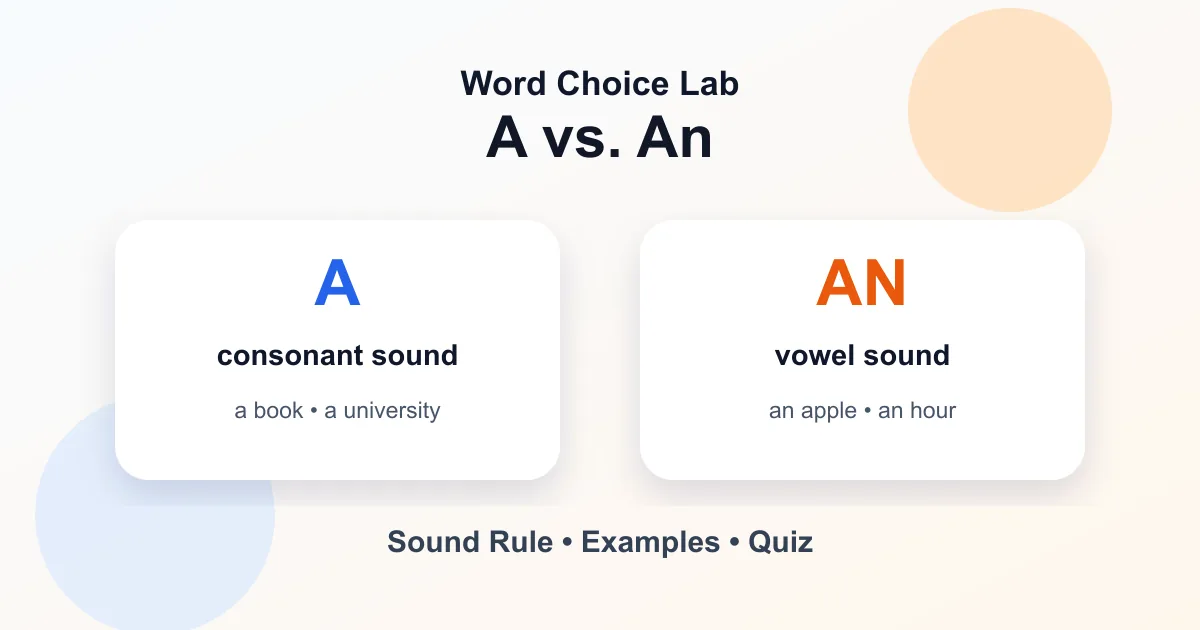
Use a before a consonant sound. Use an before a vowel sound.
- a book
- an apple
- a university
- an hour
The important word is sound. The rule is based on pronunciation, not just the first letter.
A vs. an at a glance
| Article | Use before | Example |
|---|---|---|
| a | consonant sound | a dog, a user, a one-time offer |
| an | vowel sound | an egg, an hour, an MBA |
Quick test:
- Say the next word out loud.
- If it starts with a consonant sound, use a.
- If it starts with a vowel sound, use an.
When to use a
Use a before words that begin with a consonant sound.
- a car
- a teacher
- a book
- a problem
- a good idea
These examples are simple because the first letter and first sound are both consonants.
A before words that start with vowel letters
Some words begin with a vowel letter but a consonant sound. Use a before these words.
- a university
- a user
- a useful tool
- a European city
- a one-time offer
Why? Because these words begin with sounds like y or w:
- university sounds like “yoo-niversity”
- user sounds like “yoo-zer”
- one sounds like “won”
So the correct article is a, not an.
When to use an
Use an before words that begin with a vowel sound.
- an apple
- an idea
- an email
- an old car
- an interesting question
These examples are simple because the first letter and first sound are both vowels.
An before silent h
Use an before words that begin with a silent h.
- an hour
- an honest answer
- an honor
- an heir
The h is not pronounced, so the word begins with a vowel sound.
A or an before acronyms and abbreviations?
Use the article that matches the way the abbreviation is pronounced.
- an FBI agent
- an MBA program
- an IRS form
- a NASA scientist
- a URL
- a USB cable
The key is pronunciation:
- FBI starts with “eff” → vowel sound → an
- MBA starts with “em” → vowel sound → an
- NASA is pronounced as a word beginning with an n sound → a
- USB starts with “you” → consonant y sound → a
A or an before h words?
It depends on whether the h is pronounced.
Use an with silent h:
- an hour
- an honest mistake
- an honorable person
Use a with pronounced h:
- a house
- a hotel
- a history lesson
- a helpful guide
Some people say an historic, especially in older or formal styles. In modern American English, a historic is usually the natural choice because the h is pronounced.
A or an before university?
Use a university, not an university.
- Correct: She attends a university in California.
- Incorrect: She attends an university in California.
The word university begins with a yoo sound, which acts like a consonant sound.
A or an before hour?
Use an hour, not a hour.
- Correct: The meeting lasted an hour.
- Incorrect: The meeting lasted a hour.
The h in hour is silent, so the word starts with a vowel sound.
A or an before one?
Use a one-time, a one-year, and a one-person because one starts with a w sound.
- a one-time payment
- a one-year plan
- a one-person business
Even though one starts with the letter o, it sounds like won.
A or an before words with adjectives?
Choose a or an based on the sound of the next word, even if the noun comes later.
- a red apple
- an old red apple
- a useful example
- an unusual example
The article agrees with the sound immediately after it:
- a red…
- an old…
- a useful…
- an unusual…
A or an before job titles and descriptions?
Use a or an before singular countable job titles, roles, and descriptions based on the first sound.
- She is a teacher.
- He is an engineer.
- Maya is a university professor.
- Carlos is an honest manager.
- I spoke with an HR specialist.
This rule is useful because job titles often appear after be verbs such as is, are, was, and become.
The same sound rule still applies:
- a teacher = consonant sound
- an engineer = vowel sound
- an HR specialist = “aitch” begins with a vowel sound
- a history teacher = pronounced h
A, an, or the?
Use a or an when talking about one nonspecific person or thing. Use the when the listener or reader knows exactly which one you mean.
- I need a pen. = any pen
- I need the pen on your desk. = a specific pen
- She bought an umbrella. = one umbrella, not specified before
- She opened the umbrella. = the one already mentioned
This article focuses on a vs. an, but remembering the difference between a/an and the helps you choose the right article in real sentences.
Common mistakes and corrections
Incorrect: an university
Correct: a university
Use a because university starts with a yoo sound.
Incorrect: a hour
Correct: an hour
Use an because the h is silent.
Incorrect: an one-time fee
Correct: a one-time fee
Use a because one starts with a w sound.
Incorrect: a honest mistake
Correct: an honest mistake
Use an because the h is silent.
Incorrect: a MBA
Correct: an MBA
Use an because MBA starts with an em sound.
Examples with a and an together
- She had a useful idea and an interesting question.
- He waited an hour for a university shuttle.
- We need a URL, an email address, and an ID number.
- This is a one-time offer for an online course.
- She made an honest mistake on a history exam.
These examples show the main rule: listen to the sound after the article.
How to remember a and an
Use this simple rule:
- a before consonant sounds
- an before vowel sounds
Do not trust the first letter alone. Say the word out loud.
Quick quiz
Choose a or an.
- ___ apple
- ___ university
- ___ hour
- ___ useful tool
- ___ honest answer
- ___ one-year plan
- ___ MBA student
- ___ hotel room
Answers
- an — vowel sound
- a — “yoo” sound
- an — silent h
- a — “yoo” sound
- an — silent h
- a — “w” sound
- an — “em” sound
- a — pronounced h
FAQ
What is the difference between a and an?
Use a before consonant sounds and an before vowel sounds.
Is it a university or an university?
Use a university because university starts with a yoo sound.
Is it a hour or an hour?
Use an hour because the h is silent.
Is it a honest mistake or an honest mistake?
Use an honest mistake because honest starts with a vowel sound.
Is it a MBA or an MBA?
Use an MBA because the abbreviation begins with an em sound.
Does a or an depend on spelling?
No. It depends on sound, not spelling.
The same context-first habit also helps with Who’s vs. Whose and Can vs. May. For a wider set of examples in this topic, use the Grammar & Usage archive as the category grows.
Final tip
Choose a or an by pronunciation. If the next sound is a consonant sound, use a. If the next sound is a vowel sound, use an.
Remember: sound first, spelling second.