
Like vs. As: Difference, Examples, and an Easy Rule
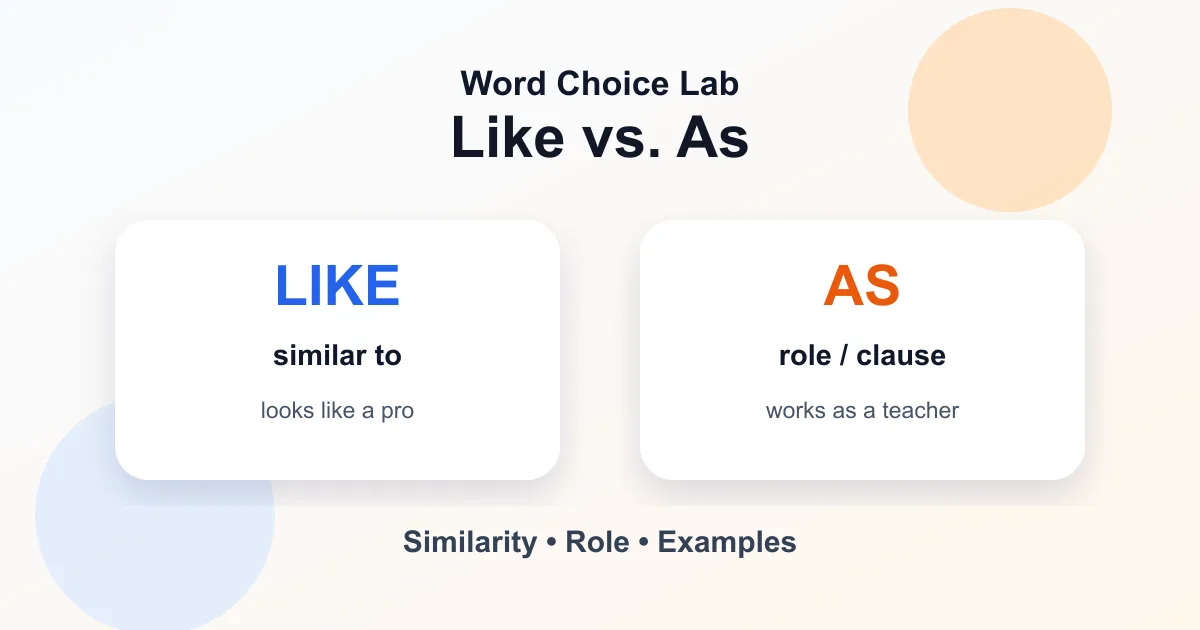
Use like before a noun or pronoun to compare similarity. Use as before a clause, or when you mean in the role of.
- She sings like a professional.
- She sings as a professional does.
- He works as a teacher.
The easiest rule is: like + noun/pronoun; as + clause or role.
Like vs. as at a glance
| Word | Main use | Simple meaning | Example |
|---|---|---|---|
| like | comparison with a noun or pronoun | similar to | This tastes like lemon. |
| as | role, function, or comparison with a clause | in the role of; in the way that | She works as a designer. |
Quick test:
- If the next words are a noun or pronoun, like is often natural.
- If the next words include a subject and verb, as is usually better in careful writing.
- If you mean someone’s job, role, or function, use as.
When to use like
Use like to compare one thing with another. It often means similar to.
- This blanket feels like wool.
- The baby looks like her mother.
- He runs like an athlete.
- The idea sounds like a good plan.
In these examples, like is followed by a noun or noun phrase: wool, her mother, an athlete, and a good plan.
Like before a noun or pronoun
Like is common before nouns and pronouns.
- someone like you
- a city like Chicago
- a problem like this
- a writer like her
- a tool like this one
Example: A clear example like this can make the rule easier.
Like meaning similar to
Use like when you are describing similarity, appearance, sound, taste, smell, or behavior.
- The room smells like fresh paint.
- That cloud looks like a rabbit.
- This sauce tastes like garlic.
- The engine sounds like it needs repair.
In informal English, people often use like before a clause: “It sounds like it needs repair.” This is common and widely accepted in conversation. In formal writing, as if may be more traditional: “It sounds as if it needs repair.”
When to use as
Use as for roles, functions, jobs, and comparisons that include a subject and verb.
As meaning “in the role of”
Use as when someone or something has a role, job, or function.
- She works as a nurse.
- He served as team captain.
- Use this box as a seat.
- I’m speaking as your friend.
Here, as does not mean “similar to.” It means the person or thing actually has that role or function.
As before a clause
Use as when the comparison includes a subject and verb.
- Do as I say.
- The results changed as we expected.
- She completed the form as the instructions explained.
- The system works as it should.
In these examples, the words after as form a clause: I say, we expected, the instructions explained, and it should.
As meaning “while” or “when”
As can also mean while or when.
- As I was leaving, the phone rang.
- The crowd cheered as the team entered.
- As the day went on, the weather improved.
Like does not normally have this time meaning in standard writing.
Like or as for comparisons?
Use like for a simple comparison before a noun.
- She dances like a professional.
- This feels like silk.
Use as when the comparison has a clause.
- She dances as a professional dancer would.
- This works as we hoped.
In casual speech, you may hear:
- She dances like a professional dancer would.
This is common in conversation, but as is often preferred in formal writing before a full clause.
As if and as though
Use as if or as though before a clause when comparing an appearance, sound, or situation.
- He looks as if he hasn’t slept.
- She acted as though nothing had happened.
- It sounds as if the machine is broken.
- They talked as though they had already decided.
In everyday speech, many people would say:
- He looks like he hasn’t slept.
That is common in informal English. For formal writing, as if or as though is usually safer.
Like or as a teacher?
The difference can change the meaning.
- She talks like a teacher.
- She works as a teacher.
Like a teacher means her way of talking is similar to a teacher’s style. As a teacher means her role or job is teacher.
More examples:
- He fought like a soldier. = in a soldier-like way
- He served as a soldier. = his role was soldier
- Use it like a hammer. = in a similar way to a hammer
- Use it as a hammer. = let it function as a hammer
Such as or like?
Use such as to introduce examples, especially in formal writing.
- Many cities, such as Boston and Seattle, have strong public libraries.
- Tools such as spell checkers can help writers.
Like can also introduce examples in casual or general writing.
- Cities like Boston and Seattle have strong public libraries.
Both are common. Such as is more precise when you are clearly giving examples.
Common mistakes and corrections
Incorrect: Do like I told you.
Correct: Do as I told you.
Use as before a clause with a subject and verb.
Incorrect: She works like a lawyer.
Correct if it is her job: She works as a lawyer.
Use as for a role or profession. Use like only if she is not a lawyer but works in a similar way.
Incorrect: Use this towel like a blanket.
Better if it functions as a blanket: Use this towel as a blanket.
Use as when something has the function or role of another thing.
Incorrect: The plan changed like we expected.
Better in careful writing: The plan changed as we expected.
Use as before a clause.
Incorrect: He looks as his brother.
Correct: He looks like his brother.
Use like before a noun or pronoun.
Examples with like and as together
- She speaks like an expert because she works as a consultant.
- This tool works as a scanner, but it looks like a small camera.
- He acted like a leader and later served as team captain.
- The software performed as expected and felt like a major improvement.
- Use this example as a guide, not like a rule that applies everywhere.
These examples show the main contrast: like compares similarity; as shows role, function, or a clause-based comparison.
How to remember like and as
Use this memory trick:
- like = similar to
- as = in the role of or in the way that
Ask yourself:
- Is it just a comparison before a noun? Use like.
- Is it a job, role, function, or clause? Use as.
Quick quiz
Choose like or as.
- This tastes ___ honey.
- She works ___ a project manager.
- Do ___ I said.
- He looks ___ his father.
- Use this folder ___ a temporary file.
- The results were ___ we predicted.
- It sounds ___ a good idea.
- She acted ___ nothing was wrong.
Answers
- like — similarity before a noun
- as — job or role
- as — before a clause
- like — comparison before a noun/pronoun
- as — function
- as — before a clause
- like — informal/common before a noun phrase
- as if or as though — clearer before a clause
FAQ
What is the difference between like and as?
Like usually means similar to and is often followed by a noun or pronoun. As is used for roles, functions, or comparisons with a clause.
Is it “like I said” or “as I said”?
In formal writing, use as I said. In casual conversation, like I said is very common.
Is it “works like a teacher” or “works as a teacher”?
Use works as a teacher if teaching is the person’s job. Use works like a teacher only if the person works in a teacher-like way.
Can like be used before a clause?
Yes, it is common in informal English. In formal writing, as, as if, or as though is often preferred before a full clause.
Is such as better than like?
Use such as when clearly introducing examples in formal writing. Like is also common, especially in general or casual writing.
Is “as if” the same as “like”?
Sometimes. As if is often more formal and clearer before a clause: “It looks as if it will rain.” In casual speech, many people say, “It looks like it will rain.”
The same context-first habit also helps with Since vs. Because and May vs. Might. For a wider set of examples in this topic, use the Similar Words archive as the category grows.
Final tip
Use like for similarity. Use as for roles, functions, and clause-based comparisons.
Remember: like = similar to, as = in the role of / in the way that.