
Since vs. Because: Difference, Examples, and an Easy Rule
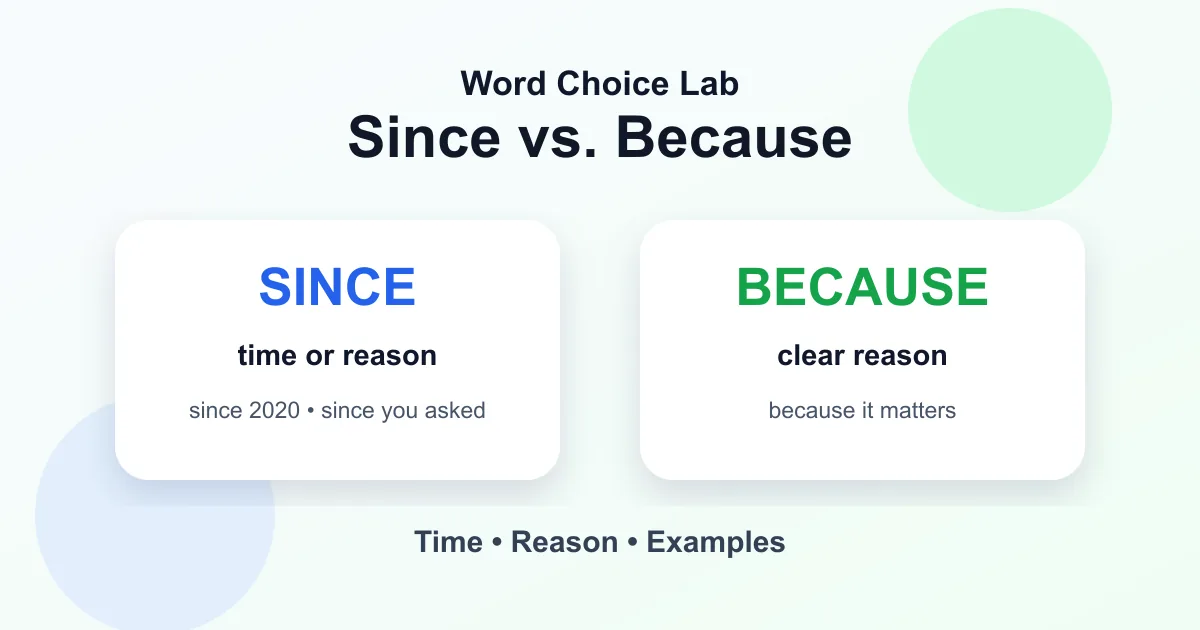
Use because when you want to give a clear reason. Use since when you mean from a time in the past until now or when the reason is already known or less emphasized.
- I stayed home because I was sick.
- I have lived here since 2020.
- Since you already know the answer, I will explain the next step.
The easiest rule is: because = clear reason; since = time or softer reason.
Since vs. because at a glance
| Word | Main use | Simple meaning | Example |
|---|---|---|---|
| since | time or reason | from a past time; because | I have worked here since May. |
| because | reason or cause | for the reason that | I left early because I felt tired. |
Quick test:
- If the sentence answers why? clearly and directly, because is usually best.
- If the sentence means from that time until now, use since.
- If the reason is background information, since can work.
When to use because
Use because to explain a reason, cause, or motive. It gives a direct answer to the question why?
- I brought an umbrella because it might rain.
- She missed the meeting because her train was late.
- We changed the title because the old one was confusing.
- He apologized because he made a mistake.
In each sentence, because clearly introduces the reason.
Because for strong cause-and-effect
Use because when you want the cause to be clear and important.
- The page loaded slowly because the image file was too large.
- The team won because they practiced every day.
- I chose this example because it is easy to understand.
- The road was closed because of construction.
If the reason is the main point of the sentence, because is usually stronger than since.
Because of
Use because of before a noun or noun phrase.
- The flight was delayed because of bad weather.
- She stayed home because of a headache.
- The event was canceled because of low attendance.
Use because before a full clause with a subject and verb.
- The flight was delayed because the weather was bad.
- She stayed home because she had a headache.
When to use since
Since has two common meanings: time and reason.
Since for time
Use since when something started in the past and continues to a later time, often now.
- I have lived in Dallas since 2021.
- She has worked at the company since January.
- We have not spoken since the conference.
- He has been interested in English since high school.
This use of since answers since when?
Since with the present perfect
When since refers to time, it often appears with the present perfect tense.
- I have known her since college.
- They have lived here since last summer.
- The website has grown steadily since launch.
The present perfect connects the past starting point to the present.
Since for reason
Use since to give a reason when the reason is already known, obvious, or less emphasized than the result.
- Since you are already here, let’s begin.
- Since the file is large, it may take a minute to upload.
- Since we have extra time, we can review the examples.
- Since the rule is confusing, a few examples will help.
In these sentences, since means something close to because, but it often feels softer or more like background information.
Because or since for a reason?
Both can introduce a reason.
- I stayed home because I was sick.
- I stayed home since I was sick.
Both sentences are understandable. The difference is emphasis:
- because strongly answers why
- since gives a reason more indirectly or as background
For the clearest reason, choose because.
Avoid ambiguity with since
Because since can mean time or reason, it can sometimes create confusion.
- Ambiguous: Since I called you, I felt better.
This could mean:
- After the time when I called you, I felt better.
- Because I called you, I felt better.
If the meaning is reason, because is clearer:
- Because I called you, I felt better.
If the meaning is time, rewrite the sentence:
- After I called you, I felt better.
Since when or because when?
Use since when to ask about the starting time of a situation.
- Since when have you lived here?
- Since when do you drink coffee?
- Since when has this rule existed?
Do not use because when in this way.
Since then or because then?
Use since then to mean from that time until now or until a later time.
- We moved in 2020, and we have lived here since then.
- She started practicing daily and has improved since then.
Because then can be correct only when because introduces a reason and then means at that time or in that case.
- We left early because then we could avoid traffic.
That structure is less common. Most learners need since then.
Because vs. since at the beginning of a sentence
Both because and since can begin a sentence.
- Because the road was closed, we took a different route.
- Since the road was closed, we took a different route.
Use a comma after the opening reason clause.
- Because it was late, we went home.
- Since it was late, we went home.
If you want the reason to be strong and unmistakable, choose because.
Common mistakes and corrections
Incorrect: I have lived here because 2020.
Correct: I have lived here since 2020.
Use since for a starting time.
Incorrect: I left early since I had a doctor’s appointment.
Better: I left early because I had a doctor’s appointment.
Use because when the reason is the main point.
Incorrect: Because last year, I have studied English.
Correct: I have studied English since last year.
Use since with a past starting point.
Incorrect: The game was canceled because of it rained.
Correct: The game was canceled because it rained.
Use because before a full clause.
Incorrect: Since I called, the meeting was canceled.
Clearer for reason: Because I called, the meeting was canceled.
Use because if since could be mistaken for time.
Examples with since and because together
- I have known her since college because we joined the same study group.
- Since the rule is common, we explain it carefully because learners often confuse it.
- The site has grown since launch because the articles answer specific questions.
- Since you asked for examples, I added more sentences because examples make the rule easier.
- I have used this method since high school because it works.
These examples show the core difference: since can point to time or background reason, while because gives a direct reason.
How to remember since and because
Use this memory trick:
- since often answers since when?
- because answers why?
If the sentence needs the clearest reason, use because. If the sentence points to a starting time, use since.
Quick quiz
Choose since or because.
- I have worked here ___ 2022.
- We stayed inside ___ it was raining.
- ___ you already finished, you can leave early.
- She has not called ___ Monday.
- The app crashed ___ the file was too large.
- I have liked grammar ___ I was a kid.
- ___ the answer is unclear, we need another example.
- The flight was delayed ___ of bad weather.
Answers
- since — starting time
- because — clear reason
- Since — background reason
- since — starting time
- because — clear reason
- since — starting time
- Since — background reason
- because — phrase “because of”
FAQ
What is the difference between since and because?
Because gives a clear reason. Since can refer to time or give a softer/background reason.
Can since mean because?
Yes. Since can mean because, especially when the reason is already known or not the main emphasis.
Is because clearer than since?
Often, yes. If your sentence could be misunderstood, use because for a reason and since for time.
Is it “since 2020” or “because 2020”?
Use since 2020. Since introduces a starting time.
Can a sentence start with because?
Yes. A sentence can start with because if it has a complete main clause: “Because it rained, we stayed home.”
Is it because of or since of?
Use because of before a noun phrase. Since of is not standard English.
The same context-first habit also helps with May vs. Might and Less vs. Fewer. For a wider set of examples in this topic, use the Similar Words archive as the category grows.
Final tip
Use because when you want to answer why clearly. Use since when you mean from a past time until now, or when the reason is background information.
Remember: because = why, since = since when or softer why.