
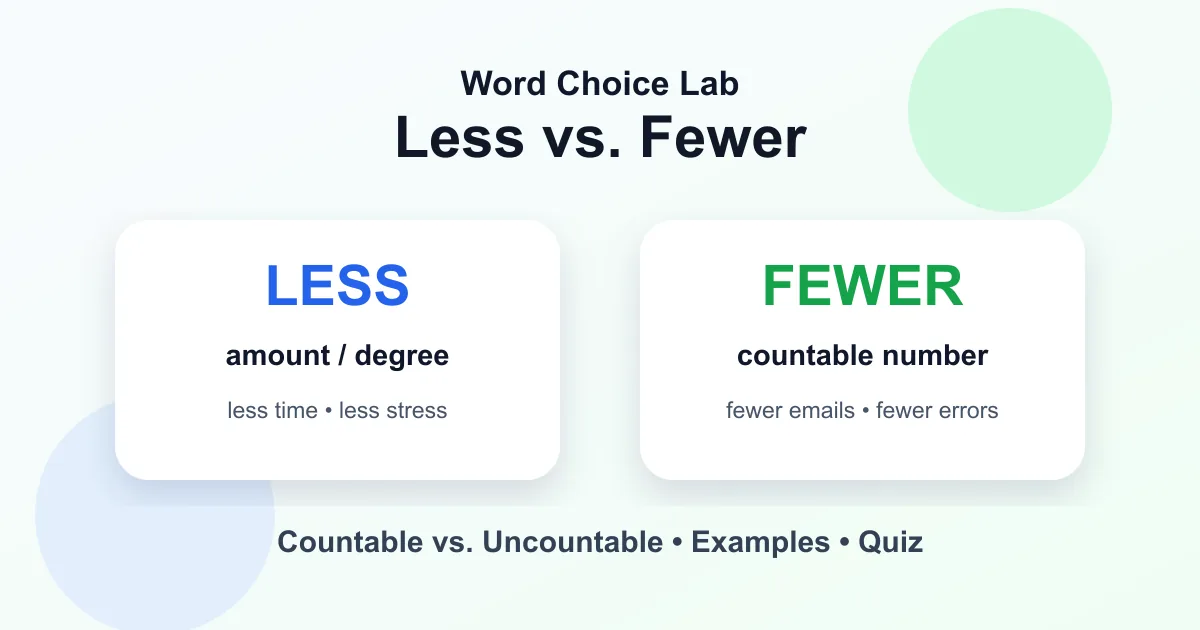
Less vs. Fewer: Difference, Examples, and an Easy Rule
Use fewer with things you can count one by one. Use less with things you measure as an amount, degree, or mass.
- We received fewer emails today.
- We had less time to answer them.
The easy rule is: fewer = countable number; less = uncountable amount.
Less vs. fewer at a glance
| Word | Use with | Meaning | Example |
|---|---|---|---|
| fewer | countable plural nouns | a smaller number | We need fewer meetings. |
| less | uncountable nouns or amounts | a smaller amount or degree | We need less stress. |
Quick test:
- Can you count the items one by one? Use fewer.
- Is it an amount, mass, quality, or degree? Use less.
When to use fewer
Use fewer with countable plural nouns. These are things you can count as individual units.
- There were fewer people at the event this year.
- I made fewer mistakes on the second test.
- The new process requires fewer steps.
- We bought fewer tickets than expected.
In each sentence, you can count the noun: people, mistakes, steps, and tickets.
Fewer with plural nouns
Fewer usually appears before plural nouns.
- fewer cars
- fewer books
- fewer questions
- fewer problems
- fewer examples
- fewer students
Example: The shorter form has fewer fields to complete.
Fewer than
Use fewer than before a countable plural noun or a countable number.
- Fewer than 20 people attended.
- The article has fewer than five headings.
- We received fewer than ten complaints.
- The team finished the task in fewer than three days.
If the noun can be counted individually, fewer than is the careful choice.
When to use less
Use less with uncountable nouns, abstract ideas, qualities, and general amounts.
- We have less time than we thought.
- This version uses less energy.
- She felt less pressure after the meeting.
- The new app creates less confusion.
In these examples, the noun is not normally counted one by one.
Less with uncountable nouns
Common uncountable nouns that use less include:
- less water
- less money
- less time
- less information
- less traffic
- less noise
- less stress
- less furniture
Example: The new schedule gives us less time between meetings.
Less with adjectives and adverbs
Use less before adjectives or adverbs to mean a lower degree.
- This route is less expensive.
- The second explanation was less confusing.
- Please speak less quickly.
- The room felt less crowded after lunch.
You cannot use fewer before an adjective in this way.
Less than or fewer than?
Use fewer than with countable plural nouns.
- Fewer than 50 students applied.
- We found fewer than six errors.
Use less than with amounts, measurements, money, time, distance, and percentages.
- The repair cost less than $100.
- The walk took less than 10 minutes.
- The package weighs less than five pounds.
- Less than 20% of respondents agreed.
This is why you often see less than before numbers. The number may represent a measurement or amount, not a countable group of items.
Common exceptions and tricky cases
The basic rule is useful, but English has a few common patterns where less is normal before numbers.
Less with money
Use less for money amounts.
- The meal cost less than $20.
- I have less money this month.
Even though dollars can be counted, the phrase usually treats money as an amount.
Less with time
Use less for periods of time when the sentence treats time as an amount.
- The drive took less than an hour.
- We have less time than before.
But use fewer when counting individual units as items:
- I worked fewer hours this week.
- The month has fewer workdays than usual.
Less with distance and weight
Use less for measurements.
- The school is less than two miles away.
- The suitcase weighs less than 30 pounds.
These are measured amounts, not separate countable objects.
Ten items or less
You may see signs like 10 items or less in stores. In strict grammar, 10 items or fewer is more precise because items are countable.
- Careful: 10 items or fewer
- Common store sign: 10 items or less
Both are widely understood, but fewer is the safer choice in edited writing.
Common mistakes and corrections
Incorrect: We need less meetings.
Correct: We need fewer meetings.
Use fewer because meetings are countable.
Incorrect: I have fewer time today.
Correct: I have less time today.
Use less because time is treated as an amount.
Incorrect: The report has less errors now.
Correct: The report has fewer errors now.
Use fewer because errors can be counted.
Incorrect: She drinks fewer water than before.
Correct: She drinks less water than before.
Use less because water is an uncountable noun.
Incorrect: There were less people in line.
Correct: There were fewer people in line.
Use fewer because people can be counted individually.
Examples with less and fewer together
- We had fewer tasks but less time.
- The new design has fewer buttons and creates less confusion.
- She made fewer mistakes because she felt less pressure.
- The team used less paper and printed fewer copies.
- There were fewer cars on the road, so there was less traffic.
These examples show the main contrast: fewer counts items; less measures amount or degree.
How to remember less and fewer
Use this simple memory trick:
- fewer = countable things
- less = amount or degree
Ask yourself: can I put a number directly before the noun?
- three meetings → fewer meetings
- three times? Usually no, when talking about the amount of time → less time
Quick quiz
Choose less or fewer.
- We need ___ chairs in this room.
- I have ___ energy today.
- The second draft has ___ mistakes.
- This plan requires ___ money.
- There were ___ than 30 people there.
- The meeting took ___ than an hour.
- Please use ___ words in the headline.
- The new machine makes ___ noise.
Answers
- fewer — chairs are countable
- less — energy is an amount
- fewer — mistakes are countable
- less — money is treated as an amount
- fewer — people are countable
- less — time measurement
- fewer — words are countable
- less — noise is uncountable
FAQ
What is the difference between less and fewer?
Use fewer for countable plural nouns. Use less for uncountable nouns, amounts, measurements, and degrees.
Is it less people or fewer people?
Use fewer people in careful writing because people can be counted.
Is it less time or fewer time?
Use less time because time is treated as an amount. Use fewer hours if you are counting individual hours.
Is it less mistakes or fewer mistakes?
Use fewer mistakes because mistakes are countable.
Is “10 items or less” wrong?
In strict edited writing, 10 items or fewer is more precise. But 10 items or less is common on store signs and widely understood.
Do you use less or fewer with money?
Use less with money amounts: less than $50, less money, less expensive.
The same context-first habit also helps with Further vs. Farther and Between vs. Among. For a wider set of examples in this topic, use the Similar Words archive as the category grows.
Final tip
If you can count the noun one by one, use fewer. If you are talking about an amount, measurement, or degree, use less.
Remember: fewer things, less stuff.