
License vs. Licence: American and British Spelling, Noun/Verb Rules, and Examples
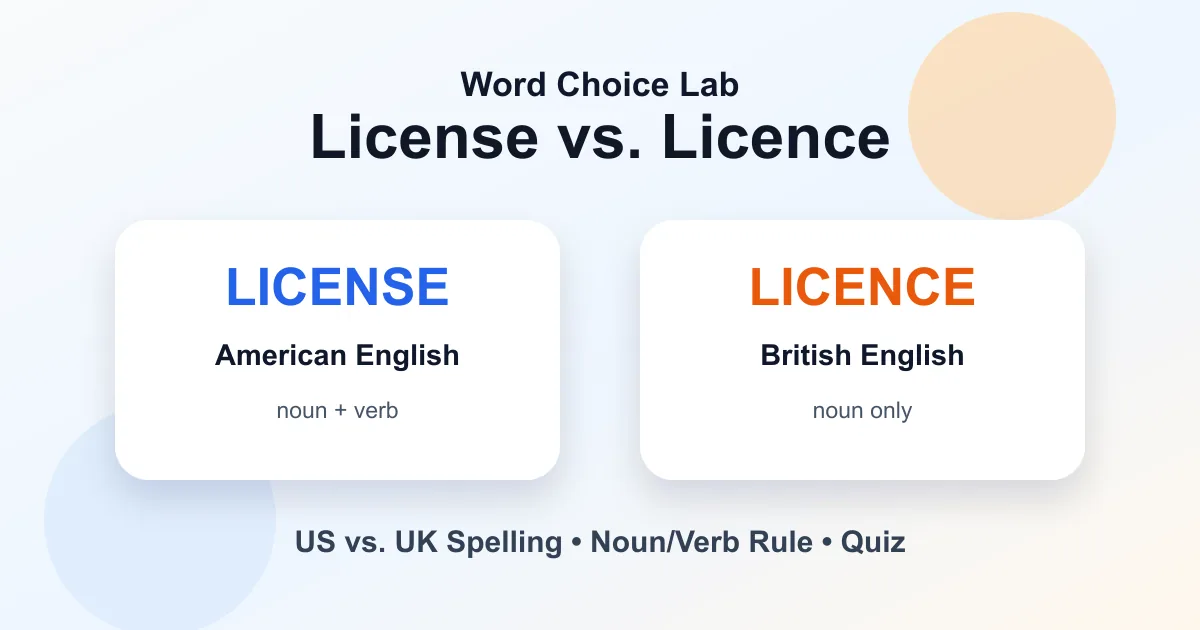
License is the standard spelling in American English for both the noun and the verb. In British English, licence is usually the noun, and license is the verb.
- American noun: I renewed my driver’s license.
- American verb: The state will license new drivers.
- British noun: I renewed my driving licence.
- British verb: The authority will license new drivers.
This pair is trickier than many American vs. British spelling differences because British English keeps a noun/verb distinction. If you remember one thing, remember this: US uses license for both; UK uses licence for the noun and license for the verb.
License vs. licence at a glance
| Variety | Noun | Verb | Example |
|---|---|---|---|
| American English | license | license | She has a valid driver’s license. |
| British English | licence | license | She has a valid driving licence. |
Quick rule:
- Writing for US readers? Use license for everything.
- Writing for UK readers? Use licence for the noun and license for the verb.
- Keep official names exactly as they are written.
When to use license in American English
In American English, license works as both a noun and a verb.
As a noun, license means an official permission, permit, or document.
- I need to renew my driver’s license.
- The restaurant applied for a liquor license.
- The software license allows installation on two computers.
- She showed her professional license at the office.
As a verb, license means to give official permission.
- The state will license new contractors.
- The company can license its technology to other firms.
- The board decided to license the clinic.
- The city may license more taxi drivers.
For a US-focused website, license is normally the spelling you want in almost every general context.
When to use licence in British English
In British English, licence is usually the noun. It means the permit, document, or permission itself.
- I need to renew my driving licence.
- The pub applied for an alcohol licence.
- The software licence covers one user.
- He lost his fishing licence.
But British English usually uses license as the verb:
- The council will license the venue.
- The company can license its software.
- The authority may license new operators.
So in UK-style writing, this sentence is correct:
- The agency will license the business after it receives a valid licence application.
That looks odd to some learners, but it follows the British noun/verb pattern.
Is license or licence correct?
Both can be correct, but the answer depends on region and grammar.
- In American English, license is both noun and verb.
- In British English, licence is the noun and license is the verb.
This is similar to the difference between advice and advise:
- Advice = noun
- Advise = verb
- Licence = noun in British English
- License = verb in British English
American English does not keep this spelling distinction for license.
Driver’s license or driving licence?
For a US audience, write driver’s license.
- I forgot my driver’s license at home.
- You need a valid driver’s license to rent a car.
For a UK audience, write driving licence.
- I forgot my driving licence at home.
- You need a valid driving licence to hire a car.
Both phrases refer to the official document that allows someone to drive, but the regional wording is different.
License vs. licence in software
Software writing often depends on audience and company style.
For US style:
- software license
- license agreement
- licensed software
- license key
For UK style:
- software licence as a noun
- licence agreement
- licensed software
- license the software as a verb
Examples:
- American: The license lets you install the app on one device.
- British: The licence lets you install the app on one device.
- Both as verb: The company will license the app to schools.
Notice that licensed is spelled with s in both American and British English.
Related words: licensed, licensing, licensee, licensor
Many related forms use s in both spelling systems.
| Word | American English | British English |
|---|---|---|
| noun | license | licence |
| verb | license | license |
| past tense/adjective | licensed | licensed |
| gerund/noun | licensing | licensing |
| person receiving permission | licensee | licensee |
| person granting permission | licensor | licensor |
Examples:
- The restaurant is fully licensed.
- The licensing board will review the application.
- The licensee must follow the agreement.
- The licensor owns the rights.
The big spelling difference is mainly the noun: license in American English, licence in British English.
What about official names?
Keep official names exactly as they are written. Do not change the spelling inside a law, agency name, form title, product title, or quoted text.
Correct:
- A US form may say driver’s license.
- A UK form may say driving licence.
Incorrect:
- Changing an official UK document title from licence to license.
- Changing an official US document title from license to licence.
Proper names and official document titles are not places to “fix” spelling.
Common mistakes
Mistake 1: Using licence as a verb in British English
Incorrect in standard UK style: The council will licence the business.
Correct: The council will license the business.
Mistake 2: Using licence for a US audience
Incorrect for US style: I renewed my driver’s licence.
Correct for US style: I renewed my driver’s license.
Mistake 3: Forgetting the UK noun/verb distinction
Incorrect in UK style: The agency will licence the shop after it receives a license.
Correct in UK style: The agency will license the shop after it receives a licence.
Mistake 4: Changing licensed to licenced
In modern standard English, licensed is the usual spelling in both American and British English.
Incorrect: The restaurant is licenced.
Correct: The restaurant is licensed.
More example sentences
American English examples
- The driver’s license expires next month.
- The state can license electricians.
- The bar has a liquor license.
- The software license includes updates.
- Only licensed professionals may perform the work.
British English examples
- The driving licence expires next month.
- The council can license taxi drivers.
- The pub has an alcohol licence.
- The software licence includes updates.
- Only licensed professionals may perform the work.
Quick quiz
Choose the best spelling for each sentence.
- US noun: I renewed my driver’s ___.
- UK noun: I renewed my driving ___.
- UK verb: The council will ___ the venue.
- US verb: The state will ___ new contractors.
- Both styles: The restaurant is fully ___.
Answers:
- license
- licence
- license
- license
- licensed
FAQ
Is licence wrong in American English?
It is understandable, but license is the standard American spelling for both the noun and the verb.
Is license wrong in British English?
Not always. In British English, license is normally the verb. Licence is normally the noun.
Which spelling should I use for a US website?
Use license for both noun and verb. For example: driver’s license, software license, and license a business.
Which spelling should I use for a UK website?
Use licence as the noun and license as the verb. For example: driving licence and license a business.
Is licensed spelled with s or c?
Licensed is usually spelled with s in both American and British English.
The same context-first habit also helps with Defense vs. Defence and Realize vs. Realise. For a wider set of examples in this topic, use the American vs British English archive as the category grows.
Final tip
Use license for both noun and verb in American English. In British English, use licence for the noun and license for the verb.
Remember: US = license for both, UK = licence noun, license verb.