Is It Mail or Male? Difference, Examples, and Easy Rule
Learn the difference between mail and male, with meanings, examples, common mistakes, memory tips, and a quick quiz.

Homophones are words that sound the same or nearly the same but have different spellings, meanings, or grammar roles. This collection helps you avoid mistakes with common groups such as their/there/they’re, your/you’re, its/it’s, to/too/two, bare/bear, brake/break, fair/fare, and other sound-alike words.
Each guide focuses on meaning first, then shows examples, quick tests, common corrections, and memory tricks. This is especially useful because spellcheck may not catch homophone mistakes when both words are real words.
Use this category when you know how a word sounds but are unsure which spelling fits the sentence. For practice, pair these guides with the Homophones Quiz in the Quizzes & Practice section.
Learn the difference between mail and male, with meanings, examples, common mistakes, memory tips, and a quick quiz.
Learn the difference between role and roll, with meanings, examples, common mistakes, memory tips, and a quick quiz.
Learn the difference between stare and stair, with meanings, examples, common mistakes, memory tips, and a quick quiz.
Learn the difference between suit and suite, with meanings, examples, common mistakes, memory tips, and a quick quiz.
Learn the difference between through and threw, with meanings, examples, common mistakes, memory tips, and a quick quiz.
Learn the difference between right and write, with meanings, examples, common mistakes, memory tips, and a quick quiz.
Learn the difference between sea and see, with meanings, examples, common mistakes, memory tips, and a quick quiz.
Learn the difference between two and to, with meanings, examples, common mistakes, memory tips, and a quick quiz.
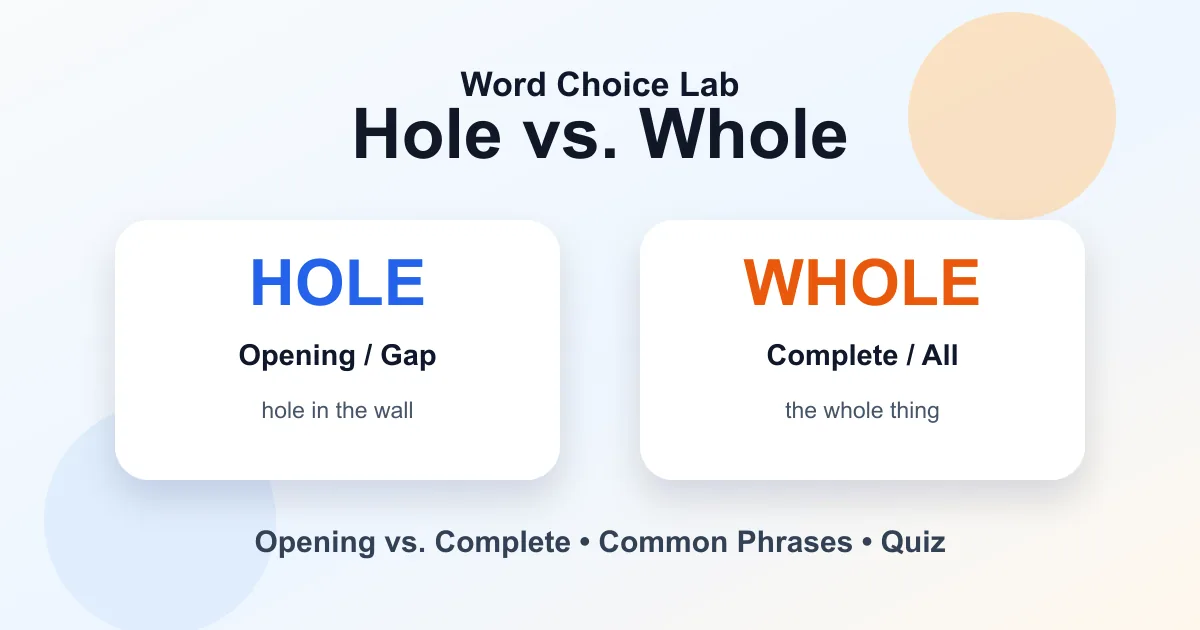
Learn the difference between hole and whole, how to use each word correctly, examples, common phrases like hole in the wall and whole thing, and a quick quiz.
Learn the difference between bye and by, with meanings, examples, common mistakes, memory tips, and a quick quiz.