
Amount vs. Number: Difference, Examples, and an Easy Rule
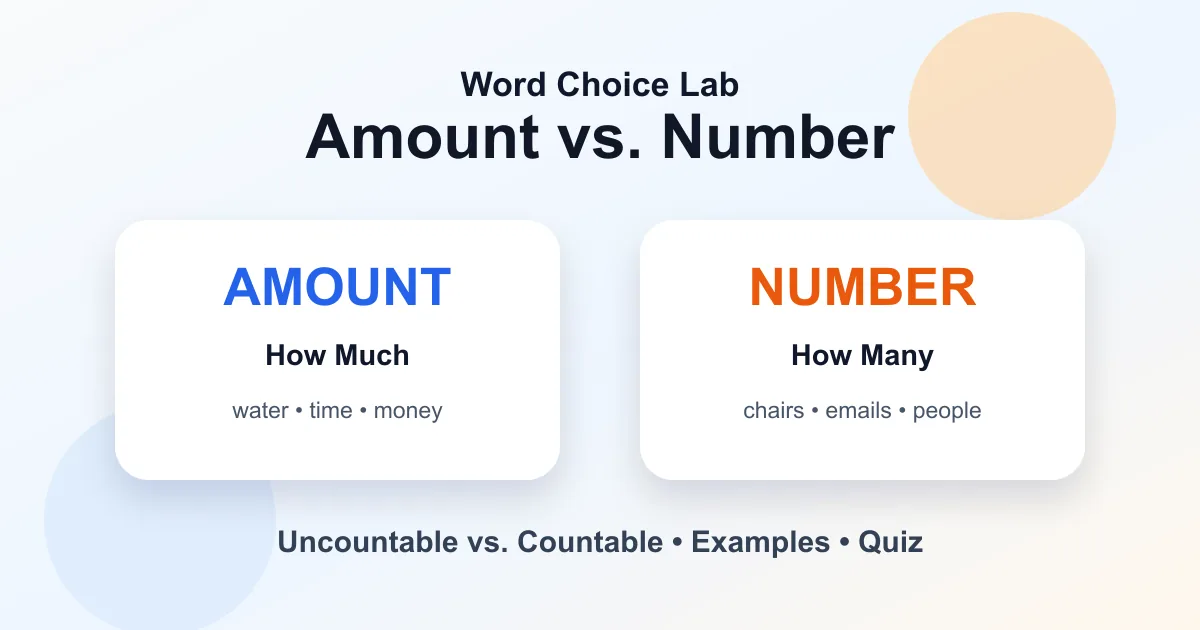
Use amount with things you measure as a mass or total quantity. Use number with things you can count one by one.
- We need a large amount of water.
- We need a large number of chairs.
The difference is about countable and uncountable nouns. If you can count the items as individual units, number is usually better. If you are talking about a quantity that is measured, not counted individually, amount is usually better.
Amount vs. number at a glance
| Word | Use with | Example |
|---|---|---|
| amount | uncountable nouns; total quantity | a small amount of money |
| number | countable plural nouns; individual items | a small number of coins |
Quick rule:
- Use amount for things you measure: water, money, time, work, traffic.
- Use number for things you count: bottles, dollars, hours, tasks, cars.
- If the noun is plural and countable, number is usually the safer choice.
When to use amount
Use amount when you are talking about a quantity that is treated as one mass, total, or measurement.
- a large amount of water
- a small amount of sugar
- a huge amount of traffic
- a limited amount of time
- a surprising amount of money
In these examples, the nouns are not normally counted one by one in the sentence. You measure them or think of them as a total quantity.
Examples:
- The recipe needs a small amount of salt.
- We spent a large amount of time on the project.
- The storm caused a serious amount of damage.
- The company saved a significant amount of money.
- There is only a tiny amount of space left.
If the word after of is singular and uncountable, amount is usually correct.
When to use number
Use number when you are talking about countable people, places, things, or ideas.
- a large number of students
- a small number of books
- a growing number of users
- a limited number of tickets
- a surprising number of mistakes
In these examples, the nouns are plural and countable. You could count them: one student, two students, three students.
Examples:
- A large number of people attended the event.
- The website received a high number of visits.
- Only a small number of seats remain.
- The report found a rising number of errors.
- A number of customers requested refunds.
If the word after of is plural and countable, number is usually correct.
The easy count test
Ask yourself:
> Can I count these things one by one?
If yes, use number.
- cars → a number of cars
- emails → a number of emails
- students → a number of students
- problems → a number of problems
If no, use amount.
- traffic → an amount of traffic
- information → an amount of information
- money → an amount of money
- work → an amount of work
This test is not perfect for every advanced usage, but it solves most everyday mistakes.
Amount with money
Money can be tricky because dollars, pounds, and coins are countable, but money itself is usually treated as an uncountable noun.
Correct:
- a large amount of money
- a small amount of cash
- a fixed amount of rent
Also correct:
- a large number of dollars
- a small number of coins
- a limited number of payments
Use amount for the total money. Use number for the countable units.
Examples:
- The total amount of money was higher than expected.
- The number of dollar bills in the drawer was small.
Amount with time
Time is usually uncountable when you mean duration in general.
Correct:
- a large amount of time
- a short amount of time
- the same amount of time
But specific units of time are countable.
Correct:
- a large number of hours
- a small number of days
- a limited number of weeks
Examples:
- We spent a huge amount of time editing the article.
- We spent a huge number of hours editing the article.
Both sentences are correct because time is uncountable, but hours are countable.
Amount with data, information, and evidence
Words like data, information, and evidence often cause confusion.
In everyday writing:
- a large amount of information
- a small amount of evidence
- a huge amount of data
But if you are counting individual pieces, records, files, or examples, use number.
- a large number of reports
- a small number of files
- a huge number of data points
- a limited number of examples
Examples:
- The article contains a large amount of information.
- The article contains a large number of examples.
A number of vs. the number of
Two common phrases behave differently.
A number of
A number of means several or many. It is followed by a plural noun and usually takes a plural verb.
- A number of students are absent.
- A number of problems were reported.
- A number of customers have complained.
The number of
The number of refers to the total count. It is usually followed by a singular verb.
- The number of students is rising.
- The number of problems was surprising.
- The number of customers has increased.
This is a grammar point, but it matters because number often appears in these phrases.
Amount of people or number of people?
In careful writing, use number of people because people are countable.
Better:
- A large number of people attended.
- The number of people in the room increased.
Less formal:
- A large amount of people attended.
You may hear amount of people in casual speech, but number of people is stronger for edited writing, school assignments, business writing, and SEO content.
Common mistakes
Mistake 1: Using amount with countable plural nouns
Incorrect: A large amount of students joined the class.
Correct: A large number of students joined the class.
Mistake 2: Using number with uncountable nouns
Incorrect: We have a small number of information.
Correct: We have a small amount of information.
Mistake 3: Forgetting units can change the word
Correct:
- a large amount of water
- a large number of bottles of water
Correct:
- a small amount of money
- a small number of coins
Mistake 4: Confusing a number of and the number of
Incorrect: A number of problems is still unsolved.
Correct: A number of problems are still unsolved.
Incorrect: The number of problems are increasing.
Correct: The number of problems is increasing.
More example sentences
Amount
- The project requires a large amount of work.
- We only have a small amount of space.
- The machine uses a surprising amount of energy.
- She saved the same amount of money each month.
- The article gives a useful amount of background.
Number
- The project includes a large number of tasks.
- We only have a small number of seats.
- The machine has a surprising number of settings.
- She saved the same number of coins each month.
- The article gives a useful number of examples.
Quick quiz
Choose the correct word.
- A large ___ of people signed up.
- We need a small ___ of water.
- The ___ of visitors increased this month.
- The recipe uses a tiny ___ of salt.
- A ___ of emails were unread.
Answers:
- number
- amount
- number
- amount
- number
FAQ
What is the difference between amount and number?
Amount is for uncountable quantities. Number is for countable items or people.
Is it amount of people or number of people?
Use number of people in careful writing because people are countable.
Is it amount of money or number of money?
Use amount of money. Use number only when counting units, such as dollars, coins, bills, or payments.
Is it amount of time or number of time?
Use amount of time. Use number with countable units, such as hours, days, or weeks.
Can amount ever be used with plural nouns?
You may hear it in casual speech, but in edited writing, number is usually better with plural countable nouns.
The same context-first habit also helps with Ensure vs. Insure and Imply vs. Infer. For a wider set of examples in this topic, use the Similar Words archive as the category grows.
Final tip
Use amount when you measure a total quantity. Use number when you count individual items.
Remember: amount = how much, number = how many.