
Accept vs. Except: Difference, Examples, and an Easy Rule
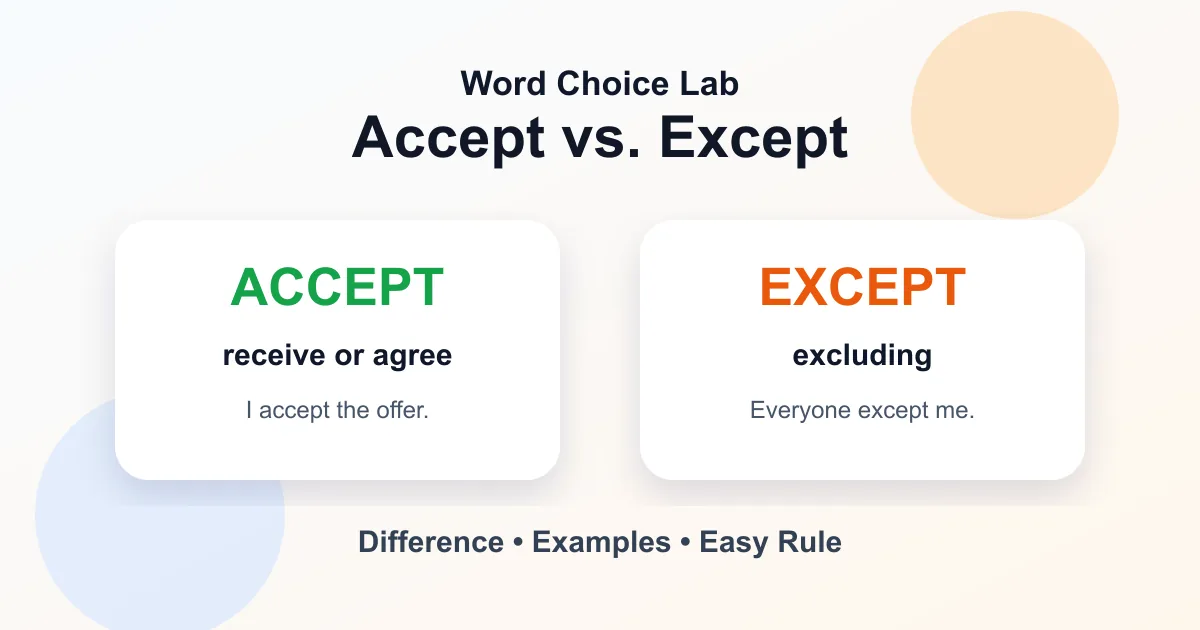
Accept is a verb meaning to receive, agree to, or believe something. Except usually means excluding or but not.
- Maya accepted the invitation.
- Everyone except Maya attended the event.
The simplest memory rule is: accept = agree or receive; except = exclude.
If similar-sounding word pairs cause trouble, our guide to affect vs. effect explains another common distinction.
Accept vs. except at a glance
| Word | Usually used as | Main meaning | Example |
|---|---|---|---|
| accept | verb | receive or agree to | I accept your offer. |
| except | preposition or conjunction | excluding; but not | Everyone agreed except Sam. |
Both words sound similar in everyday speech, but they play different roles in a sentence. Accept always describes an action. Except usually introduces something that is left out.
When to use accept
Use accept when someone willingly receives something, agrees to something, or recognizes that something is true.
Accept meaning “receive willingly”
- She accepted the award on behalf of her team.
- The store does not accept personal checks.
- Please accept this gift as a thank-you.
- He accepted the package at the front desk.
The person or organization receives something instead of refusing it.
Accept meaning “agree to”
- We accepted the terms of the contract.
- Jordan accepted the job offer.
- The committee will accept the proposal if the budget is revised.
- By clicking the button, you accept the conditions.
Here, accept means to say yes or give approval.
Accept meaning “recognize as true”
- Scientists widely accept that explanation.
- She finally accepted that the plan would need to change.
- The court did not accept his account of the event.
This meaning is about believing or acknowledging a fact, explanation, or situation.
Accept meaning “tolerate or allow”
- The school will not accept bullying.
- We cannot accept repeated delays.
- The software accepts several file formats.
Depending on the context, accept can mean to tolerate something or allow it as valid.
Common phrases with accept
You will often see accept in these combinations:
- accept an offer
- accept an invitation
- accept responsibility
- accept an apology
- accept payment
- accept the truth
- accept the consequences
- accept a challenge
Example: The manager accepted responsibility for the scheduling error.
When to use except
Use except when one person, thing, or situation is excluded from a group or statement. It often means not including, other than, or but not.
Except as a preposition
As a preposition, except is followed by the person or thing being excluded.
- Every seat was taken except the one beside me.
- The museum is open daily except Monday.
- I packed everything except my charger.
- All employees except interns receive that benefit.
You can often replace except with excluding or other than.
- Everyone except Leo finished.
- Everyone other than Leo finished.
Except as a conjunction
Except can connect a clause and mean but or other than the fact that.
- I would join you, except I have an appointment.
- The two designs are identical, except one uses a larger font.
- The trip went well, except that our flight was delayed.
In careful writing, except that can make the relationship clearer when a complete clause follows.
Except as a verb
In formal contexts, except can be a verb meaning to exclude.
- The policy excepts emergency vehicles from the restriction.
- Certain transactions are excepted from the rule.
This use is uncommon in everyday English. Most writers would say excludes or is excluded instead.
Common phrases with except
- everyone except
- everything except
- nothing except
- all except
- except for
- except that
- with the exception of
Example: Except for a few minor edits, the report is finished.
Except or except for?
Both forms can introduce an exclusion, but their sentence patterns sometimes differ.
Use except naturally after words such as all, every, no, everyone, and nothing:
- Everyone except Nora signed the card.
- I understood everything except the final step.
Use except for when the exception qualifies a broad statement:
- Except for one typo, the document was accurate.
- The office was empty except for a security guard.
In many sentences, both forms are possible, but except for often sounds more natural at the beginning of a sentence.
How to remember accept and except
Use these two letter clues:
- Accept = Agree
- Except = Exclude
If someone says yes, receives something, or recognizes it as true, use accept. If something is being left out, use except.
How to choose the right word
Ask one question: Is the sentence about receiving or excluding?
Receiving or agreeing: accept
- Will you ___ the invitation?
- Will you accept the invitation?
The person is receiving or agreeing to an invitation.
Leaving something out: except
- The invitation is open to everyone ___ employees.
- The invitation is open to everyone except employees.
Employees are excluded from the group.
Accepted vs. excepted
Accepted is the past tense of accept. It means received, approved, agreed to, or recognized as valid.
- Her application was accepted.
- We accepted their apology.
- That theory is generally accepted.
Excepted is the uncommon past tense of the verb except. It means excluded.
- Children under five are excepted from the fee.
- The final paragraph was excepted from the word count.
In most ordinary sentences, accepted is the word you need. Use excepted mainly in formal, administrative, or legal-style contexts.
Accept, except, and expect
Expect is another word that writers sometimes confuse with accept and except.
| Word | Meaning | Example |
|---|---|---|
| accept | receive or agree to | We accept credit cards. |
| except | exclude | We are open every day except Sunday. |
| expect | believe something will happen | We expect rain tonight. |
Compare:
- I accept your answer. I agree that it is valid.
- Everyone answered except Mia. Mia did not answer.
- I expect an answer tomorrow. I believe it will arrive tomorrow.
Common mistakes
Incorrect: Please except my apology.
Correct: Please accept my apology.
The speaker wants the apology to be received.
Incorrect: Everyone accept Daniel completed the test.
Correct: Everyone except Daniel completed the test.
Daniel is excluded from the group.
Incorrect: The store excepts cash and cards.
Correct: The store accepts cash and cards.
The store receives those forms of payment.
Incorrect: I accept the office to be quiet today.
Correct: I expect the office to be quiet today.
The sentence describes a prediction, not an agreement or an exclusion.
Accept vs. except examples by context
Work and business
- The candidate accepted the position.
- All departments except accounting approved the change.
- The vendor accepts electronic payments.
School
- The professor accepted the late assignment.
- Everyone except two students passed the quiz.
- The journal will accept submissions through Friday.
Travel
- The airline accepted my digital boarding pass.
- Every flight except ours left on time.
- The hotel accepts reservations by phone.
Everyday situations
- I accepted the invitation to dinner.
- Everyone ordered dessert except me.
- The machine will not accept damaged bills.
Quick practice quiz
Choose accept, except, or expect.
- The café ___ cash and major credit cards.
- Everyone ___ Priya arrived before noon.
- I ___ the package to arrive tomorrow.
- She decided to ___ the scholarship.
- The park is open daily ___ during severe weather.
- We cannot ___ responsibility for lost items.
- The room was empty ___ for two chairs.
- Do you ___ these terms?
Answers
- accepts — receives payment
- except — excludes Priya
- expect — predicts a future event
- accept — agrees to receive the scholarship
- except — introduces an excluded situation
- accept — takes responsibility
- except — part of the phrase except for
- accept — agrees to the terms
The same context-first habit also helps with Affect vs. Effect. For a wider set of examples in this topic, use the Commonly Confused Words archive as the category grows.
Frequently asked questions
Do you accept or except a gift?
You accept a gift because you willingly receive it. Except would mean to exclude something.
Is it “accept responsibility” or “except responsibility”?
The correct phrase is accept responsibility. It means to acknowledge that you are responsible for an action or result.
Does except always mean excluding?
That is its most common meaning. As a preposition or conjunction, except introduces an exclusion. It can also be a formal verb meaning to exclude.
Are accept and except pronounced the same?
They are often pronounced very similarly in natural speech, which helps explain the confusion. Their meanings and grammatical roles remain different.
Is it “everyone accept” or “everyone except”?
Use everyone except when you mean that one person or group is left out: “Everyone except Ava attended.”
The bottom line
Use accept when you mean receive, agree to, or recognize. Use except when you mean excluding or but not.
- We accepted every suggestion.
- We used every suggestion except the last one.
Remember: Accept = Agree. Except = Exclude.