
Affect vs. Effect: The Difference, Examples, and an Easy Rule
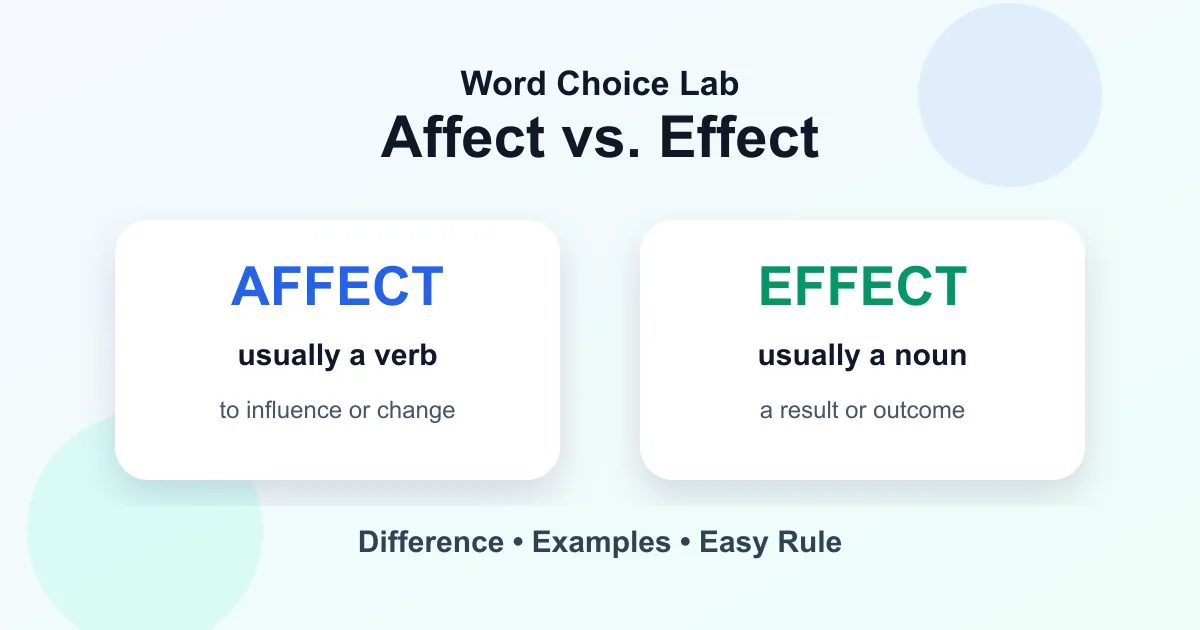
Affect is usually a verb meaning to influence or cause a change. Effect is usually a noun meaning the result of a change.
- The cold weather affected our travel plans.
- The cold weather had an effect on our travel plans.
That verb–noun distinction will give you the correct answer in most everyday sentences. There are a few exceptions, but they are less common and easy to recognize once you know what to look for.
Affect vs. effect at a glance
| Word | Usually used as | Common meaning | Example |
|---|---|---|---|
| affect | verb | to influence or change | Stress can affect your sleep. |
| effect | noun | a result or consequence | Stress can have an effect on sleep. |
Here is the relationship in one sentence:
> When one thing affects another, it produces an effect.
When to use affect
Use affect when you mean influence, change, or have an impact on. In ordinary English, it is most often an action word—a verb.
Affect meaning “influence”
- Rising prices affect nearly every household.
- The construction project will affect traffic downtown.
- Lack of sleep can affect your concentration.
- Her feedback affected the final design.
- Will the schedule change affect our deadline?
In each sentence, something acts on or changes something else.
Affect meaning “move emotionally”
Affect can also describe an emotional influence.
- The graduation speech deeply affected him.
- She was visibly affected by the news.
- The documentary affected viewers across the country.
This is still the same basic verb: something causes a change in someone’s feelings.
Affect meaning “pretend”
In a less common use, affect means to put on or pretend to have a particular manner, feeling, or style.
- He affected a British accent during the performance.
- She affected an air of confidence despite feeling nervous.
This meaning appears more often in literary or formal writing than in everyday conversation.
When to use effect
Use effect when you mean a result, outcome, or consequence. It is usually a noun.
Effect meaning “result”
- The medication had an immediate effect.
- Remote work has had a lasting effect on office culture.
- The new rule produced the opposite effect.
- Exercise can have positive effects on your mood.
- We are studying the effects of air pollution.
A useful test is to replace effect with result. If the sentence still makes sense, effect is probably correct.
- The policy had an unexpected effect.
- The policy had an unexpected result.
Both versions work.
Common expressions with effect
Several fixed expressions always use effect:
- have an effect on: The decision had an effect on everyone.
- take effect: The new policy takes effect on July 1.
- go into effect: The changes will go into effect next month.
- in effect: The rule is still in effect.
- side effect: Drowsiness is a possible side effect.
- cause and effect: The lesson explains cause and effect.
- for effect: The lights were added for dramatic effect.
- personal effects: Guests may leave personal effects at the front desk.
An easy way to remember affect and effect
Use the A–V–E–N rule:
- Affect is usually a Verb.
- Effect is usually a Noun.
You can also remember:
- Affect = Action
- Effect = End result
These memory tricks cover the uses you will see most often.
How to choose the right word in a sentence
Ask two quick questions.
1. Do I need an action?
If you need a verb meaning influence, choose affect.
- How will the budget cut ___ the program?
- How will the budget cut affect the program?
The blank describes what the budget cut will do, so a verb is needed.
2. Do I need a result?
If you need a noun meaning result, choose effect.
- What ___ will the budget cut have on the program?
- What effect will the budget cut have on the program?
The blank names the result, so a noun is needed.
Affect or effect after common words
The word immediately before the blank can provide a clue.
Usually affect
Modal and helping verbs are commonly followed by the base verb affect:
- can affect
- could affect
- may affect
- might affect
- will affect
- would affect
- does affect
- did affect
Example: The delay could affect tomorrow’s delivery.
Usually effect
Articles, adjectives, and possessives often introduce the noun effect:
- an effect
- the effect
- this effect
- its effect
- positive effects
- harmful effects
Example: The delay had a harmful effect on sales.
These patterns are clues, not absolute rules, but they work well in everyday writing.
Affected vs. effected
Affected usually means influenced or changed.
- Thousands of customers were affected by the outage.
- The storm affected flights along the East Coast.
Effected is much less common. It means brought about or caused to happen.
- The new director effected major changes in the department.
- Negotiators effected a peaceful settlement.
If you could replace the word with influenced, use affected. If you mean brought about, effected may be correct.
Affects vs. effects
Affects is usually a present-tense verb.
- Humidity affects how warm the air feels.
- The decision affects every employee.
Effects is usually a plural noun.
- Researchers measured the effects of humidity.
- The decision had several unintended effects.
Affecting vs. effecting
Affecting usually means influencing.
- A software issue is affecting online orders.
Effecting means bringing something about and is mainly used in formal contexts.
- The committee is responsible for effecting the transition.
In everyday writing, affecting is far more common.
The two uncommon exceptions
The basic rule has two notable exceptions.
Effect as a verb
As a verb, effect means to bring about, accomplish, or cause something to happen.
- The organization hopes to effect meaningful change.
- The agreement effected a transfer of ownership.
Compare these two sentences:
- The campaign affected change. It influenced the change.
- The campaign effected change. It caused the change to happen.
This use is common in formal, legal, political, and business writing.
Affect as a noun
In psychology and clinical contexts, affect can be a noun referring to a person’s observable emotional expression. It is pronounced differently, with stress at the beginning: AF-fect.
- The clinician noted that the patient had a flat affect.
Most general readers will rarely need this meaning.
Affect vs. effect examples by context
Work and business
- The merger will affect several departments.
- The merger’s long-term effects are not yet clear.
- Strong leadership can effect organizational change.
School and college
- Attendance may affect your final grade.
- The tutoring program had a positive effect on test scores.
- Researchers controlled for factors that could affect the results.
Health
- Dehydration can affect your energy level.
- Headaches are a possible side effect of the medication.
- Ask your doctor how the treatment may affect you.
Technology
- The update should not affect your saved files.
- One effect of the update is faster loading.
- The outage affected users in several states.
Common mistakes
Incorrect: The weather had a negative affect on attendance.
Correct: The weather had a negative effect on attendance.
After a negative, the sentence needs a noun meaning result.
Incorrect: How will this effect our schedule?
Correct: How will this affect our schedule?
The sentence needs a verb meaning influence.
Incorrect: The new manager affected several improvements.
Correct: The new manager effected several improvements.
Here the meaning is brought about. A more natural everyday alternative is: “The new manager made several improvements.”
Quick practice quiz
Choose affect or effect for each sentence.
- The road closure may ___ the morning commute.
- The new lighting created a calming ___.
- How did the announcement ___ employee morale?
- The tax changes take ___ next year.
- The illness ___ people differently.
- The committee hopes to ___ lasting reform.
- Screen time can have an ___ on sleep quality.
- The supply shortage is ___ several stores.
Answers
- affect — an action meaning influence
- effect — a result
- affect — a verb after did
- effect — the fixed phrase take effect
- affects — a present-tense verb
- effect — a verb meaning bring about
- effect — a noun after an
- affecting — an ongoing action
For a wider set of examples in this topic, use the Commonly Confused Words archive as the category grows.
Frequently asked questions
Is it “affect change” or “effect change”?
Both can be grammatical, but they mean different things. Affect change means influence change. Effect change means cause change to happen. In formal writing, effect change is the usual expression when you mean bring about change.
Is it “positive affect” or “positive effect”?
Use positive effect when you mean a beneficial result: “Exercise has a positive effect on health.” Positive affect is a specialized psychology term referring to outwardly observable positive emotion.
Is it “side affect” or “side effect”?
The correct expression is side effect. A side effect is an additional, often unintended, result of a medication, treatment, or action.
Is it “in affect” or “in effect”?
The correct expression is in effect. It means active, operating, or essentially true: “The policy remains in effect.”
Which word is more commonly a verb?
Affect is more commonly a verb. Effect is usually a noun, although it can be a formal verb meaning bring about.
The bottom line
Use affect for the action of influencing something and effect for the result:
- The new schedule affected productivity.
- The new schedule had a positive effect on productivity.
Remember Affect = Action and Effect = End result, and you will be right in most situations.
Editorial references
- Merriam-Webster, “Affect vs. Effect: How to Pick the Right One”
- Britannica Dictionary, “How to Use Affect and Effect”
- Cambridge Dictionary, “Affect or effect?”