
Sincerely vs. Best Regards: Differences, Examples, and When to Use Each
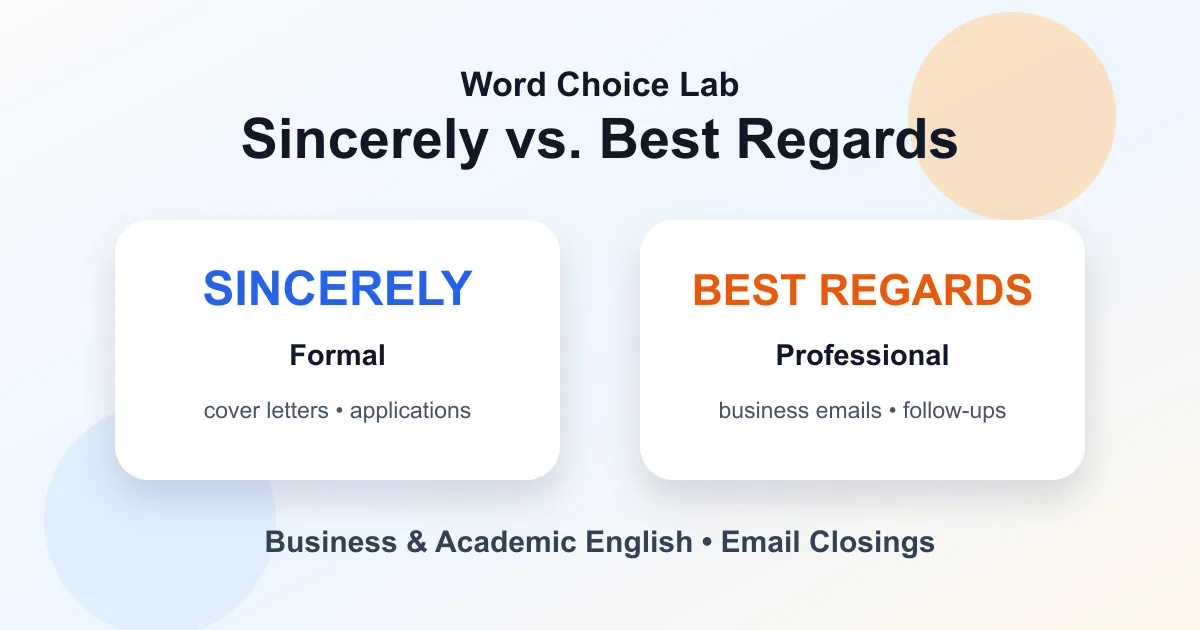
Sincerely and Best regards are both professional email closings, but they do not feel exactly the same. Sincerely is more formal and traditional. Best regards is professional but a little warmer and more common in everyday business email.
- Formal: Sincerely,
- Professional and friendly: Best regards,
Both closings are correct. The best choice depends on the message, the reader, and how formal the situation is.
Sincerely vs. Best regards at a glance
| Closing | Tone | Best use |
|---|---|---|
| Sincerely, | formal, traditional | cover letters, applications, official requests |
| Best regards, | professional, polite, warm | business emails, client emails, follow-ups |
Quick rule:
- Use Sincerely for formal letters and applications.
- Use Best regards for most professional emails.
- If the message is serious or official, choose the more formal option.
What does Sincerely mean?
Sincerely is a formal closing that means the message is written honestly and respectfully. It is common in letters, job applications, cover letters, formal requests, and official communication.
Examples:
- Sincerely,
- Sincerely yours,
- Yours sincerely,
In American English, Sincerely is a safe and common closing for formal letters.
Use Sincerely when you want to sound:
- formal
- respectful
- traditional
- serious
- professional
Example:
Dear Hiring Manager,
Thank you for considering my application. I would welcome the opportunity to discuss how my experience can support your team.
Sincerely, Your Name
What does Best regards mean?
Best regards is a polite professional closing. It is warmer than Sincerely, but still appropriate for work emails, client messages, follow-ups, and everyday business communication.
Examples:
- Best regards,
- Kind regards,
- Warm regards,
Use Best regards when you want to sound:
- professional
- polite
- friendly
- modern
- not too stiff
Example:
Hello Jordan,
I have attached the updated report for your review. Please let me know if you have any questions.
Best regards, Your Name
Key differences between Sincerely and Best regards
The main difference is tone. Sincerely sounds more formal. Best regards sounds professional but more conversational.
| Feature | Sincerely | Best regards |
|---|---|---|
| Formality | more formal | professional but warmer |
| Best for | cover letters, official letters | work emails, client emails |
| Feels | traditional | modern |
| Relationship | often less familiar | works for ongoing professional contact |
| Risk | can feel stiff in casual emails | can feel too relaxed for very formal letters |
Neither closing is wrong. The right one depends on how formal you need to be.
When should you use Sincerely?
Use Sincerely for formal or high-stakes communication.
Good situations for Sincerely:
- cover letters
- job applications
- scholarship applications
- formal complaints
- recommendation letters
- official requests
- letters to institutions
- academic or legal-style communication
Examples:
- Sincerely,
Maria Lopez
- Sincerely,
Jordan Ellis
If you are applying for a job, writing to an official office, or sending a formal letter, Sincerely is usually a strong choice.
When should you use Best regards?
Use Best regards for professional emails that should sound polite and natural.
Good situations for Best regards:
- client emails
- coworker emails
- follow-up messages
- project updates
- customer support replies
- business introductions
- meeting summaries
- professional thank-you emails
Examples:
- Best regards,
Taylor Morgan
- Best regards,
Alex Chen
For many everyday workplace emails, Best regards sounds more natural than Sincerely.
Is Best regards formal?
Best regards is professional and semi-formal. It is not too casual, but it is usually less formal than Sincerely.
Professional:
- Best regards,
More formal:
- Sincerely,
Warmer:
- Kind regards,
More casual:
- Best,
If you are unsure in a normal business email, Best regards is a safe option.
Is Sincerely too formal for email?
Sometimes. Sincerely is not wrong in email, but it can feel stiff in a quick message to a coworker or someone you email often.
Stiff for a casual work email:
- Thanks for the update. Sincerely, Alex
More natural:
- Thanks for the update. Best regards, Alex
Use Sincerely when the message feels like a formal letter, not a quick workplace note.
Examples in real emails
Job application
Dear Hiring Manager,
I am writing to apply for the administrative assistant position. My experience managing schedules, preparing reports, and supporting client communication matches the responsibilities listed in your posting.
Sincerely, Your Name
Client follow-up
Hello Ms. Rivera,
Thank you for meeting with me today. I have attached the revised proposal and included the timeline we discussed.
Best regards, Your Name
Professor email
Dear Professor Lewis,
Thank you for your feedback on my draft. I will revise the introduction and send the updated version by Friday.
Sincerely, Your Name
Coworker update
Hi Maya,
I updated the project tracker and added notes from today’s meeting.
Best regards, Your Name
Other professional email closings
You do not have to use only Sincerely or Best regards. Other closings may fit different situations.
| Closing | Tone | Best use |
|---|---|---|
| Kind regards, | polite and warm | professional emails |
| Thank you, | appreciative | requests and follow-ups |
| Respectfully, | very formal | serious requests or complaints |
| Best, | concise and semi-formal | familiar work contacts |
| Warm regards, | friendly and professional | relationship-based emails |
If you want a safe professional closing, Best regards works well in many situations.
Common mistakes
Mistake 1: Using Best regards in a very formal letter
Acceptable but less formal:
- Best regards,
More formal:
- Sincerely,
For a cover letter or official request, Sincerely is usually better.
Mistake 2: Using Sincerely for every email
Sincerely can sound too stiff in everyday workplace messages. Use Best regards or Best when the relationship is more familiar.
Mistake 3: Forgetting the comma
Incorrect:
- Best regards
Correct:
- Best regards,
The comma after the closing is standard in professional emails.
Mistake 4: Mixing a formal closing with a casual message
Mixed tone:
- Hey, just checking in lol. Sincerely,
Better:
- Hi Jordan, just checking in on the report. Best regards,
Mistake 5: Using too many closings together
Incorrect:
- Thanks and best regards sincerely,
Correct:
- Best regards,
Choose one clear closing.
Quick quiz
Choose Sincerely or Best regards.
- A cover letter for a job application.
- A follow-up email to a client.
- A formal request to a university office.
- A project update to a coworker.
- A scholarship application letter.
Answers:
- Sincerely
- Best regards
- Sincerely
- Best regards
- Sincerely
FAQ
What is the difference between Sincerely and Best regards?
Sincerely is more formal and traditional. Best regards is professional, polite, and a little warmer.
Is Best regards professional?
Yes. Best regards is professional and appropriate for many business emails.
Is Sincerely good for emails?
Yes, especially formal emails, cover letters, applications, and official requests. For everyday workplace email, it may sound a little stiff.
Should Best regards have a comma?
Yes. Write Best regards, before your name.
Which is better for a cover letter?
Sincerely is usually better for a cover letter because it sounds formal and traditional.
Which is better for a client email?
Best regards is often better for a client email because it sounds professional and friendly.
The same context-first habit also helps with To Whom It May Concern Alternatives and Cover Letter vs. Resume. For a wider set of examples in this topic, use the Business & Academic English archive as the category grows.
Final tip
Use Sincerely when the message is formal, official, or application-related.
Use Best regards when the message is professional but warmer, such as a client email, work update, or follow-up.
Simple memory trick:
- Sincerely = formal letter
- Best regards = professional email
When in doubt, match the closing to the seriousness of the message.