
Professional Email Greetings and Closings: Examples for Work and School
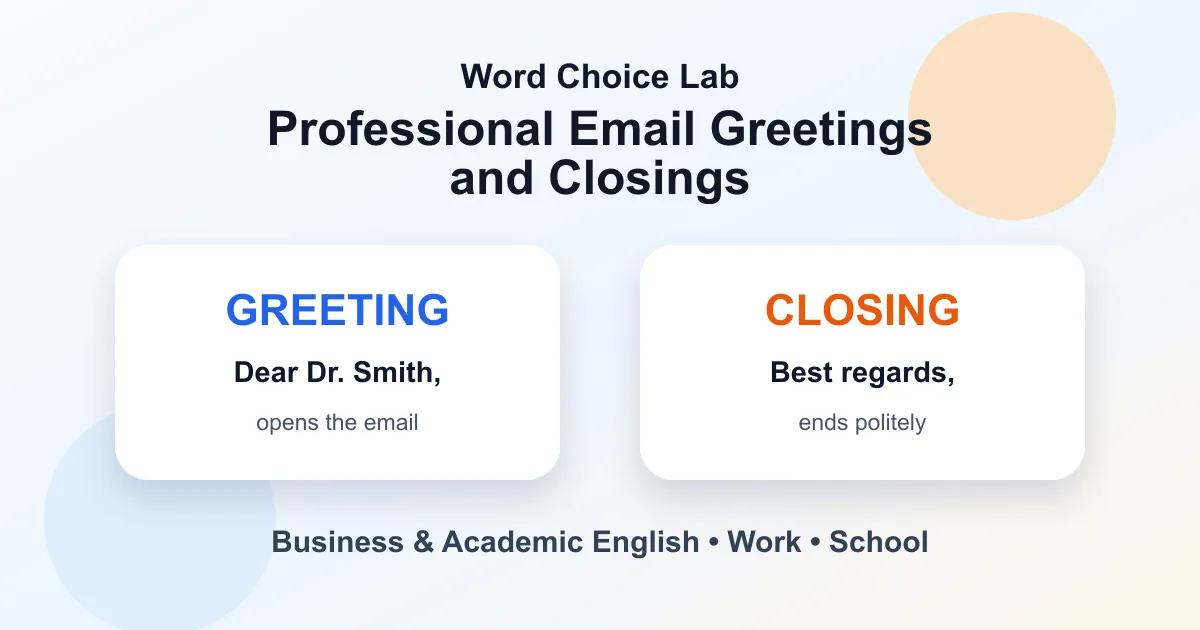
Professional email greetings and closings help your message sound polite, clear, and appropriate. The greeting opens the email. The closing ends it.
- Greeting: Dear Ms. Johnson,
- Closing: Sincerely,
For work, school, job applications, customer service, and formal requests, your opening and ending matter. A good greeting shows respect. A good closing leaves the reader with a professional final impression.
Professional email greetings and closings at a glance
| Email part | Purpose | Example |
|---|---|---|
| greeting | opens the message | Dear Professor Lee, |
| closing | ends the message politely | Best regards, |
Quick rule:
- Use a more formal greeting when you do not know the reader well.
- Use a warmer greeting when the relationship is familiar.
- Match the closing to the tone of the email.
What is an email greeting?
An email greeting is the opening line of an email. It usually includes a greeting word and the recipient’s name or title.
Examples:
- Dear Dr. Smith,
- Hello Ms. Garcia,
- Hi Jordan,
- Good morning, Professor Chen,
The greeting sets the tone. A job application should not begin the same way as a quick message to a close coworker.
What is an email closing?
An email closing is the final sign-off before your name. It helps end the message politely.
Examples:
- Sincerely,
- Best regards,
- Thank you,
- Respectfully,
- Best,
The closing should fit the purpose of the message. A formal request may need Sincerely or Respectfully. A friendly work email may use Best or Thanks.
Best professional email greetings
Here are safe greetings for professional emails:
| Greeting | Best use |
|---|---|
| Dear Mr./Ms./Dr. Last Name, | formal emails, applications, professors, official messages |
| Dear Hiring Manager, | job applications when you do not know the name |
| Hello First Name, | professional but friendly emails |
| Hi First Name, | friendly workplace emails |
| Good morning, Name, | polite emails sent earlier in the day |
| Good afternoon, Name, | polite emails sent later in the day |
Examples:
- Dear Dr. Patel,
- Hello Morgan,
- Good afternoon, Ms. Williams,
- Dear Hiring Manager,
If you are unsure, Dear [Title/Last Name] is usually the safest formal choice.
Best professional email closings
Here are useful closings for work, school, and formal communication:
| Closing | Tone | Best use |
|---|---|---|
| Sincerely, | formal | cover letters, applications, formal requests |
| Best regards, | professional | business emails, client emails |
| Kind regards, | polite | professional but warm emails |
| Thank you, | appreciative | requests, follow-ups, support emails |
| Respectfully, | very formal | complaints, official requests, professors |
| Best, | semi-formal | everyday workplace emails |
Examples:
- Sincerely,
- Best regards,
- Thank you,
- Kind regards,
A good closing should not feel too casual for the situation.
Greetings for job applications
Job application emails should usually be formal and careful.
Best greetings:
- Dear Hiring Manager,
- Dear Ms. Thompson,
- Dear Dr. Harris,
- Dear Recruiting Team,
Avoid:
- Hey,
- Hi there!!!
- To whoever,
- Hello guys,
Example:
Dear Hiring Manager,
I am writing to apply for the marketing assistant position listed on your website.
Best closing:
Sincerely, Your Name
Greetings for professors and teachers
When emailing a professor or teacher, use a respectful greeting unless they have told you to use their first name.
Good greetings:
- Dear Professor Adams,
- Hello Dr. Nguyen,
- Good morning, Professor Lewis,
Avoid:
- Hey professor,
- Hi teacher,
- Yo,
- Hello Mrs. Professor,
Example:
Dear Professor Adams,
I hope you are doing well. I am writing to ask whether I may submit the assignment one day late.
Good closings:
- Sincerely,
- Thank you,
- Respectfully,
Greetings for clients and customers
Client emails should usually be polite and professional, but not stiff.
Good greetings:
- Hello Ms. Rivera,
- Good afternoon, Mr. Brown,
- Dear Customer Service Team,
- Hi Alex,
If you already know the client well, Hi [First Name] may be fine. For a first message, a more formal greeting is safer.
Good closings:
- Best regards,
- Kind regards,
- Thank you,
- Best,
Example:
Hello Ms. Rivera,
Thank you for reaching out. I have attached the updated proposal for your review.
Best regards, Your Name
Greetings when you do not know the name
If you do not know the recipient’s name, avoid guessing. Use a neutral professional greeting.
Better options:
- Dear Hiring Manager,
- Dear Admissions Team,
- Dear Customer Support Team,
- Hello,
- Good morning,
Use To Whom It May Concern only when the message is very formal and you cannot identify a person, team, or department. It is correct, but it can sound old-fashioned.
Is “Hi” professional?
Yes, Hi can be professional in many workplace emails, especially when you know the person.
Professional:
- Hi Maya,
- Hi Daniel,
- Hi team,
Too casual for formal situations:
- Heyyy,
- Yo Alex,
- Hi guys!!!
For a professor, hiring manager, or official contact, Dear or Hello may be safer than Hi.
Is “Dear” too formal?
No. Dear is still useful in professional and academic emails. It is especially appropriate for:
- job applications
- cover letters
- formal requests
- professor emails
- legal or official messages
- emails to someone you have never contacted before
Example:
- Dear Dr. Wilson,
For regular workplace emails, Hello or Hi may sound more natural.
Common mistakes
Mistake 1: Using no greeting
Weak:
- Need the report by Friday.
Better:
- Hello Jordan, could you please send the report by Friday?
Mistake 2: Being too casual
Too casual:
- Hey boss,
Better:
- Hello Mr. Carter,
Mistake 3: Using the wrong title
Avoid guessing titles like Mrs., Miss, or Dr. if you are not sure. If you know the full name but not the title, use:
- Hello Taylor Morgan,
Mistake 4: Ending without a closing
Weak:
- Send me the file.
Better:
- Thank you,
Your Name
Mistake 5: Mixing formal and casual tone
Mixed tone:
- Dear Professor Lee, thx for helping me out!!!
Better:
- Dear Professor Lee, thank you for your help.
Quick templates
Formal request
Dear Dr. Smith,
I hope you are doing well. I am writing to ask whether you would be available to discuss my application.
Thank you, Your Name
Professional workplace email
Hello Jordan,
I have attached the updated document for your review. Please let me know if you have any questions.
Best regards, Your Name
Friendly work email
Hi Maya,
Thanks for sending the notes. I will review them this afternoon.
Best, Your Name
Quick quiz
Choose the better option.
- You are emailing a hiring manager for the first time.
- You are messaging a coworker you know well.
- You are emailing a professor about an assignment.
- You are sending a proposal to a new client.
- You are writing a quick thank-you note after a meeting.
Answers:
- Dear Hiring Manager,
- Hi [First Name],
- Dear Professor [Last Name],
- Hello Ms./Mr./Mx. [Last Name],
- Thank you, or Best regards,
FAQ
What is the most professional email greeting?
Dear [Title] [Last Name], is one of the most professional greetings. For general business emails, Hello [Name], is also safe.
What is a good professional email closing?
Sincerely, Best regards, Kind regards, and Thank you are good professional closings.
Is “Hey” professional in email?
Usually no. Hey can sound too casual for professional, academic, or first-contact emails.
Should I use a comma after the greeting?
In most emails, yes. Example: Hello Jordan,
Is “Best” a professional closing?
Yes. Best is common in semi-formal workplace emails. For very formal messages, use Sincerely or Best regards.
What if I do not know the person’s name?
Use a team or role-based greeting, such as Dear Hiring Manager, or Hello Customer Support Team,.
The same context-first habit also helps with Formal vs. Informal Writing and Calendar vs. Calender. For a wider set of examples in this topic, use the Business & Academic English archive as the category grows.
Final tip
For professional emails, keep the greeting and closing polite, simple, and matched to the reader.
Safe pattern:
- Formal greeting: Dear [Title/Name],
- Clear message
- Professional closing: Best regards, or Sincerely,
When in doubt, choose a little more polite than casual.