
Embarrass vs. Embarass: Correct Spelling, Examples, and an Easy Memory Trick
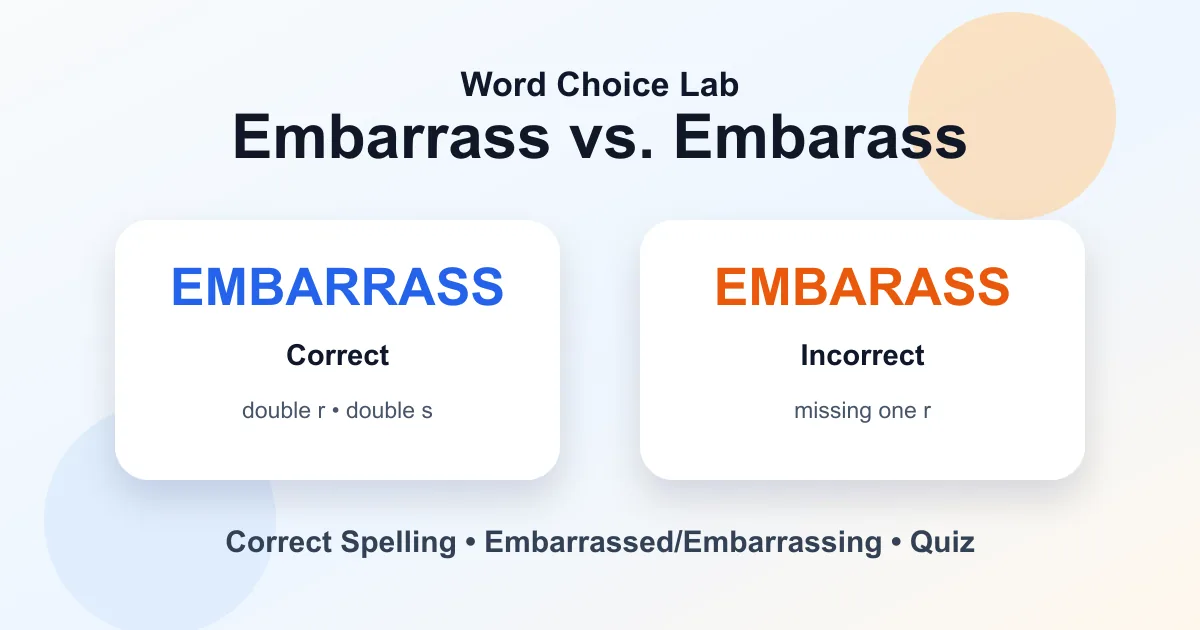
Embarrass is the correct spelling. Embarass is a common misspelling.
- Correct: I did not mean to embarrass you.
- Incorrect: I did not mean to embarass you.
This word is tricky because the correct spelling has double r and double s. Many writers remember one double letter but forget the other. The standard spelling is embarrass: e-m-b-a-r-r-a-s-s.
Embarrass vs. embarass at a glance
| Spelling | Status | Example |
|---|---|---|
| embarrass | correct | Please don’t embarrass him. |
| embarass | incorrect | Avoid embarass in careful writing. |
Quick rule:
- Write embarrass.
- Do not write embarass.
- Remember: two r’s and two s’s.
What does embarrass mean?
Embarrass means to make someone feel awkward, ashamed, self-conscious, or uncomfortable in front of others.
- The mistake did not embarrass her.
- I didn’t want to embarrass anyone.
- His loud comment embarrassed the speaker.
- The old photo made me feel embarrassed.
It often describes a social feeling caused by attention, mistakes, private information, awkward behavior, or public criticism.
Examples:
- embarrass a friend
- feel embarrassed
- an embarrassing moment
- an embarrassing mistake
- easily embarrassed
If you mean make someone feel awkward or ashamed, the correct spelling is embarrass.
Is embarass a word?
No. Embarass is not the standard spelling. It is a misspelling of embarrass.
You may see embarass in drafts, text messages, casual posts, or typing mistakes, but it should be corrected in polished writing.
Use embarrass in:
- school essays
- business emails
- blog posts
- personal writing
- HR messages
- support replies
- SEO content
Because this word often appears in sensitive social situations, spelling it correctly helps the sentence feel more careful and respectful.
The easiest memory trick
Use this memory trick:
> It can be embarrassing to forget the two r’s and two s’s in embarrass.
Look at the spelling:
- embarrass
The correct spelling has:
- double r
- double s
The common misspelling embarass has only one r, so it is missing one of the doubled letters.
Embarrass examples
Here are more sentences with embarrass.
- I didn’t want to embarrass you in front of the team.
- The teacher corrected the error without trying to embarrass the student.
- His joke accidentally embarrassed his friend.
- Please don’t embarrass me at the party.
- The typo may embarrass the company if it appears in the final report.
- She handled the situation calmly and did not embarrass anyone.
In each sentence, embarrass means make someone feel awkward or self-conscious.
Embarass examples corrected
These examples show the common misspelling and the corrected version.
Incorrect:
- I don’t want to embarass myself.
- The mistake embarassed him.
- That was an embarassing moment.
- She felt embarassed by the comment.
Correct:
- I don’t want to embarrass myself.
- The mistake embarrassed him.
- That was an embarrassing moment.
- She felt embarrassed by the comment.
The meaning is understandable, but only embarrass and its correct forms are standard.
Embarrassed, embarrassing, and embarrassment
Related words keep the double r and double s pattern.
| Word | Example |
|---|---|
| embarrass | Don’t embarrass her. |
| embarrassed | He felt embarrassed. |
| embarrassing | It was an embarrassing mistake. |
| embarrassment | She laughed to hide her embarrassment. |
Correct:
- embarrassed
- embarrassing
- embarrassment
Incorrect:
- embarassed
- embarassing
- embarassment
When in doubt, remember the base word: embarrass.
Embarrass vs. shame
Embarrass and shame are related, but they are not always the same.
Embarrass often means make someone feel awkward or self-conscious.
- The joke embarrassed him.
Shame can sound stronger and more serious. It often involves guilt, dishonor, or deep humiliation.
- The public accusation shamed him.
In everyday writing, embarrass is usually milder than shame.
When should you use embarrass?
Use embarrass when a person feels awkward, exposed, or uncomfortable because of attention, a mistake, or a social situation.
Good situations for embarrass:
- A student gives the wrong answer in class.
- Someone’s private mistake becomes public.
- A joke makes a person feel uncomfortable.
- A typo appears in an important email.
- A friend is teased in front of others.
Example:
- The typo in the report embarrassed the whole team.
Do not use embarrass only for spelling errors. The word describes a feeling or an action that causes that feeling.
Embarrass in polite writing
Because embarrass can involve someone’s feelings, polite writing often softens the sentence.
Direct:
- You embarrassed the client.
Softer:
- The situation may have embarrassed the client.
- The comment put the client in an uncomfortable position.
- We should avoid embarrassing anyone.
The spelling stays the same, but tone matters when writing about people.
Common phrases with embarrass
Use embarrass and related forms in phrases like:
- embarrass someone
- embarrass yourself
- feel embarrassed
- easily embarrassed
- embarrassing mistake
- embarrassing moment
- public embarrassment
- avoid embarrassment
Examples:
- I didn’t mean to embarrass you.
- He was embarrassed by the attention.
- The mistake caused public embarrassment.
Common mistakes
Mistake 1: Writing embarass
Incorrect: I didn’t want to embarass her.
Correct: I didn’t want to embarrass her.
Mistake 2: Forgetting the second r
Incorrect: embarass
Correct: embarrass
The correct spelling has two r letters.
Mistake 3: Forgetting the second s
Incorrect: embarras
Correct: embarrass
The correct spelling also has two s letters.
Mistake 4: Misspelling embarrassing
Incorrect: That was embarassing.
Correct: That was embarrassing.
More example sentences
Correct use of embarrass
- Please do not embarrass the guest.
- The question seemed to embarrass him.
- I was embarrassed by my mistake.
- It was an embarrassing situation.
- The company apologized for the embarrassment.
Incorrect spelling fixed
- Incorrect: I felt embarassed.
- Correct: I felt embarrassed.
- Incorrect: The error was embarassing.
- Correct: The error was embarrassing.
- Incorrect: He tried not to embarass anyone.
- Correct: He tried not to embarrass anyone.
Quick quiz
Choose the correct spelling.
- Please don’t ___ me.
- I felt ___ after the mistake.
- That was an ___ moment.
- The correct spelling is ___.
- Avoid writing ___.
Answers:
- embarrass
- embarrassed
- embarrassing
- embarrass
- embarass
FAQ
Is it embarrass or embarass?
The correct spelling is embarrass. Embarass is incorrect.
Is embarass a word?
No. Embarass is a common misspelling of embarrass.
How do you remember embarrass?
Remember that embarrass has two r’s and two s’s.
Is it embarrassed or embarassed?
The correct spelling is embarrassed.
Is it embarrassing or embarassing?
The correct spelling is embarrassing.
The same context-first habit also helps with Accommodate vs. Accomodate and Occurrence vs. Occurance. For a wider set of examples in this topic, use the Spelling Confusions archive as the category grows.
Final tip
The correct spelling is embarrass. Do not write embarass.
Remember: embarrass has double r and double s.