
Receive vs. Recieve: Correct Spelling, Examples, and an Easy Memory Trick
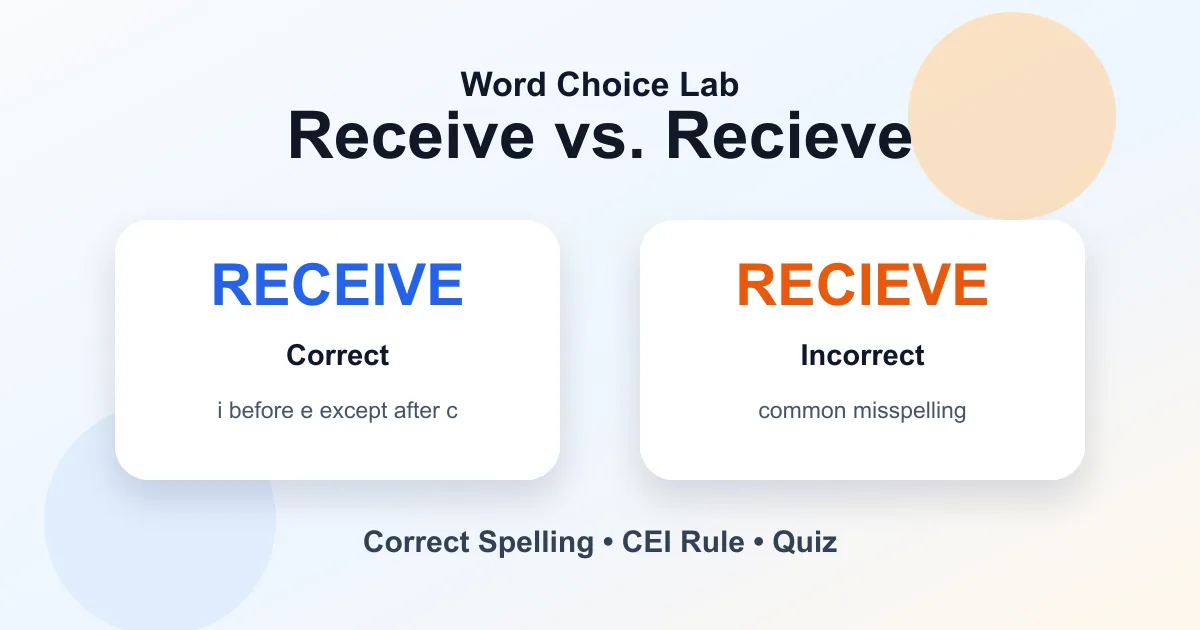
Receive is the correct spelling. Recieve is a common misspelling.
- Correct: Did you receive my email?
- Incorrect: Did you recieve my email?
This mistake is common because English has confusing ie and ei spelling patterns. In receive, the correct order is ei after c: r-e-c-e-i-v-e.
Receive vs. recieve at a glance
| Spelling | Status | Example |
|---|---|---|
| receive | correct | I hope you receive the package today. |
| recieve | incorrect | Avoid recieve in careful writing. |
Quick rule:
- Write receive.
- Do not write recieve.
- Remember: i before e, except after c — receive has cei.
What does receive mean?
Receive means to get, accept, be given, or take in something.
- I will receive the report tomorrow.
- She hopes to receive a reply soon.
- We did not receive your payment.
- The winner will receive a prize.
You can receive many kinds of things:
- an email
- a message
- a package
- a gift
- a payment
- an award
- advice
- information
If you mean “get” in a slightly more formal way, receive is often the right word.
Is recieve a word?
No. Recieve is not the standard spelling. It is a misspelling of receive.
You may see recieve in drafts, text messages, old comments, or typing mistakes, but it should be corrected in polished writing.
Use receive in:
- school writing
- business emails
- invoices
- resumes
- website copy
- support messages
- SEO articles
This spelling matters because recieve is a very noticeable error in professional writing.
The easiest memory trick
Use the classic spelling rule:
> I before E, except after C.
In receive, the vowel pair comes after c, so the order is ei:
- rec + ei + ve
- receive
Not:
- rec + ie + ve
- recieve
The rule has exceptions in English, but it works well for receive.
Receive examples
Here are more sentences with receive.
- You should receive a confirmation email.
- Did the office receive the documents?
- The charity will receive the donation next week.
- Students who pass will receive a certificate.
- I did not receive the package.
- The customer may receive a refund.
In each sentence, receive means get, accept, or be given.
Recieve examples corrected
These examples show the common misspelling and the corrected version.
Incorrect:
- I didn’t recieve the message.
- You will recieve a code by email.
- Did she recieve the award?
- We hope to recieve payment soon.
Correct:
- I didn’t receive the message.
- You will receive a code by email.
- Did she receive the award?
- We hope to receive payment soon.
The meaning is understandable, but the spelling should be receive.
Received, receiving, and receiver
Related forms keep the same cei spelling pattern.
| Form | Example |
|---|---|
| receive | I will receive the file. |
| received | I received the file. |
| receiving | We are receiving calls. |
| receiver | The receiver picked up the signal. |
Examples:
- I received your email yesterday.
- We are receiving more orders this month.
- The radio receiver stopped working.
Do not change receive to recieve when adding endings.
Incorrect:
- recieved
- recieving
- reciever
Correct:
- received
- receiving
- receiver
Receive vs. receipt
Receive and receipt are related in meaning, but they are spelled differently.
Receive is a verb.
- Did you receive the payment?
Receipt is a noun.
- Please keep the receipt.
The spelling of receipt is also tricky because it has a silent p. But the start of the word still helps:
- receive
- receipt
Both begin with rece-, not recie-.
Receive vs. get
Receive and get are close, but they have different tones.
Get is more casual:
- Did you get my text?
Receive is more formal or professional:
- Did you receive my email?
Both are correct. Use receive when you want a clearer, more polished, or businesslike tone.
Receive in email and business writing
Receive is especially common in email, customer service, shipping, and payment contexts.
- Did you receive the invoice?
- We did not receive your application.
- You should receive a tracking number soon.
- The customer will receive a confirmation email.
In business writing, receive often sounds more professional than get.
Casual:
- Did you get my email?
More professional:
- Did you receive my email?
Both sentences are understandable, but the second one may fit better in formal communication.
Receive in passive sentences
Receive also appears in passive-style sentences where the focus is on what someone got.
- The payment was received on Monday.
- Your request has been received.
- The package was received by the front desk.
- Applications must be received before the deadline.
These sentences are common in official notices and business messages. The spelling still uses cei:
- received
- not recieved
If you write customer emails, order updates, or application instructions, this form is worth memorizing.
Common phrases with receive
Use receive in phrases like:
- receive an email
- receive a message
- receive a package
- receive payment
- receive a refund
- receive an award
- receive permission
- receive feedback
- receive treatment
Examples:
- You will receive a refund within five business days.
- The student received an award for writing.
- We did not receive permission to publish the image.
Common mistakes
Mistake 1: Writing recieve
Incorrect: Did you recieve the email?
Correct: Did you receive the email?
Mistake 2: Writing recieved
Incorrect: I recieved your message.
Correct: I received your message.
Mistake 3: Writing recieving
Incorrect: We are recieving many calls.
Correct: We are receiving many calls.
Mistake 4: Confusing receive and receipt
Incorrect: I need a receive for this purchase.
Correct: I need a receipt for this purchase.
Correct:
- I need to receive the receipt.
More example sentences
Correct use of receive
- I expect to receive a reply today.
- The team received helpful feedback.
- You will receive instructions after registration.
- The company is receiving applications now.
- The school received new computers.
Incorrect spelling fixed
- Incorrect: I hope to recieve the package soon.
- Correct: I hope to receive the package soon.
- Incorrect: She recieved a scholarship.
- Correct: She received a scholarship.
- Incorrect: We are recieving updates every hour.
- Correct: We are receiving updates every hour.
Quick quiz
Choose the correct spelling.
- Did you ___ my email?
- I ___ your message yesterday.
- We are ___ many requests.
- The correct spelling is ___.
- Avoid writing ___ in standard English.
Answers:
- receive
- received
- receiving
- receive
- recieve
FAQ
Is it receive or recieve?
The correct spelling is receive. Recieve is incorrect.
Is recieve a word?
No. Recieve is a common misspelling of receive.
Why is receive spelled with ei?
Because the vowel pair comes after c. The memory rule is i before e, except after c.
Is it received or recieved?
The correct spelling is received.
Is it receiving or recieving?
The correct spelling is receiving.
The same context-first habit also helps with Necessary vs. Neccessary and Separate vs. Seperate. For a wider set of examples in this topic, use the Spelling Confusions archive as the category grows.
Final tip
The correct spelling is receive. Do not write recieve.
Remember: i before e, except after c — receive.