
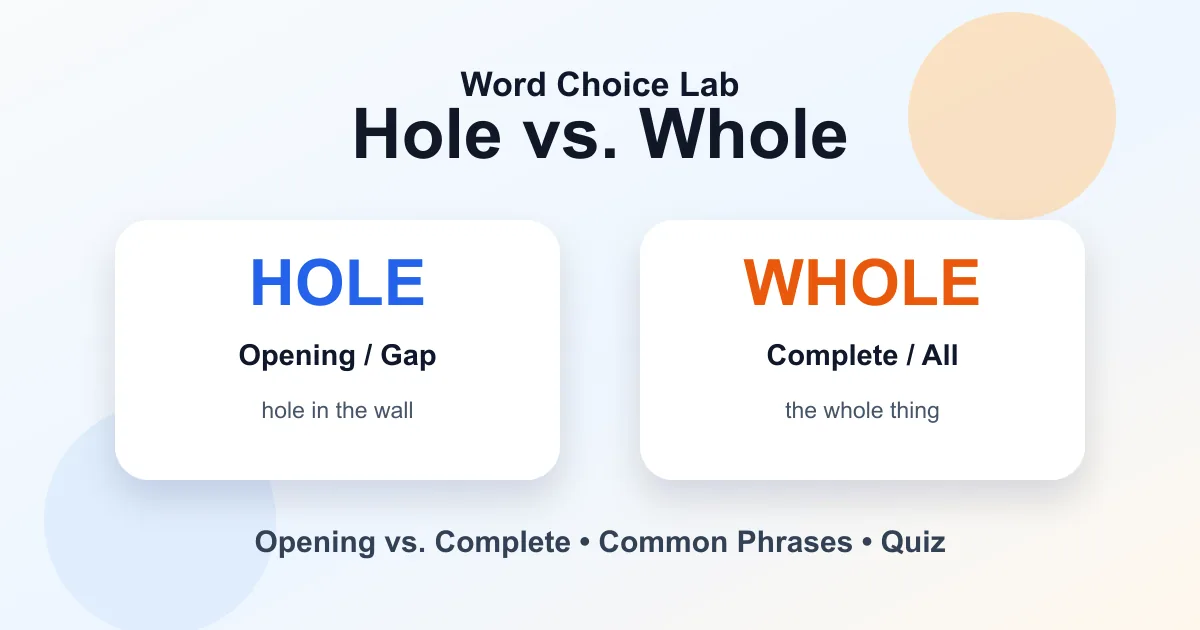
Hole vs. Whole: Difference, Examples, and an Easy Memory Trick
Hole means an opening, gap, hollow space, or empty place. Whole means complete, entire, full, or all of something.
- There is a hole in my sock.
- I read the whole book in one day.
These words sound the same, so they are easy to confuse. If you mean an opening or empty space, use hole. If you mean complete or all of something, use whole.
Hole vs. whole at a glance
| Word | Meaning | Example |
|---|---|---|
| hole | opening, gap, hollow space | The dog dug a hole in the yard. |
| whole | complete, entire, all | We watched the whole movie. |
Quick rule:
- Hole = opening or gap.
- Whole = complete or all.
- If you can replace it with entire, use whole.
When to use hole
Use hole when you mean an opening, gap, empty space, pit, or missing part.
- There is a hole in the wall.
- The child dug a hole in the sand.
- My sweater has a small hole.
- The story has a plot hole.
Hole is usually a noun. It can refer to physical openings or figurative gaps.
Common phrases include:
- a hole in the ground
- a hole in the wall
- a hole in my sock
- a plot hole
- a loophole
- a black hole
- a golf hole
If the sentence is about a gap, opening, missing piece, or hollow area, hole is usually correct.
When to use whole
Use whole when you mean complete, entire, full, or not divided.
- I ate the whole apple.
- She told the whole story.
- The whole class passed the test.
- We spent the whole day cleaning.
Whole is often an adjective. It describes a noun as complete or entire.
Common phrases include:
- the whole thing
- the whole day
- the whole story
- the whole family
- the whole world
- a whole number
- whole milk
If the sentence means complete, entire, or all of something, whole is usually correct.
The easiest memory trick
Use this memory trick:
> A hole has an empty space in it.
And:
> Whole begins with wh, like wholly, which means completely.
So:
- hole = gap or opening
- whole = complete or entire
Another easy test:
> If you can say entire, use whole.
Example:
- the whole book = the entire book
- a hole in the book = an opening, tear, or missing part
Hole examples
Here are more sentences with hole.
- The nail left a hole in the wall.
- He stepped into a hole and twisted his ankle.
- There is a hole in the roof.
- The detective found a hole in the suspect’s story.
- The golfer hit the ball into the hole.
- The company discovered a hole in its security system.
In each sentence, hole means an opening, gap, pit, or missing part.
Whole examples
Here are more sentences with whole.
- The whole team celebrated the win.
- I slept for the whole flight.
- She spent the whole weekend studying.
- The whole house smelled like fresh bread.
- He wanted to understand the whole problem.
- The recipe uses a whole cup of sugar.
In each sentence, whole means complete, entire, full, or all.
Hole in the wall or whole in the wall?
The correct phrase is hole in the wall.
Correct:
- There is a hole in the wall.
- We found a small hole in the wall behind the shelf.
Incorrect:
- There is a whole in the wall.
Why? Because the phrase refers to an opening or gap in a wall.
However, hole-in-the-wall can also describe a small, simple, hidden, or inexpensive place, often a restaurant or shop.
- We found a great hole-in-the-wall restaurant downtown.
Whole thing or hole thing?
The correct phrase is whole thing when you mean all of something.
Correct:
- I watched the whole thing.
- Tell me the whole thing from the beginning.
- She bought the whole thing instead of one piece.
Incorrect:
- I watched the hole thing.
Use whole because you mean complete or entire.
Whole day or hole day?
The correct phrase is whole day.
Correct:
- We worked the whole day.
- She waited the whole day for a reply.
- The whole day felt busy.
Incorrect:
- We worked the hole day.
Use whole because you mean the entire day.
Hole story or whole story?
Usually, the correct phrase is whole story.
Correct:
- Tell me the whole story.
- You do not know the whole story.
But hole in the story can also be correct if you mean a missing part or problem.
Correct:
- There is a hole in his story.
- The movie has a major plot hole.
So:
- whole story = complete story
- hole in the story = missing or weak part
Hole vs. whole in common phrases
| Correct phrase | Meaning |
|---|---|
| hole in the wall | an opening in a wall; also a small hidden place |
| hole in my sock | an opening or tear |
| plot hole | a gap or inconsistency in a story |
| golf hole | the target cup in golf |
| whole day | entire day |
| whole thing | all of it |
| whole family | all family members |
| whole number | a number without a fraction or decimal |
Most mistakes happen in phrases like whole thing, whole day, and hole in the wall.
Common mistakes
Mistake 1: Writing hole for complete
Incorrect: I read the hole book.
Correct: I read the whole book.
Mistake 2: Writing whole for an opening
Incorrect: There is a whole in my shirt.
Correct: There is a hole in my shirt.
Mistake 3: Writing hole thing
Incorrect: I watched the hole thing.
Correct: I watched the whole thing.
Mistake 4: Writing whole in the wall
Incorrect: The picture covered a whole in the wall.
Correct: The picture covered a hole in the wall.
More example sentences
Hole
- The rabbit disappeared into a hole.
- The plumber fixed the hole in the pipe.
- The argument has a serious hole.
- The child cut a hole in the paper.
- The road had a deep hole after the storm.
Whole
- The whole room was silent.
- I want the whole truth.
- The whole project took six months.
- She drank a whole bottle of water.
- The whole plan changed after the meeting.
Quick quiz
Choose the correct word.
- There is a ___ in my shoe.
- I ate the ___ sandwich.
- The movie has a plot ___.
- The ___ class was excited.
- We spent the ___ morning outside.
Answers:
- hole
- whole
- hole
- whole
- whole
FAQ
What is the difference between hole and whole?
Hole means an opening, gap, or empty space. Whole means complete, entire, or all.
Is it hole thing or whole thing?
The correct phrase is whole thing when you mean all of something.
Is it hole day or whole day?
The correct phrase is whole day because it means the entire day.
Is it hole in the wall or whole in the wall?
The correct phrase is hole in the wall because it means an opening or gap in a wall.
What is a plot hole?
A plot hole is a gap, mistake, or inconsistency in the logic of a story.
The same context-first habit also helps with Forth vs. Fourth and Flair vs. Flare. For a wider set of examples in this topic, use the Homophones archive as the category grows.
Final tip
Use hole for an opening, gap, or missing part. Use whole for complete, entire, or all.
Remember: whole = entire, hole = empty space.