
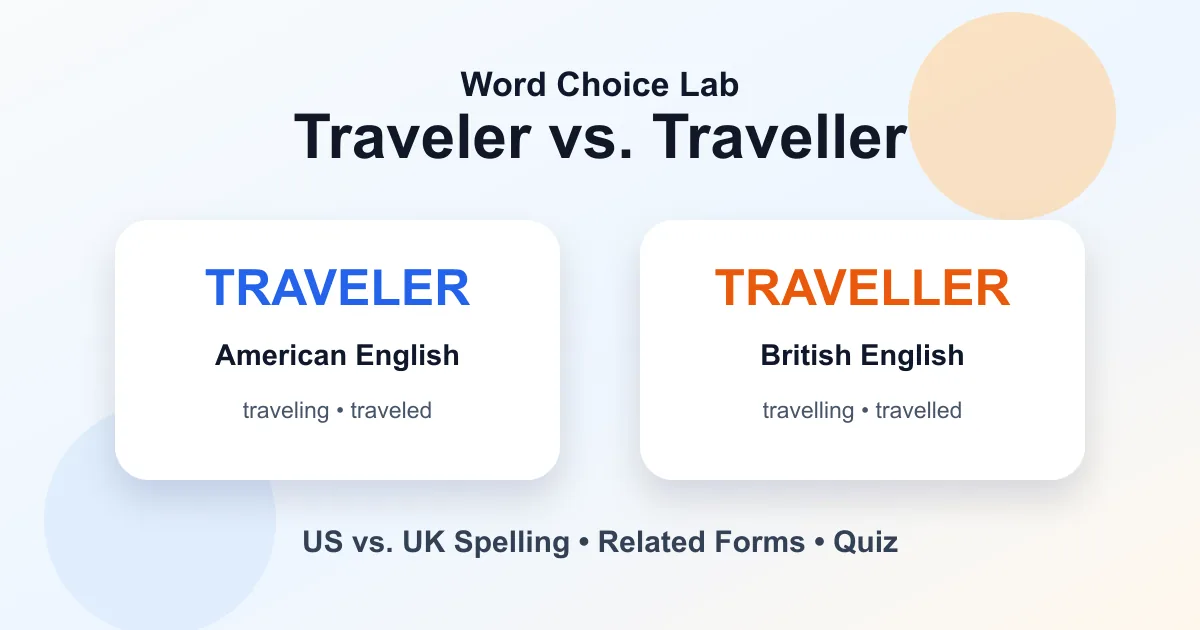
Traveler vs. Traveller: American and British Spelling, Examples, and Related Words
Traveler is the standard spelling in American English. Traveller is the standard spelling in British English and in many other varieties of English.
- American English: The traveler booked a flight to Denver.
- British English: The traveller booked a train to Edinburgh.
Both spellings are correct. The best choice depends on your audience and the spelling style you are using. If your website, school paper, business document, or article is written for a US audience, traveler is usually the safer choice. If it is written for a UK audience, traveller is usually expected.
Traveler vs. traveller at a glance
| Spelling | English variety | Example |
|---|---|---|
| traveler | American English | The traveler carried one small bag. |
| traveller | British English | The traveller arrived before noon. |
Quick rule:
- Writing for US readers? Use traveler.
- Writing for UK readers? Use traveller.
- Keep the same spelling style across related words.
When to use traveler
Use traveler in American English to mean a person who travels from one place to another.
- The traveler checked in at the hotel.
- A careful traveler keeps copies of important documents.
- The guide was written for the solo traveler.
- Every frequent traveler knows the airport layout.
In US writing, traveler has one l in the middle. This spelling matches other common American forms such as traveling and traveled.
Traveler in everyday American English
In American English, traveler can describe almost anyone who takes a trip. It can refer to a tourist, a commuter, a business passenger, a backpacker, or someone moving through a place.
- Business travelers often prefer early flights.
- The museum offers discounts for young travelers.
- The app helps travelers compare hotel prices.
The word does not always mean someone is on a long or international trip. A person taking a short weekend trip can still be called a traveler.
When to use traveller
Use traveller in British English and in many countries that follow British spelling.
- The traveller waited on platform four.
- The map is useful for first-time travellers.
- A tired traveller asked for directions.
- The hotel welcomes business travellers.
In British spelling, traveller has a double l. This spelling matches related British forms such as travelling and travelled.
Traveller in UK-style writing
If your article uses British spelling in words like colour, centre, and favourite, then traveller will look more consistent than traveler.
- The traveller walked through the city centre.
- Many travellers prefer rail travel.
- The guide gives practical advice for new travellers.
Consistency matters because mixed spelling can make writing look unedited. For example, colour and traveler in the same article may distract readers unless there is a specific reason for the mix.
Is traveler or traveller correct?
Both are correct. They are regional spellings of the same word.
- Traveler = American spelling
- Traveller = British spelling
Neither spelling is more intelligent, formal, or grammatical. The choice is about audience and style.
Use this simple test:
> If you would write color, write traveler. If you would write colour, write traveller.
Related words: traveling, travelling, traveled, travelled
The same American vs. British spelling pattern appears in related words.
| American English | British English |
|---|---|
| traveler | traveller |
| travelers | travellers |
| traveling | travelling |
| traveled | travelled |
| traveler-friendly | traveller-friendly |
Examples:
- American: We are traveling through Arizona.
- British: We are travelling through Scotland.
- American: She traveled alone last summer.
- British: She travelled alone last summer.
This pattern can be confusing because the base word travel ends in l in both spelling systems. The difference appears when endings are added.
Why does British English double the l?
British English often keeps a double consonant before adding endings such as -er, -ed, and -ing in words like traveller, travelled, and travelling.
American English usually uses the shorter spelling in these forms:
- traveler
- traveled
- traveling
This is a spelling convention, not a meaning difference. A traveler and a traveller are the same kind of person.
What about proper names?
Always keep official names exactly as they are written. Do not change a brand, organization, book title, newspaper name, or product name just to match your spelling style.
For example, if a publication or company uses Traveller in its official name, keep Traveller. If it uses Traveler, keep Traveler.
Correct:
- I read an article in a travel magazine called Traveller.
- The company name uses Traveler with one l.
Incorrect:
- Changing a proper name from Traveller to Traveler without permission.
- Changing a proper name from Traveler to Traveller because your article uses British spelling.
Proper names are names first and spelling examples second.
Traveler vs. tourist
Traveler and tourist are related, but they are not always identical.
A traveler is a broad word for someone who travels. A tourist usually means someone visiting a place for pleasure, sightseeing, or vacation.
Examples:
- Every tourist is a traveler, but not every traveler is a tourist.
- A business traveler may not be a tourist.
- A tourist might visit museums, beaches, and landmarks.
This distinction is the same in British English:
- Every tourist is a traveller, but not every traveller is a tourist.
Common mistakes
Mistake 1: Mixing spelling styles
Incorrect for US style: The traveller is traveling today.
Better for US style: The traveler is traveling today.
Better for UK style: The traveller is travelling today.
Mistake 2: Thinking one spelling is wrong
Incorrect: Traveller is a misspelling.
Better: Traveller is the British spelling.
Incorrect: Traveler is a misspelling.
Better: Traveler is the American spelling.
Mistake 3: Changing official names
Incorrect: I changed the magazine title from Traveller to Traveler for consistency.
Better: Keep official names exactly as they appear.
Mistake 4: Using traveller in a US-only style guide
If your audience is mainly in the United States, traveler is usually the better choice for general writing.
More example sentences
American English examples
- The traveler packed light for the weekend.
- A frequent traveler can earn airline rewards quickly.
- The airport lounge is open to business travelers.
- The website offers tips for the budget traveler.
- Every traveler should check the weather before leaving.
British English examples
- The traveller packed light for the weekend.
- A frequent traveller can earn rail rewards quickly.
- The station lounge is open to business travellers.
- The website offers tips for the budget traveller.
- Every traveller should check the weather before leaving.
Quick quiz
Choose the best spelling for each sentence.
- US style: The ___ missed the morning flight.
- UK style: The ___ waited at the railway station.
- US style: Many ___ compare hotel prices online.
- UK style: We are ___ through Wales next month.
Answers:
- traveler
- traveller
- travelers
- travelling
FAQ
Is traveller wrong in American English?
It is not impossible to understand, but traveler is the standard general American spelling.
Is traveler wrong in British English?
It is understandable, but traveller is the standard British spelling.
Which spelling should I use for a US website?
Use traveler for a US audience unless you are quoting or writing an official name that uses traveller.
Which spelling should I use for SEO?
Use the spelling your target audience searches and expects. For a US-focused site, use traveler as the main spelling and explain traveller as the British spelling.
Is travelling British or American?
Travelling is British spelling. Traveling is American spelling.
The same context-first habit also helps with Theater vs. Theatre and Center vs. Centre. For a wider set of examples in this topic, use the American vs British English archive as the category grows.
Final tip
Use traveler for American English and traveller for British English. Keep related forms consistent: traveler/traveling/traveled for US style and traveller/travelling/travelled for UK style.
Remember: US = traveler, UK = traveller.