
Can vs. May: Difference, Examples, and an Easy Rule
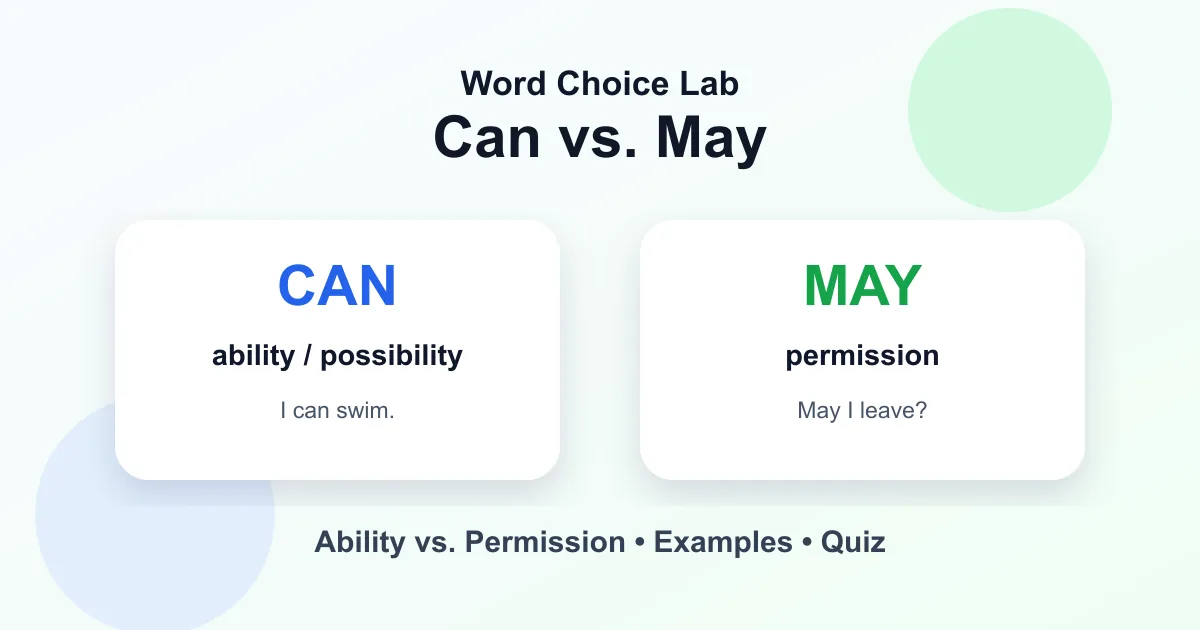
Use can for ability or possibility. Use may for permission or formal possibility.
- I can swim.
- May I leave early?
- It may rain later.
The easy rule is: can = able to; may = allowed to.
Can vs. may at a glance
| Word | Main use | Simple meaning | Example |
|---|---|---|---|
| can | ability, possibility, informal permission | be able to; be possible | She can speak Spanish. |
| may | permission or possibility | be allowed to; possibly | You may begin now. |
Quick test:
- If the meaning is able to, use can.
- If the meaning is allowed to, may is the more formal choice.
- In casual speech, can is common for permission too.
When to use can
Can is a modal verb. It often means that someone has the ability to do something.
- I can drive a manual car.
- She can answer the question.
- We can finish this by Friday.
- He can run five miles without stopping.
In these examples, can means is able to.
Can for possibility
Use can when something is generally possible.
- Grammar can be confusing.
- A small mistake can change the meaning.
- Too much caffeine can affect sleep.
- Good examples can make a rule easier.
Here, can means something is possible or sometimes happens.
Can for informal permission
In everyday English, can is commonly used to ask for or give permission.
- Can I borrow your pen?
- You can leave when you finish.
- Can we use our notes?
- You can park behind the building.
This is natural in conversation. In more formal settings, may can sound more polite or traditional.
When to use may
May is used for permission and possibility. It often sounds more formal than can.
May for permission
Use may to ask for or give permission politely.
- May I ask a question?
- You may begin the test.
- Students may use a calculator.
- Visitors may enter after 9 a.m.
In these examples, may means be allowed to.
May for possibility
Use may when something is possible but not certain.
- It may snow tonight.
- She may arrive late.
- This update may solve the problem.
- We may need more examples.
This use is similar to might, though might often sounds less certain.
Can I or may I?
Both are common, but the tone is different.
- Can I leave early? = casual and natural
- May I leave early? = more polite or formal
Teachers sometimes say that can asks about ability and may asks about permission. That distinction is useful, especially in formal writing. But in real everyday English, can I is widely used for permission.
Use may I when you want to sound especially polite:
- May I use your phone?
- May I speak with you for a moment?
Use can I in normal casual situations:
- Can I call you later?
- Can I sit here?
Can or may for rules?
Use may for formal rules, policies, and official permission.
- Employees may work remotely on Fridays.
- Students may not use phones during the exam.
- Guests may enter through the main door.
Use can when the tone is casual or practical.
- You can pay online.
- You can pick up your order after 3 p.m.
Can not, cannot, and may not
Cannot or can’t means not able to or not possible.
- I cannot open the file.
- We can’t attend the meeting.
May not often means not allowed.
- You may not enter this area.
- Students may not copy answers.
Be careful: may not can also mean possibly not.
- She may not know the answer. = It is possible she does not know.
Context shows the meaning.
Can have or may have?
Use may have when you are uncertain about a past event.
- She may have missed the email.
- The file may have been deleted.
Use can have less often. It appears in certain general possibility or question patterns, but may have is usually clearer for past uncertainty.
- This kind of error can have serious consequences.
- Can she have forgotten already?
For most learners, may have is the safer choice for “possibly happened.”
Common mistakes and corrections
Incorrect: May you help me?
Better: Can you help me? More polite: Could you help me?
Use can/could when asking someone to do something for you.
Incorrect: I may swim very well.
Correct: I can swim very well.
Use can for ability.
Incorrect: Students can not use phones during the exam.
Better for a rule: Students may not use phones during the exam.
Use may not when the meaning is not allowed.
Incorrect: Can I be excused? is always wrong.
Correct: Can I be excused? is common in everyday English. More formal: May I be excused?
Both are understandable. May I is more formal.
Incorrect: She can be late today.
Better for possibility: She may be late today.
Use may when you mean something is possible in a specific situation.
Examples with can and may together
- I can finish the report, but I may need more time.
- You may use the lab if you can follow the safety rules.
- She can speak French, so she may help with the translation.
- This rule can be confusing, but examples may make it clearer.
- Can you send the file, and may I share it with the team?
These examples show the main contrast: can often points to ability, while may often points to permission or possibility.
How to remember can and may
Use this memory trick:
- can = capability
- may = permission
Ask yourself:
- Is the question about ability? Use can.
- Is the question about permission? Use may for formal writing, or can for casual speech.
Quick quiz
Choose can or may.
- I ___ type 80 words per minute.
- ___ I ask a question?
- Students ___ leave after they finish the test.
- This medicine ___ cause drowsiness.
- She ___ be at home, but I am not sure.
- ___ you help me move this table?
- Visitors ___ not enter this room.
- He ___ play the piano well.
Answers
- can — ability
- may — polite permission
- may — formal permission
- can — general possibility
- may — specific possibility
- can or could — request for help
- may — not allowed
- can — ability
FAQ
What is the difference between can and may?
Can usually means ability or possibility. May usually means permission or possibility.
Is “can I” wrong?
No. Can I is common and natural in everyday English when asking permission. May I is more formal or polite.
Is it can I help you or may I help you?
Both are possible. Can I help you? is common and natural. May I help you? sounds more formal or service-oriented.
Is may more polite than can?
Usually, yes. May I often sounds more polite or formal than can I.
Should I use can or may in business writing?
Use may for formal permission and can for ability or practical possibility.
What is the difference between may not and cannot?
May not often means not allowed. Cannot means not able to or not possible.
The same context-first habit also helps with Good vs. Well and Lay vs. Lie. For a wider set of examples in this topic, use the Grammar & Usage archive as the category grows.
Final tip
Use can for ability. Use may for permission, especially in formal writing.
Remember: can = able, may = allowed.