
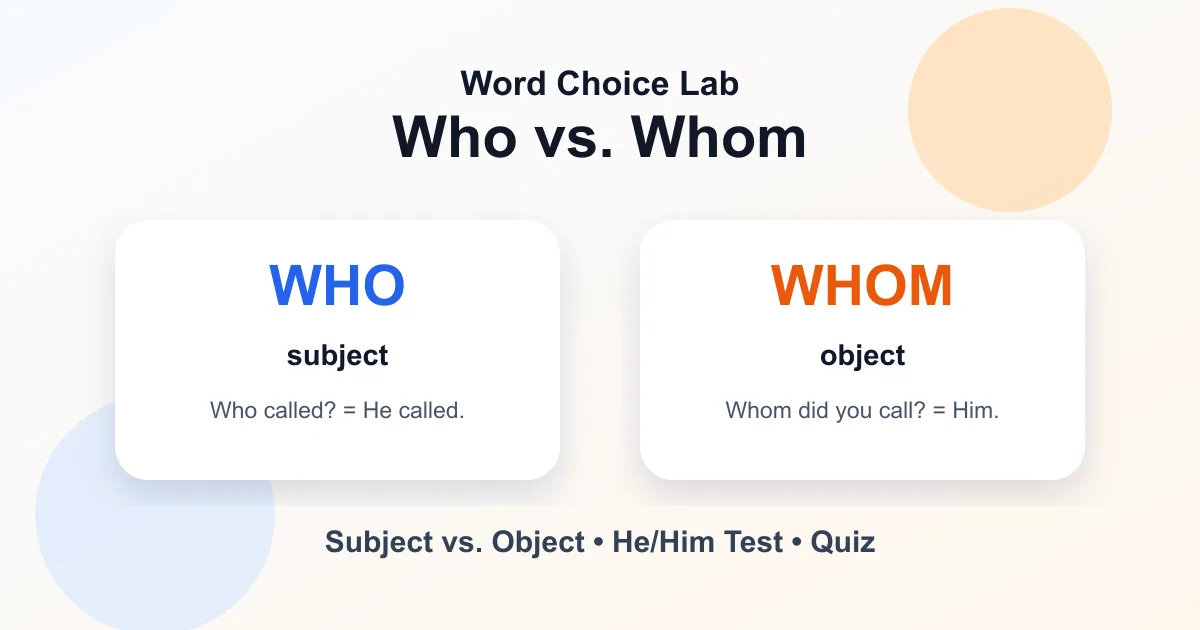
Who vs. Whom: Difference, Examples, and an Easy Test
Use who for the subject of a verb. Use whom for the object of a verb or preposition.
- Who called you?
- Whom did you call?
- To whom should I send the file?
The easiest test is: if you could answer with he or she, use who. If you could answer with him or her, use whom.
Who vs. whom at a glance
| Word | Grammar role | Simple test | Example |
|---|---|---|---|
| who | subject | he/she | Who wrote this? |
| whom | object | him/her | Whom did you invite? |
Quick test:
- If the word is doing the action, use who.
- If the word is receiving the action or follows a preposition, use whom.
When to use who
Use who when the pronoun is the subject of a verb. The subject is the person doing the action or being described.
- Who wants coffee?
- Who wrote the report?
- Do you know who called?
- The woman who lives next door is a teacher.
In these examples, who is doing the action: wanting, writing, calling, or living.
Who in questions
Use who when asking about the person performing the action.
- Who sent the email?
- Who is responsible for this task?
- Who can answer this question?
- Who made the decision?
The answer would be a subject:
- She sent the email.
- He made the decision.
Because she and he are subject forms, who is correct.
Who in relative clauses
Use who when referring to a person who is the subject inside a relative clause.
- She is the editor who reviewed the article.
- I thanked the teacher who helped me.
- The students who arrived early got seats.
- He is someone who works carefully.
In each relative clause, who performs the action.
When to use whom
Use whom when the pronoun is the object of a verb or the object of a preposition.
- Whom did you meet?
- Whom should we contact?
- To whom did you speak?
- The manager whom we hired starts Monday.
In these examples, whom receives the action or follows a preposition.
Whom as the object of a verb
Use whom when someone receives the action.
- Whom did Sarah invite?
- Whom did the committee choose?
- Whom do you admire most?
- The candidate whom we interviewed was excellent.
The answer would use an object pronoun:
- Sarah invited him.
- The committee chose her.
Because him and her are object forms, whom is the formal choice.
Whom after a preposition
Use whom after prepositions such as to, for, with, by, from, and about.
- To whom should I address the letter?
- For whom is this package?
- With whom are you meeting?
- By whom was the decision approved?
This structure sounds formal. In everyday conversation, people often move the preposition to the end and use who:
- Who should I address the letter to?
- Who are you meeting with?
Those informal versions are common in speech and casual writing.
The he/him test
The he/him test is the easiest way to choose who or whom.
Use who if the answer would be he or she.
- Who called?
- He called.
Use whom if the answer would be him or her.
- Whom did you call?
- I called him.
Helpful shortcut:
- him = whom
- he = who
The m in him can remind you to use whom.
Who or whom in everyday English?
In modern spoken English, many people use who instead of whom, especially in casual questions.
- Casual: Who did you invite?
- Formal: Whom did you invite?
This means whom can sound formal, careful, or old-fashioned in some contexts. However, whom is still useful in formal writing, academic writing, and after a preposition.
For most everyday situations, who is common and natural. For polished formal writing, use whom when the grammar calls for it.
Who or whom after a preposition?
After a preposition, whom is the formal standard.
- Formal: To whom did you speak?
- Formal: The person with whom I spoke was helpful.
In casual English, the preposition often moves to the end and who is used.
- Casual: Who did you speak to?
- Casual: The person who I spoke with was helpful.
Both styles are understandable. Choose based on tone.
Whoever or whomever?
Use the same subject-object logic inside the clause.
- Give the ticket to whoever wants it.
- Give the ticket to whomever you choose.
In the first sentence, whoever is the subject of wants. In the second sentence, whomever is the object of choose.
Do not choose whomever just because it follows to. Look at the role inside its own clause.
Common mistakes and corrections
Incorrect: Whom is calling?
Correct: Who is calling?
Use who because the person is doing the action.
Incorrect: Who did you invite?
Formal: Whom did you invite?
Use whom in formal writing because the person is receiving the action. In casual English, who did you invite? is very common.
Incorrect: To who should I send this?
Correct: To whom should I send this?
Use whom after the preposition to.
Incorrect: The man whom helped us was kind.
Correct: The man who helped us was kind.
Use who because the man did the helping.
Incorrect: Whomever wants to join can sign up.
Correct: Whoever wants to join can sign up.
Use whoever because it is the subject of wants.
Examples with who and whom together
- Who sent the message, and to whom was it sent?
- The writer who created the guide is the person whom we interviewed.
- Who approved the plan, and with whom did they discuss it?
- The student who answered first is the student whom the teacher praised.
- Who is responsible for choosing whom to invite?
These examples show the main contrast: who does the action; whom receives the action.
How to remember who and whom
Use this memory trick:
- who = he/she
- whom = him/her
Or remember:
- who acts
- whom receives
If you are writing casually, who will often sound more natural. If you are writing formally, the subject-object rule will help you use whom correctly.
Quick quiz
Choose who or whom.
- ___ wrote this article?
- ___ did you call yesterday?
- To ___ should I send the invitation?
- The person ___ helped me was patient.
- The person ___ I helped thanked me.
- ___ wants to join the meeting?
- With ___ are you working?
- Give the prize to ___ wins.
Answers
- Who — subject of wrote
- Whom — object of call in formal writing
- whom — object of the preposition to
- who — subject of helped
- whom — object of helped in formal writing
- Who — subject of wants
- whom — object of the preposition with
- whoever — subject of wins
FAQ
What is the difference between who and whom?
Who is used for the subject of a verb. Whom is used for the object of a verb or preposition.
Is whom still used?
Yes, but it is more common in formal writing than in everyday speech. Many speakers use who where formal grammar would use whom.
Is it who did you call or whom did you call?
In formal writing, use whom did you call? In casual speech, who did you call? is common.
Is it to who or to whom?
Use to whom in formal writing because whom is the object of the preposition to.
What is the easiest test for who vs. whom?
Use who if the answer could be he or she. Use whom if the answer could be him or her.
Is whoever or whomever correct?
It depends on the word’s role inside its own clause. Use whoever as a subject and whomever as an object.
The same context-first habit also helps with Ensure vs. Insure and Imply vs. Infer. For a wider set of examples in this topic, use the Grammar & Usage archive as the category grows.
Final tip
Use who when the person is doing the action. Use whom when the person is receiving the action or following a preposition.
Remember: who = he, whom = him.