
Imply vs. Infer: Difference, Examples, and an Easy Rule
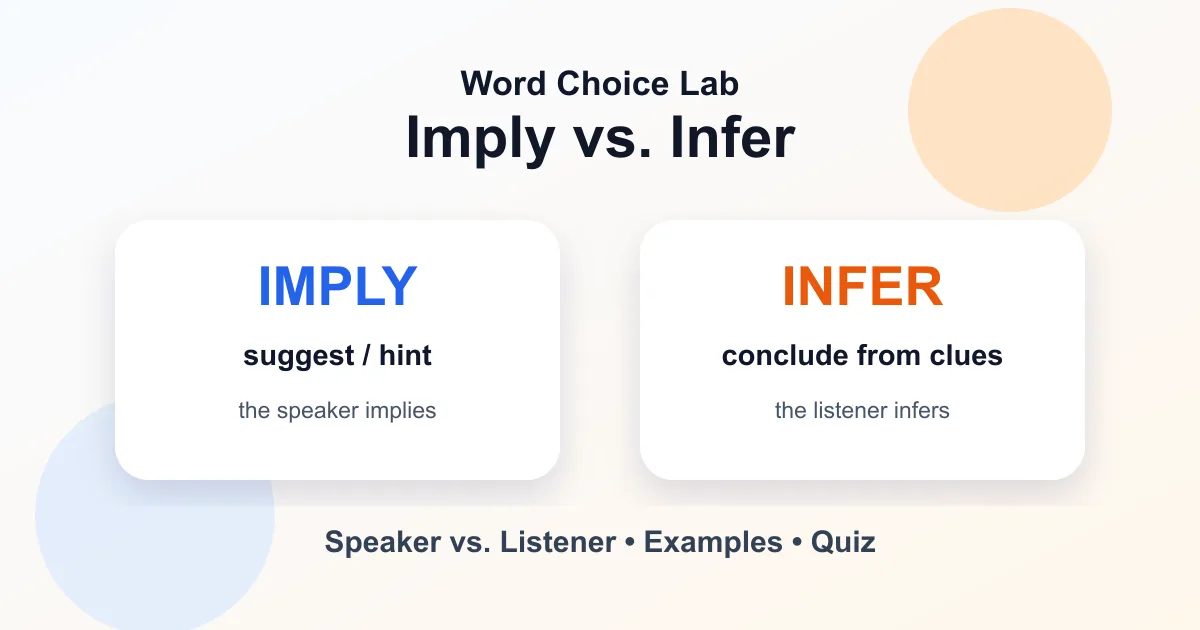
Use imply when someone suggests something without saying it directly. Use infer when someone understands or concludes something from clues.
- Her tone implied that she was upset.
- I inferred from her tone that she was upset.
The easiest rule is: the speaker implies; the listener infers.
Imply vs. infer at a glance
| Word | Who does it? | Meaning | Example |
|---|---|---|---|
| imply | speaker, writer, action, or evidence | to suggest without saying directly | His comment implied a problem. |
| infer | listener, reader, or observer | to conclude from evidence or clues | We inferred a problem from his comment. |
Quick test:
- If someone hints at a meaning, use imply.
- If someone figures out a meaning, use infer.
When to use imply
Imply means to suggest, hint, or communicate an idea indirectly. The meaning is sent out by a speaker, writer, action, situation, or piece of evidence.
- Are you implying that I made a mistake?
- The email implied that the deadline had changed.
- Her silence implied disagreement.
- The report implies that costs will rise.
In these examples, the words, silence, or report suggest a meaning without stating it directly.
Imply with speech and writing
Use imply when a person’s words suggest something.
- His joke implied that the plan was unrealistic.
- The announcement implied that more changes were coming.
- The article implies that the rule is outdated.
- She did not say no, but her answer implied it.
The person or text gives the clue.
Imply with actions or evidence
Actions and evidence can also imply something.
- A locked door implies that the office is closed.
- His expression implied surprise.
- The missing files imply a larger security problem.
- The data implies a connection between sleep and memory.
In this use, imply means the evidence points toward a meaning.
When to use infer
Infer means to reach a conclusion based on evidence, clues, or reasoning. The meaning is received or figured out by a listener, reader, or observer.
- I inferred that she was busy because she did not reply.
- From the data, researchers inferred a pattern.
- We can infer the meaning from context.
- The reader may infer that the narrator is unreliable.
In these examples, someone draws a conclusion.
Infer from clues
Use infer when someone understands something indirectly.
- From his accent, I inferred that he grew up in Texas.
- We inferred from the empty chairs that the meeting was canceled.
- The teacher asked students to infer the character’s motive.
- You can infer the answer from the final paragraph.
The clues do not say everything directly, so the person uses reasoning.
Infer in reading and analysis
Infer is common in school, reading comprehension, research, and analysis.
- What can you infer from the passage?
- The study allows us to infer a possible trend.
- Readers may infer that the character feels guilty.
- Analysts inferred that demand was increasing.
In these contexts, infer means to interpret evidence.
Speaker implies, listener infers
The clearest way to remember the difference is to think of communication as two sides:
- The speaker implies a message.
- The listener infers the message.
Example:
- Maria said, “Interesting choice,” in a cold voice.
- Maria implied that she did not like the choice.
- I inferred that Maria did not like the choice.
The same idea travels from one side to the other.
Imply or infer with “that”?
Both words can be followed by that, but the subject changes.
- His comment implied that the project was late.
- I inferred that the project was late.
Use implied that when the comment or speaker suggested the idea. Use inferred that when a person understood or concluded the idea.
Common phrases with imply and infer
Common phrases with imply:
- imply that
- seem to imply
- meant to imply
- the evidence implies
- the statement implies
Common phrases with infer:
- infer from
- reasonably infer
- readers can infer
- we can infer
- difficult to infer
Example: We can infer from the ending that the problem is not fully solved.
Common mistakes and corrections
Incorrect: I implied from her tone that she was angry.
Correct: I inferred from her tone that she was angry.
Use infer because you reached a conclusion from a clue.
Incorrect: The article infers that prices will rise.
Correct: The article implies that prices will rise.
Use imply because the article suggests the meaning.
Incorrect: Are you inferring that I lied?
Better: Are you implying that I lied?
Use implying when asking whether someone is hinting at a meaning.
Incorrect: Her silence inferred disagreement.
Correct: Her silence implied disagreement.
Silence gives the clue; it does not draw a conclusion.
Incorrect: The reader implies that the character is nervous.
Correct: The reader infers that the character is nervous.
The reader reaches the conclusion.
Examples with imply and infer together
- The email implied urgency, so I inferred that the task was important.
- His smile implied confidence, but we could not infer his real opinion.
- The author implies the answer, and the reader must infer it.
- The data implies a trend, but scientists should not infer too much from one study.
- She implied that the meeting was private, so I inferred that I should not attend.
These examples show the core contrast: imply sends the hint; infer receives and interprets it.
How to remember imply and infer
Use this memory trick:
- imply = put meaning in the message
- infer = find meaning from the message
Or keep the simple rule:
- speaker implies
- listener infers
Quick quiz
Choose imply or infer.
- What did the author ___ in the final paragraph?
- From the final paragraph, what can the reader ___?
- Her expression seemed to ___ disappointment.
- I ___ from the empty office that everyone had left.
- Are you ___ that this is my fault?
- The evidence ___ that the system failed earlier.
- Students should ___ the meaning from context.
- His answer did not directly say no, but it ___ it.
Answers
- imply — the author suggests
- infer — the reader concludes
- imply — expression gives a clue
- inferred — I concluded
- implying — you are hinting
- implies — evidence suggests
- infer — students conclude
- implied — answer suggested
FAQ
What is the difference between imply and infer?
Imply means to suggest something indirectly. Infer means to conclude something from evidence or clues.
Who implies and who infers?
The speaker or writer implies. The listener or reader infers.
Is “are you inferring” correct?
It can be correct if you mean “are you drawing a conclusion?” But if you mean “are you hinting that something is true?” use are you implying.
Can evidence imply something?
Yes. Evidence, data, silence, tone, or actions can imply a meaning.
Can a reader imply something?
Usually no. A reader usually infers. An author or text implies.
Is infer the same as guess?
Not exactly. To infer means to reach a conclusion based on clues or evidence. A guess may have little or no evidence.
The same context-first habit also helps with Raise vs. Rise and Like vs. As. For a wider set of examples in this topic, use the Similar Words archive as the category grows.
Final tip
Use imply when meaning is suggested. Use infer when meaning is understood from clues.
Remember: the message implies; the reader infers.