
Raise vs. Rise: Difference, Examples, and an Easy Rule
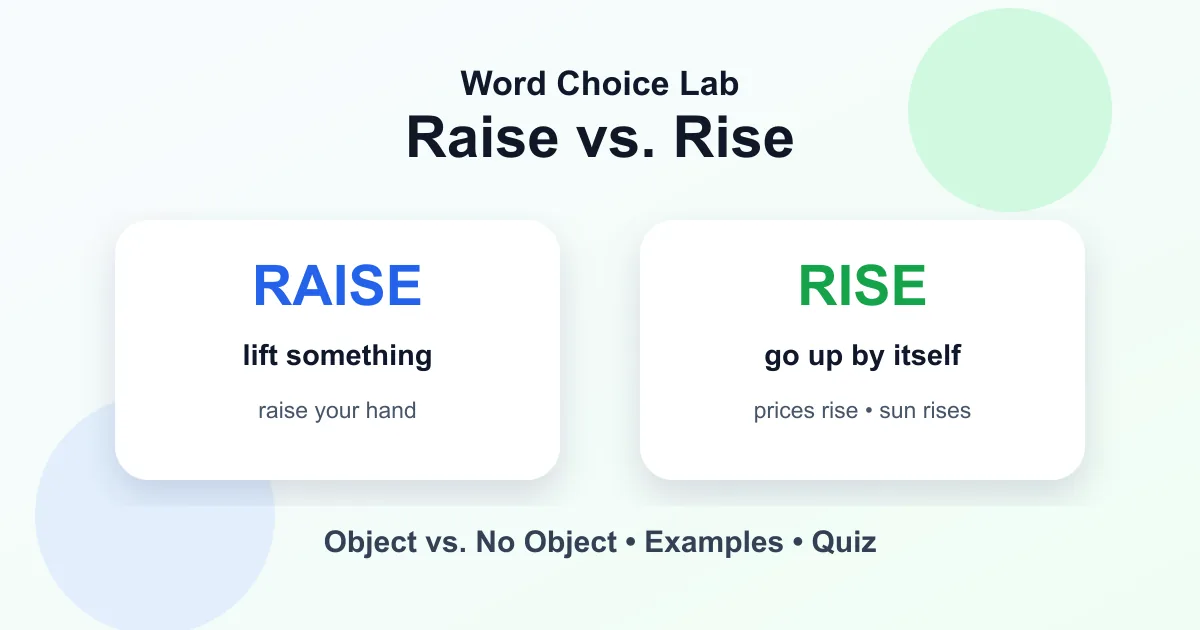
Use raise when someone or something lifts, increases, or brings something up. Use rise when something goes up by itself.
- Please raise your hand.
- The sun will rise at 6:15.
The easiest rule is: raise needs an object; rise usually does not.
Raise vs. rise at a glance
| Word | Main job | Simple meaning | Example |
|---|---|---|---|
| raise | transitive verb | to lift, increase, or bring something up | They will raise the price. |
| rise | intransitive verb | to go up, increase, or get higher by itself | Prices may rise next month. |
Quick test:
- If someone is doing the action to something, use raise.
- If something goes up on its own, use rise.
When to use raise
Raise is a transitive verb, which means it usually needs an object. The object is the thing being lifted, increased, or brought up.
- She raised her hand.
- The company raised its prices.
- We need to raise more money.
- The teacher raised an important question.
In each sentence, something receives the action: hand, prices, money, or question.
Raise meaning “lift”
Use raise when someone physically lifts something.
- Please raise the window.
- He raised the flag before the ceremony.
- She raised the cup to her lips.
- The worker raised the platform slowly.
If you can ask “What was lifted?” the answer is the object of raise.
Raise meaning “increase”
Use raise when someone or something causes an amount, level, price, salary, or number to increase.
- The bank may raise interest rates.
- The store raised the price by $5.
- The new policy could raise costs.
- Her manager raised her salary.
Here, raise means to make something higher.
Raise meaning “bring up”
Raise can also mean to mention, introduce, or bring attention to an issue.
- He raised a concern during the meeting.
- The article raises several questions.
- She raised the topic at dinner.
- The report raises doubts about the plan.
This meaning is common in business, academic, and formal writing.
Raise meaning “care for children or animals”
In American English, raise can mean to bring up or care for children or animals.
- They raised three children in Ohio.
- My grandparents raised chickens.
- She was raised by her aunt.
This use is standard in modern American English.
When to use rise
Rise is usually an intransitive verb, which means it does not take a direct object. The subject goes up, increases, or becomes higher.
- The sun rises in the east.
- Smoke rose from the chimney.
- Prices continue to rise.
- The crowd rose to its feet.
Nothing is directly being “risen” by someone else. The subject itself moves or increases.
Rise meaning “go up”
Use rise when something moves upward.
- The balloon began to rise.
- The water level may rise after the storm.
- Steam rose from the cup.
- The elevator rose to the tenth floor.
In these examples, the subject moves upward by itself or as the focus of the sentence.
Rise meaning “increase”
Use rise when a number, price, temperature, rate, or level increases.
- Gas prices may rise this summer.
- Temperatures will rise tomorrow.
- The unemployment rate rose slightly.
- Demand for the product has risen.
Compare:
- The company raised prices. = The company caused prices to go up.
- Prices rose. = Prices went up.
Rise meaning “get out of bed or stand up”
Rise can also mean to get up or stand.
- She rises at 6 a.m. every day.
- The audience rose and applauded.
- Please rise for the national anthem.
This use is more formal than get up, but it is still common in certain phrases.
Raise or rise with prices?
Both words can be correct, but the sentence structure changes.
- The company raised prices.
- Prices rose.
Use raise when someone causes the increase. Use rise when the thing increases.
More examples:
- The landlord raised the rent.
- The rent rose again this year.
- The city raised parking fees.
- Parking fees rose after the new policy.
Raise or rise with salary?
Use raise when talking about increasing someone’s salary.
- Her manager raised her salary.
- The company raised wages for hourly workers.
Use rise when the salary or wage itself increases.
- Her salary rose after the promotion.
- Average wages have risen in recent years.
In American English, a raise as a noun can also mean an increase in pay.
- She got a raise.
- I asked for a raise.
Raise or rise with hand?
Use raise your hand, not rise your hand.
- Correct: Please raise your hand.
- Incorrect: Please rise your hand.
The hand is the object being lifted, so raise is correct.
Past tense: raised, rose, risen
The past tense forms are different.
| Base verb | Simple past | Past participle |
|---|---|---|
| raise | raised | raised |
| rise | rose | risen |
Examples:
- She raised the flag yesterday.
- The sun rose at 6:30.
- Prices have risen quickly.
- The company has raised its fees.
Do not write rised. The correct past tense of rise is rose.
Common mistakes and corrections
Incorrect: Prices raised last month.
Correct: Prices rose last month.
Use rise because prices went up by themselves in the sentence.
Incorrect: The company rose the price.
Correct: The company raised the price.
Use raise because the company caused the price to increase.
Incorrect: Please rise your hand.
Correct: Please raise your hand.
Use raise because hand is the object.
Incorrect: The sun raises in the east.
Correct: The sun rises in the east.
Use rise because the sun goes up by itself.
Incorrect: The water has rose.
Correct: The water has risen.
Use risen after has/have.
Examples with raise and rise together
- The company raised prices, so prices rose.
- Heavy rain can raise the water level, and the river may rise quickly.
- She raised the blinds as the sun rose.
- The manager raised wages after average living costs rose.
- The teacher raised a question after student interest rose.
These examples show the main contrast: raise causes something to go up; rise means something goes up.
How to remember raise and rise
Use this memory trick:
- raise = someone raises something
- rise = something rises by itself
Ask yourself:
- What is being lifted or increased? Use raise.
- Is the subject going up on its own? Use rise.
Quick quiz
Choose raise or rise.
- Please ___ your hand if you have a question.
- The sun will ___ soon.
- The company may ___ prices next quarter.
- Prices could ___ next quarter.
- The river began to ___ after the rain.
- The charity hopes to ___ $10,000.
- Smoke ___ from the old building.
- Her salary has ___ since last year.
Answers
- raise — hand is the object
- rise — sun goes up
- raise — company causes increase
- rise — prices increase
- rise — river level goes up
- raise — collect money
- rose — past tense of rise
- risen — past participle of rise
FAQ
What is the difference between raise and rise?
Raise means to lift, increase, or bring something up. It usually needs an object. Rise means to go up or increase by itself and usually does not take a direct object.
Is it raise your hand or rise your hand?
Use raise your hand. The hand is the object being lifted.
Is it prices raise or prices rise?
Use prices rise when prices go up. Use raise prices when someone causes prices to go up.
What is the past tense of rise?
The simple past tense of rise is rose. The past participle is risen.
Is raised the past tense of raise?
Yes. Raise is regular: raise, raised, raised.
Can raise mean care for children?
Yes. In American English, raise children is standard and means to bring up or care for children as they grow.
The same context-first habit also helps with Like vs. As and Since vs. Because. For a wider set of examples in this topic, use the Similar Words archive as the category grows.
Final tip
Use raise when someone lifts or increases something. Use rise when something goes up by itself.
Remember: raise something; something rises.