
Principal vs. Principle: Difference, Examples, and an Easy Trick
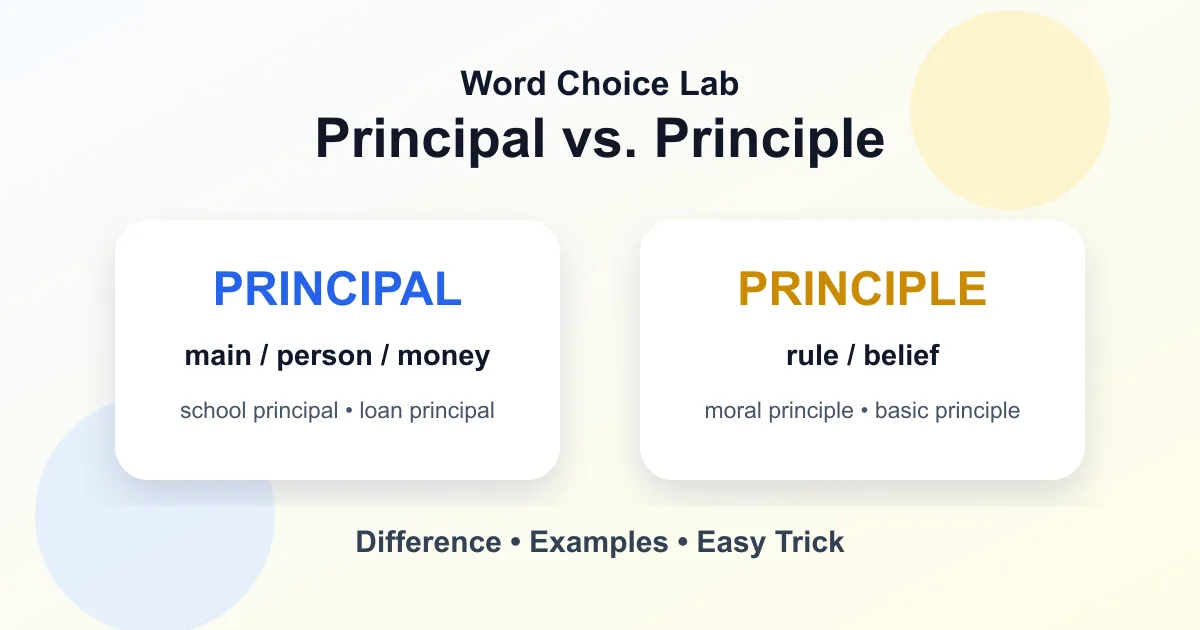
Use principal for the main person, main thing, or original amount of money. Use principle for a rule, belief, standard, or basic truth.
- The school principal spoke at the assembly.
- Honesty is an important principle.
The easiest memory trick is: the school principal is your pal. The word principal can also mean main or most important.
Principal vs. principle at a glance
| Word | Main job | Meaning | Example |
|---|---|---|---|
| principal | noun or adjective | main person, main thing, or original money amount | The principal reason was cost. |
| principle | noun | rule, belief, standard, or basic truth | The decision was based on a legal principle. |
Quick test:
- If you mean a person in charge, a main thing, or money borrowed/invested, use principal.
- If you mean a rule, belief, or standard, use principle.
When to use principal
Principal can be a noun or an adjective. It often means main, most important, or person in charge.
Principal meaning a school leader
As a noun, principal can mean the person who leads a school.
- The principal welcomed the new students.
- Please schedule a meeting with the principal.
- The assistant principal handled the discipline issue.
- Our principal announced a new attendance policy.
This is the meaning many students learn first.
Principal meaning the main person or thing
Principal can also mean the main or most important person, reason, problem, or object.
- The principal reason for the delay was weather.
- Cost is the principal concern.
- She is the principal researcher on the project.
- The principal goal is to improve safety.
In these examples, principal means main or primary.
Principal as an adjective
Before a noun, principal usually means main or most important.
- the principal cause
- the principal speaker
- the principal issue
- the principal city
- the principal investor
Example: The principal issue is whether the data is accurate.
Principal in money and finance
In finance, principal means the original amount of money borrowed, invested, or owed, before interest.
- The monthly payment includes interest and principal.
- She paid extra toward the loan principal.
- The investment earned interest on the original principal.
- Paying down the principal can reduce total interest.
If the sentence is about a loan, mortgage, investment, or original money amount, principal is usually correct.
When to use principle
Principle is a noun. It refers to a rule, belief, moral standard, law, or basic truth.
Principle meaning a rule or standard
- The company follows the principle of transparency.
- The judge explained the legal principle behind the ruling.
- The course teaches basic design principles.
- The policy is based on the principle of fairness.
In these examples, principle means a guiding rule or standard.
Principle meaning a belief or value
Use principle when talking about someone’s values or moral beliefs.
- She refused the offer on principle.
- He believes in the principle of equal opportunity.
- They acted according to their principles.
- It is a matter of principle, not money.
The phrase on principle means because of a belief about what is right.
Scientific or technical principles
Principle can also refer to a basic truth or rule in science, math, design, business, or another field.
- The lesson explains the principle of supply and demand.
- This machine works on the same principle.
- Students learned the basic principles of physics.
- Good editing follows several simple principles.
Principal or principle in common phrases
“In principle”
Use in principle when something is true or accepted as a general idea, even if the details are not final.
- We agree in principle, but we still need a written contract.
- The plan sounds good in principle.
“On principle”
Use on principle when someone acts because of a belief or moral standard.
- She returned the money on principle.
- He refuses to lie on principle.
“Principal amount”
Use principal amount for the original sum of money in a loan or investment.
- The principal amount was $20,000.
- Interest is calculated on the remaining principal amount.
“Principal reason”
Use principal reason when you mean the main reason.
- The principal reason for moving was the job offer.
Principal vs. principle pronunciation
In standard American English, principal and principle are usually pronounced the same. They are homophones: words that sound alike but have different meanings and spellings.
Because sound will not help much, focus on meaning:
- principal = main, person, or money
- principle = rule or belief
How to remember principal and principle
Use two memory tricks:
- The school principal is your pal.
- A principle is a rule.
Also remember that principal can mean primary. Both words start with pri-, and both can point to what is main or first.
Common mistakes and corrections
Incorrect: The school principle called my parents.
Correct: The school principal called my parents.
Use principal for the person who leads a school.
Incorrect: Honesty is one of her strongest principals.
Correct: Honesty is one of her strongest principles.
Use principle for a belief or moral standard.
Incorrect: The loan principle is still high.
Correct: The loan principal is still high.
Use principal for the original or remaining amount of money owed.
Incorrect: The principal of fairness matters here.
Correct: The principle of fairness matters here.
Use principle for a rule or standard.
Incorrect: The principle reason was lack of time.
Correct: The principal reason was lack of time.
Use principal when the meaning is main or most important.
Examples with principal and principle together
- The principal explained the school’s guiding principles.
- The principal reason for the rule was the principle of safety.
- Paying down the loan principal is a smart financial principle.
- The principal investor agreed with the company’s ethical principles.
- The principal concern was whether the decision violated a legal principle.
These examples show the key contrast: principal points to what is main, who is in charge, or money; principle points to rules and beliefs.
Quick quiz
Choose principal or principle.
- The school ___ gave a short speech.
- The decision was based on a moral ___.
- The ___ reason was the high cost.
- She paid extra toward the loan ___.
- We learned three design ___ in class.
- The company acted on ___.
- He is the ___ author of the report.
- Freedom of speech is an important ___.
Answers
- principal — school leader
- principle — moral rule or belief
- principal — main reason
- principal — loan amount
- principles — rules or standards
- principle — belief or standard
- principal — main author
- principle — important rule or value
FAQ
What is the difference between principal and principle?
Principal means the main person, main thing, or original money amount. Principle means a rule, belief, standard, or basic truth.
Is it school principal or school principle?
Use school principal. A principal is the person who leads a school.
Is it principal amount or principle amount?
Use principal amount. In finance, principal is the original amount of money borrowed or invested.
Is it “in principal” or “in principle”?
Use in principle. The phrase means as a general idea or rule.
Is it “on principal” or “on principle”?
Use on principle. The phrase means because of a belief about what is right.
Do principal and principle sound the same?
Yes. In standard American English, principal and principle usually sound the same, so you need to choose by meaning.
The same context-first habit also helps with Then vs. Than and Advice vs. Advise. For a wider set of examples in this topic, use the Commonly Confused Words archive as the category grows.
Final tip
Use principal for a school leader, a main thing, or money. Use principle for a rule or belief.
Remember: principal = main or money, principle = rule.